UNDP and ISPAE introduce four circular economy models for Viet Nam's coffee sector
The United Nations Development Programme (UNDP) and the Institute of Strategy and Policy on Agriculture and Environment (ISPAE) recently released the "Circular Economy in Coffee Production" handbook.
The handbook contributes to the objectives of the Prime Minister's Decision No. 540/QD-TTg dated June 19, 2024, approving the Program for the development, application, and transfer of science and technology to promote a circular economy in agriculture. The information is compatible with the requirements of the European Union Deforestation Regulation (EUDR).
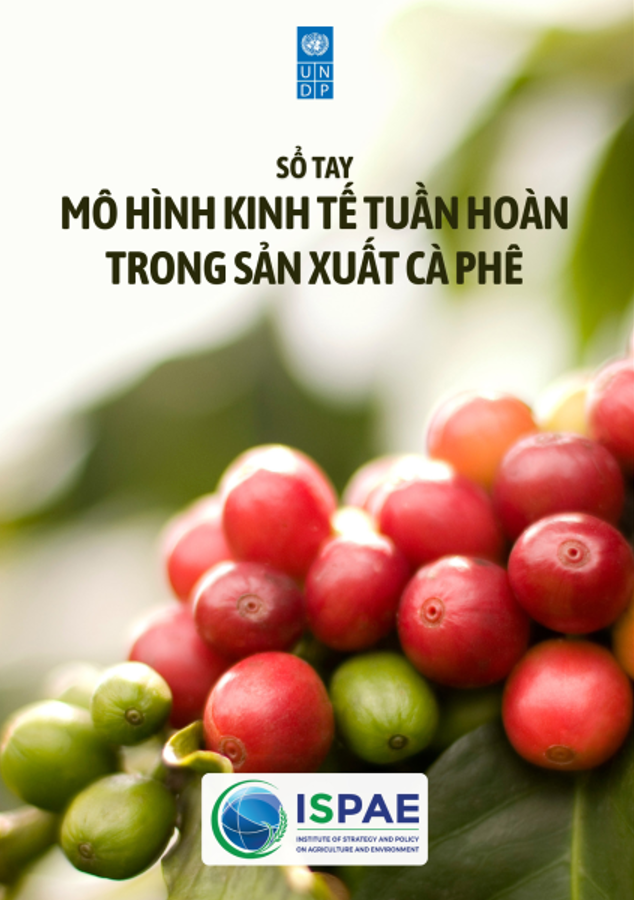
Coffee production plays an important role in Viet Nam's socio-economic development, creating direct jobs for over 600,000 farmers and supporting over 2.6 million jobs. However, coffee production is also a resource-intensive and high-emission sector, contributing significantly to the agricultural industry's greenhouse gas emissions. Circular economy models in the coffee sector can simultaneously reduce emissions, recycle waste, improve soil health, and enhance resilience to climate change, as evidenced in the Central Highlands and Northern provinces of Viet Nam. Best practices and examples already exist and need to be replicated.
The handbook introduces four high-impact circular economy models for coffee production, validated through expert interviews and field surveys. These include intercropping coffee with avocado, durian, persimmon, pepper, and macadamia; producing organic fertilizer from coffee husks; small-scale wastewater treatment; and large-scale biogas wastewater treatment. Readers are provided with technical implementation guidelines, detailed steps, and illustrations to guide farmers and cooperatives in applying these practices.
All models offer proven economic and environmental benefits. Specifically, the model of intercropping coffee with avocado, durian, pepper, persimmon, and macadamia diversifies income, increases carbon sequestration capacity, and boosts Net Present Value (NPV) by 57% compared to monoculture. The model for producing organic fertilizer from coffee husks transforms 45% of waste from dry coffee cherries into nutrient-rich compost, reducing reliance on chemical fertilizers and lowering costs. The small-scale wastewater treatment model utilizes a low-cost biological system to reduce pollution from the wet processing of Arabica coffee. Finally, the large-scale biogas wastewater treatment model generates profits for processing plants, with an Internal Rate of Return (IRR) of 28–34% and an NPV of up to 983 million VND over 15 years.
Aiming to reduce emissions in agriculture, the handbook also outlines three priorities for coffee production. First and foremost, producers need to optimize fertilizers using improved nutrient formulas and adjusted application rates to reduce nitrous oxide (N2O) emissions.
Quynh Chi