Viet Nam prepares for developing carbon market post-COP30
Over two days, from November 25-26 in Hanoi, the policy workshop “Navigating global and Viet Nam’s carbon market: Post-COP30 insights and the pathway forward” gathered nearly 200 domestic and international participants.
The event was co-organized by the Carbon For Good Project, the VNU University of Economics and Business (VNU-UEB), CARE, CIFOR, the University of British Columbia, and Flinders University, with experts from Viet Nam, Canada, and many other countries in attendance.
Article 6.4 Enters the Official Operational Phase
Speaking at the workshop, Assoc. Prof. Dr. Le Trung Thanh, Rector of VNU-UEB, noted that the world is witnessing profound changes in global climate action. After COP30, particularly following key decisions related to Article 6 of the Paris Agreement, the carbon market is entering a new phase of development in which governments, businesses, and the scientific community are increasingly engaged in the pursuit of net-zero emissions.
Viet Nam is currently accelerating preparations to formally operate its domestic carbon market from early 2029, while gradually connecting with international carbon credit trading mechanisms. New decisions adopted at COP30 are expected to have a direct impact on this roadmap.
Meanwhile, Nguyen Tuan Quang, Deputy Director General of the Department of Climate Change under the Ministry of Agriculture and Environment, said that the world has now officially entered the operational phase of Article 6.4 of the Paris Agreement—a major milestone that enhances environmental standards, transparency, and the integrity of carbon credits.
A fundamental shift is underway, as the carbon market transitions from a model focused mainly on “offsetting” to one centered on “real contributions.” This shift requires carbon credits—especially forest carbon credits—to reflect genuine and long-lasting emission reductions, supported by transparent monitoring and verification systems. The establishment of the Tropical Forests Forever Facility (TFFF) further reinforces the trend of valuing forests not only for their carbon sequestration capacity, but for their full range of ecosystem services.
Under the new standards, low-quality or non-transparent credits are rapidly losing their place in international markets. Article 6.4 is set to become a critical reference framework for countries in developing, trading, and recognizing carbon credits in support of their Nationally Determined Contributions (NDCs).
Viet Nam pursues a “quality-oriented” carbon market
In recent years, Viet Nam has steadily strengthened the legal foundation for its carbon market. The 2020 Law on Environmental Protection was the first to formally regulate the organization and development of a carbon market. Decree No. 06/2022/ND-CP and Decree No. 119/2025/ND-CP established a pilot phase through 2028, with full operation scheduled to begin in 2029.

The Ministry of Agriculture and Environment is currently finalizing draft decrees on international exchanges of mitigation outcomes and carbon credits; on carbon absorption and storage by forests; and on the operation of Viet Nam’s domestic carbon exchange. These legal instruments will progressively incorporate new international standards formed in the post-COP30 context.
According to Deputy Director General Nguyen Tuan Quang, Viet Nam views the carbon market not merely as a trading platform, but as a powerful lever to drive a low-emissions growth model. As a result, Viet Nam will not pursue the volume of low-priced credits, but will prioritize credit quality to protect national interests and enhance its international credibility.
From an international cooperation perspective, Canadian Ambassador to Viet Nam Jim Nickel affirmed that carbon markets are a key instrument for countries to achieve net-zero targets. Sharing international experience, he said, will help Viet Nam design a market that strikes a balance between economic growth and environmental protection.
At the workshop, participants also held in-depth discussions on necessary adjustments to Viet Nam’s legal framework after COP30, trends in voluntary and compliance carbon markets, forest carbon credits, green credits, as well as the challenges faced by the private sector in developing high-quality carbon credit projects.
According to Mr. Le Kim Dung, Country Director of CARE Viet Nam, social equity must be placed at the heart of carbon market development. Mechanisms must ensure that women, the poor, and ethnic minority communities have opportunities to participate and benefit, in line with the principle of “leaving no one behind.”
Forest carbon credits gain strategic importance
One of the central messages emphasized at the workshop was the growing role of forest carbon credits. The World Bank’s 2025 “State and Trends of Carbon Pricing” report shows that carbon pricing instruments now cover about 28% of global greenhouse gas emissions, generating more than USD 100 billion in revenue over the past year - making them a major source of public finance for the green transition.
In 2024 alone, forestry and land-use projects led in the number of newly registered projects. Nature-based carbon sequestration credits command higher prices and show stronger price resilience than other credit types, and are expected to play a core role in many countries’ implementation of NDCs from 2026 onward.
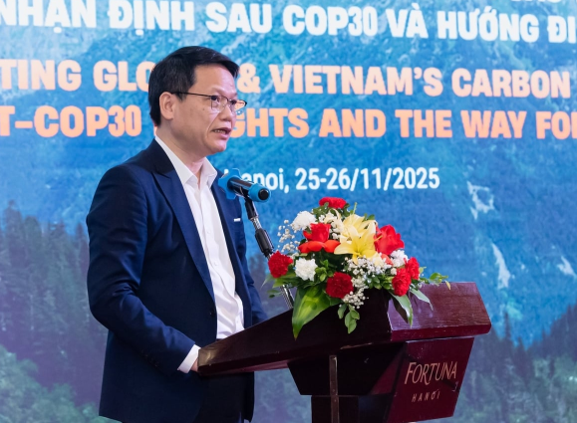
According to Dr. Luu Tien Dat, Deputy Head of the Department of Science, Technology and International Cooperation under the Department of Forestry and Forest Protection, forest carbon credits are recognized only when they fully meet four criteria: environmental integrity, additionality, sustainability, and absolute transparency. These requirements are no longer merely technical standards, but have become benchmarks of national and corporate competitiveness in international markets.
In Viet Nam, forest carbon sequestration and storage services are regulated under the 2017 Forestry Law as one of five forest environmental services. After more than a decade of implementation, the Payment for Forest Environmental Services (PFES) mechanism has generated total revenues exceeding VND 30 trillion by the end of 2024. Of this amount, revenues from forest carbon under the pilot emissions reduction program in the North Central region account for about 4%, although the program has only been implemented since 2023.
To prepare for participation in domestic and international forest carbon markets, the Department of Forestry and Forest Protection is developing the necessary legal framework and technical conditions, with the goal of establishing a high-quality credit system linked to sustainable forestry development, community livelihoods, and national credibility.
However, international experience shows that Viet Nam must overcome several major challenges, including land tenure clarification, benefit-sharing mechanisms for carbon revenues, and the establishment of a robust measurement, reporting, and verification (MRV) system. The current push to strengthen carbon traceability in the timber and aviation sectors is seen as a key opportunity to link forest carbon credits with sustainable value chains, thereby enhancing the competitiveness of Vietnamese enterprises.
Quyet Thang