Controlling cadmium and strengthening supply chain linkages are crucial for maintaining the export market for durian
On December 12th, in Long Tien commune, Dong Thap province, the conference "Improving the quality of planting area codes and linking production and consumption of durian for export" was held, attracting approximately 150 farmers, businesses, scientists, and representatives from management agencies.
The conference focused on solutions to improve the quality of durian for export in the context of increasingly stringent technical requirements from importing markets, especially China. The main topics of discussion revolved around maintaining planting area codes (MPCs), controlling the risk of cadmium residue in cultivated land, and strengthening production-consumption linkages along the value chain.
At the conference, delegates were updated on the overall picture of durian production in Long Tien commune, Dong Thap province, and nationwide. Many in-depth topics were presented, including the current situation and risks of cadmium in durian-growing soil, the results of cadmium treatment and soil improvement models, and the orientation for building a sustainable supply chain for export. The consensus was that ensuring cultivation conditions, food safety, and strict compliance with import market regulations are mandatory requirements for the stable development of the industry.
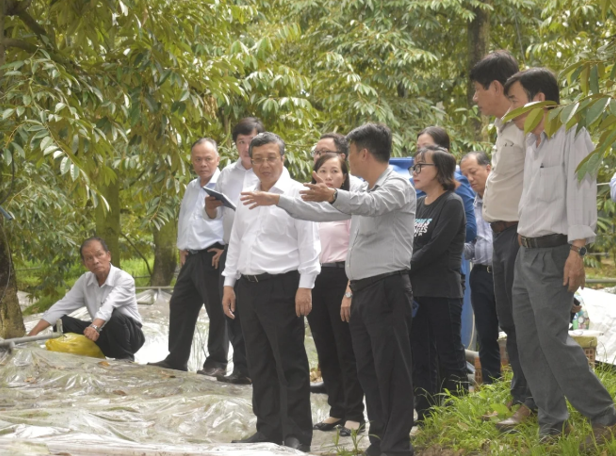
According to Mr. Do Quoc Khanh, Chairman of the Long Tien Commune People's Committee, the locality currently has over 3,500 hectares of durian orchards with approximately 7,200 farming households. To date, the commune has 23 durian growing areas granted export codes, covering over 1,900 hectares; 15 establishments have been granted export codes for fresh durian to China, and 15 processing facilities have received food safety certification. However, some households still do not fully comply with cultivation procedures, pest control, and production logbook keeping, leading to the risk of violating plant quarantine requirements.
On a provincial scale, Mr. Tran Thanh Tam, Head of the Department of Crop Production and Plant Protection of Dong Thap province, said that the locality currently has 35,500 hectares of durian, of which nearly 19,000 hectares are bearing fruit. The province has been granted 350 MSVT (equivalent to about 15,000 hectares) and 111 packaging facility codes. However, some codes have been temporarily suspended or revoked due to violations of regulations, potentially affecting the export market. "To maintain the durian industry, farmers must strictly adhere to cultivation processes, proactively treat cadmium, and improve soil health," Mr. Tam emphasized.
Representing the business, Mr. Vo Thanh Toan, Deputy Director of Thien Tam Agricultural Products Trading Joint Stock Company, shared that the company currently has 3 packaging facilities that have been assigned codes by the General Administration of Customs of China and has exported approximately 3,000 containers of durian in 2025, guided through the customs "green channel". The company hopes to cooperate in building concentrated raw material areas based on the principles of voluntariness, openness, and transparency; and at the same time support farmers with technical assistance, cadmium testing and other food safety indicators before harvest, and the implementation of electronic logs for traceability.
According to Mr. Le Anh Trung, Chairman of the Dak Lak Durian Association, China's increased import controls require all stages in the supply chain to strictly adhere to procedures. He believes that loose linkages are a major weakness of the industry today, therefore building a sustainable supply chain is a mandatory requirement, and Dong Thap's efforts in recent times are a positive sign for the long-term development of Vietnamese durian.
Minh Dam