Viet Nam - Japan partner on low-emission rice cultivation
On March 3, the National Agricultural Extension Center of Viet Nam signed a memorandum of understanding with Japan’s Newgreen Inc. and Viet Nam’s Loc Troi Group to cooperate on low-emission rice cultivation.
Under the agreement, the parties will establish a strategic partnership to research, pilot, refine and transfer technical solutions for low-emission rice farming. The collaboration aims to support greenhouse gas reduction targets in Viet Nam’s rice sector, particularly within the framework of the national plan to develop 1 million hectares of high-quality, low-emission rice cultivation in the Mekong Delta by 2030.
The partners will jointly study, test and improve low-emission rice cultivation processes using the Aigamorobo system and other advanced Japanese technologies. The results will serve as a basis for proposing the recognition of technical innovations by relevant authorities and facilitating technology transfer and wider adoption in Viet Nam.
The cooperation will also assess the feasibility of producing, assembling and commercialising the Aigamorobo system in the Vietnamese market in accordance with local regulations.
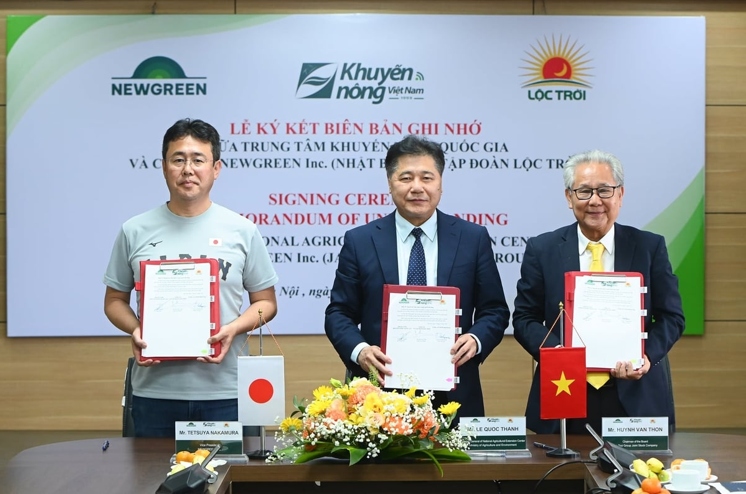
Specific activities include conducting field experiments and trials of low-emission rice farming models that integrate the Aigamorobo system with alternate wetting and drying (AWD) irrigation techniques, along with other technical solutions proposed by Newgreen and adapted to Viet Nam’s ecological conditions and farming practices.
The partners will jointly monitor implementation, collect data and evaluate technical, environmental and economic indicators, and compile scientific reports to support agricultural extension and technology transfer.
In addition, the sides will organise training programmes and technical guidance for extension officers, cooperatives and farmers in areas where the models are implemented. Communication activities, scientific workshops, field visits and model reviews will also be conducted to disseminate research results and promote wider adoption of low-emission rice cultivation.
They will also work together to prepare technical documentation for submission to relevant authorities in Viet Nam for recognition of the low-emission rice cultivation process using the Aigamorobo system.
The partnership will further promote trade connections and market linkages for low-emission rice products produced under the cooperation, in line with the regulations of each side.
According to the roadmap, small-scale trials will be conducted during 2026–2027, followed by large-scale trials and process refinement from 2028 to 2030.
Earlier, the National Agricultural Extension Center and Loc Troi Group had already piloted the Aigamorobo robot system in rice production. Initial trials showed positive results, including improved efficiency, reduced costs and notably lower emissions.
Duc Tung