Building a national land database by 2026: A ‘non-negotiable’ task
The goal of establishing a national land database by 2026 has been defined as a non-negotiable priority, requiring strong political will and coordinated solutions.
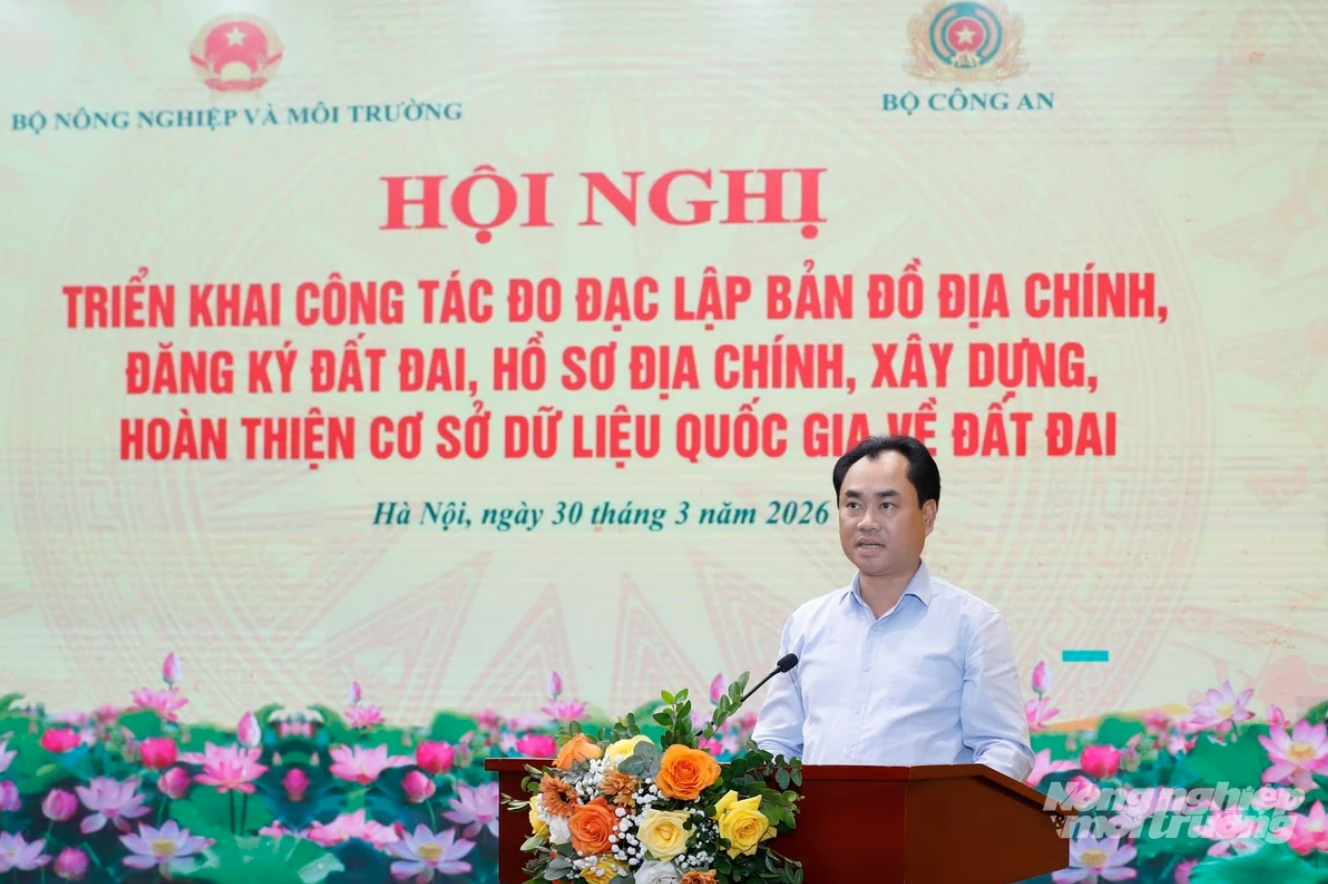
On the afternoon of March 30 in Hanoi, the Ministry of Agriculture and Environment (MAE), in coordination with the Ministry of Public Security, convened a conference to roll out cadastral surveying, mapping, land registration, cadastral record compilation, and the development and completion of the national land database. The event was connected online to provincial and municipal People’s Committees nationwide.

Local bottlenecks and proposed solutions
At the conference, local authorities candidly highlighted obstacles in implementation while proposing measures to accelerate progress.
Nguyen Thi Loan, Vice Chair of the Thai Nguyen Provincial People’s Committee, said that following its merger with Bac Kan province, the locality now has more than 4.3 million land parcels. During a 90-day campaign to enrich and clean land data, the province completed processing for 1.5 million parcels, integrating them into the national database and linking them with population data.

However, a subsequent review identified more than 700,000 parcels still requiring data cleaning to meet the “accurate - complete - clean - live” standard. For the remaining 1.6 million parcels, the province has developed a plan for surveying, certificate reissuance, and cadastral record compilation, aiming for completion in 2026.
The biggest challenge, local officials noted, lies in the former Bac Kan area, which spans more than one million hectares but was largely surveyed manually using outdated technology. The estimated cost to implement a comprehensive overhaul is nearly VND 400 billion.
Based on these realities, Thai Nguyen proposed the early issuance of integrated procedures, technical guidance, and funding allocations to ensure consistent implementation.
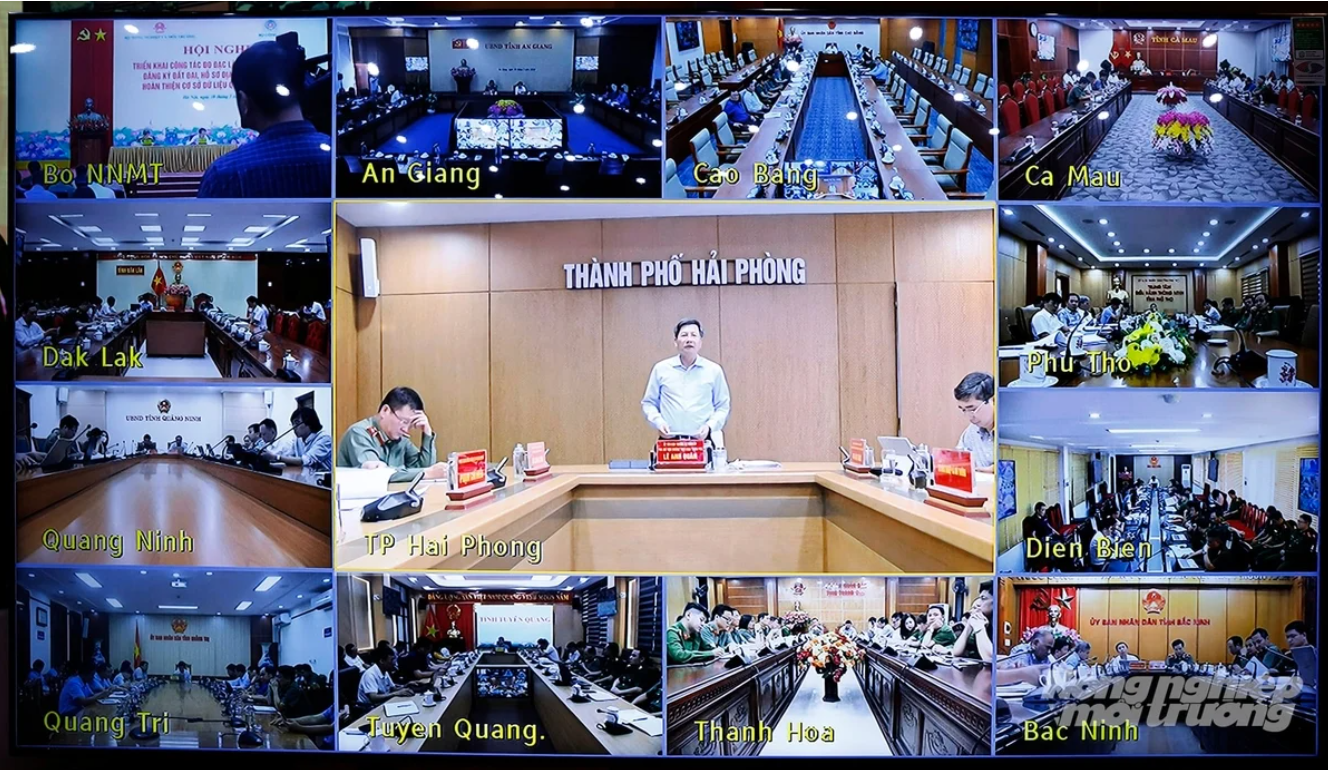
Representatives from Hai Phong also called for mechanisms allowing contractor designation in urgent cases, alongside the prompt issuance of pricing frameworks, technical standards, and operational manuals.
While the discussions reflected strong local commitment, they also underscored the urgent need to resolve bottlenecks related to institutional mechanisms, resources, and technical capacity to meet the 2026 deadline.
More than 37 million parcels yet to be updated
Addressing the conference, Deputy Minister Nguyen Van Long emphasized that building the national land database is a critical task already outlined in central and government resolutions and programs.
He noted that the intensive “90-day campaign” to clean land data has delivered significant results, particularly the adoption of unified software nationwide, laying the groundwork for a synchronized land management system from central to local levels.
To date, more than 61 million land parcels have been reviewed, with over 24 million meeting the “accurate, complete, clean” criteria. However, the “live” criterion - real-time updating - has yet to be fully assessed.

More than 37 million parcels still require surveying and data updates, while around 45 million have not yet been integrated into the system. In some localities, compliance rates remain very low.
In addition, many provinces have yet to meet cybersecurity requirements. In the current context, Long stressed, data security must be treated as a top priority, arguably even more critical than system development itself.
He called on agencies to intensify data reconciliation with population records, ensure full system connectivity, strengthen security measures, and proactively allocate resources while coordinating closely to meet deadlines.
A “non-negotiable” mission
Concluding the conference, Standing Deputy Minister Trinh Viet Hung reaffirmed that completing the national land database by 2026 is a “non-negotiable” mission, requiring synchronized and decisive action across all levels of government.
He acknowledged the positive outcomes of the 90-day campaign, noting that its systematic and coordinated approach has significantly improved data quality and begun addressing inconsistencies between land and population databases. Notably, the new approach—“cleaning combined with enriching data”, has shown early effectiveness, with quality and usability as key benchmarks.
Awareness of the importance of land data has improved markedly across agencies, and coordination mechanisms have become increasingly robust. Long-standing issues in financial record management have also been identified and addressed in a timely manner.
However, he pointed out several shortcomings: uneven progress across localities, inconsistent data quality in some areas, and insufficient real-time updating.
“Local authorities must recognize this as a continuous, ongoing task to ensure that land data meets the ‘accurate, complete, clean, live’ standard,” he said.
He stressed that building the land database is not merely a technical undertaking but a core political task - urgent and central to reforming state governance, streamlining administrative procedures, advancing national digital transformation, and supporting national defense and security.

The 2026 target is to fundamentally complete cadastral surveying and mapping, land registration, financial record compilation, and the establishment of a fully operational national land database covering all parcels nationwide, ensuring unified, synchronized operations that effectively support state management and public service delivery.
“If the data is not accurate, complete, clean, and live, if it is not unified, shared, and interconnected, we cannot safeguard the legitimate rights and interests of land users or citizens at large,” Hung warned.
The requirement, therefore, is to fully integrate land-use right certificates across all sectors. Once data is fully digitized, accurate, and connected within a national system, transactions such as transfers, leases, inheritance, mortgages, capital contributions, and the resolution of disputes or complaints can all be conducted on digital platforms, ensuring transparency and efficiency.
To achieve this, ministries and localities must prioritize several key tasks. First, accelerate cadastral surveying and mapping, complete land registration, and finalize cadastral records nationwide. Gaps such as missing records or unmeasured areas are not objective constraints but long-standing governance responsibilities.
Localities must urgently review unmeasured areas, regions lacking cadastral records, and “white zones” in the database to develop detailed plans with clear accountability, ensuring completion by 2026.
According to Hung, two main issues persist: areas not yet surveyed and areas surveyed but with inaccurate or substandard data. The latter, in particular, risks wasting public funds and even creating opportunities for misconduct if not addressed.
Surveying must therefore comply with technical standards, maintain acceptable error margins, and be closely linked to registration, documentation, and data creation from the outset.
Priority should be given to rapidly urbanizing areas, key economic zones, border and island regions, and locations with frequent disputes or complaints. Implementation should follow a phased approach, addressing simpler areas first, then gradually tackling more complex cases.
Resources must be mobilized flexibly, with difficulties promptly reported to higher authorities for support.
Hung also emphasized the need to operationalize data immediately after creation and ensure continuous, real-time updates. Localities must reconcile land-user information with the national population database, fully resolve discrepancies, and address cases with unclear ownership or incomplete legal documentation.
At the same time, efforts must continue to fill data gaps nationwide, upgrade technological infrastructure, ensure data safety and security, and enable effective data sharing and utilization for citizens and businesses.
The MAE will lead guidance, inspection, and progress monitoring, coordinating with the Ministry of Public Security. The Ministry of Finance will ensure funding, while the Ministry of Science and Technology will support standards and technological solutions. Provincial and municipal authorities will bear direct responsibility before the Prime Minister for the progress and quality of implementation in their jurisdictions.
Closing the conference, Hung expressed confidence that with unified leadership from the Party, decisive direction from the Government, and coordinated action across ministries and localities, the goal of completing the national land database by 2026 will be achieved-laying a critical foundation for rapid and sustainable national development.
By Staff Reporters