HCMC seeks investment in environmental projects for 2026-2030
From 2026 to 2030, Ho Chi Minh City (HCMC) is seeking investment in major wastewater projects to upgrade its urban environmental infrastructure.
The HCMC People’s Committee has announced its priority investment list for 2026-2030, with a strong focus on environmental projects that improve water quality, cut pollution, and drive sustainable growth.
According to the list, the city plans to develop several large-scale wastewater collection systems and treatment plants across various areas.
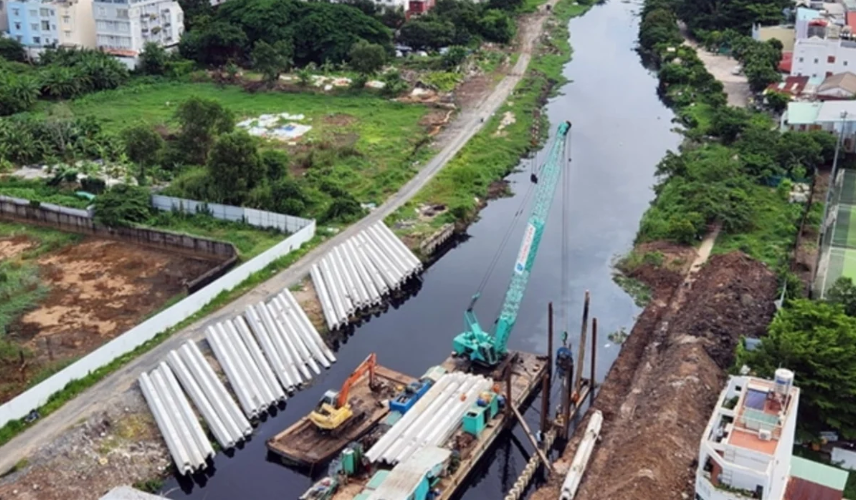
Notably, the Tham Luong - Ben Cat wastewater collection and treatment project (Phase 2), located in An Phu Dong Ward, will cover approximately 2.53 hectares. Its planned treatment capacity is expected to reach around 230,000 cubic meters per day by 2040 and 270,000 cubic meters per day by 2060.
Another key project is the Bac Sai Gon 2 wastewater treatment plant in Long Truong Ward, spanning about 8.5 hectares. It is designed to handle approximately 140,000 cubic meters per day by 2040 and 170,000 cubic meters per day by 2060, playing a crucial role in controlling pollution in the city’s eastern urban expansion area.
In the southern region, the city is calling for investment in the Nam Sai Gon wastewater collection and treatment system, which will serve the Nha Be basin and surrounding areas. Phase 1 is expected to have a treatment capacity of around 132,000 cubic meters per day, addressing domestic wastewater needs in the area.
Meanwhile, the Northwest wastewater treatment project, located in Tan An Hoi Commune, will cover about 19 hectares. Its capacity is projected to reach approximately 280,000 cubic meters per day by 2040 and 380,000 cubic meters per day by 2060, helping to tackle environmental challenges in rapidly urbanizing zones.
In addition to centralized treatment plants, Ho Chi Minh City is seeking investment in wastewater collection networks, such as an 8.8-kilometer system in Binh Co Ward, to complete the drainage infrastructure and reduce the direct discharge of untreated wastewater into the environment.
Beyond wastewater infrastructure, the project list also promotes the development of clean, low-emission industrial zones, moving toward green and circular industrial models. These zones are expected to attract high-tech industries, reduce emissions, and improve resource efficiency.
The simultaneous call for investment in environmental projects reflects the city’s shift from a reactive approach - focused on pollution treatment - to a proactive strategy emphasizing control and prevention. This transition is essential to align economic development with environmental protection, enhance climate resilience, and improve the quality of life for residents in the years ahead.
Ha Duyen