General Secretary and President: Clearly define strong maritime nation in the 21st century
General Secretary and President emphasized renew thinking, build a strong maritime nation, and turn the sea into a strategic development space.
On June 8, at the Party Central Committee Headquarters, General Secretary and President To Lam chaired a working session with the Central Policy and Strategy Commission and relevant agencies on the review project of Resolution No. 36-NQ/TW, dated October 22, 2018, of the 12th Party Central Committee on Viet Nam’s sustainable marine economic development strategy to 2030, vision to 2045.
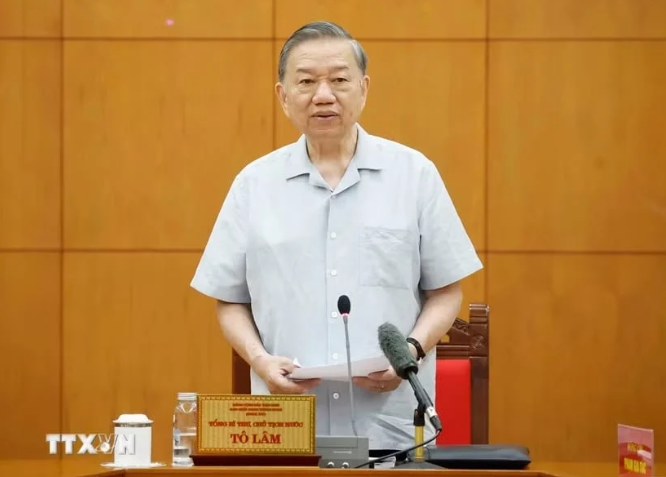
After hearing the report on the review of Resolution No. 36-NQ/TW and in-depth, practical discussions at the working session, General Secretary and President To Lam delivered the concluding remarks, emphasizing that the assessment of the implementation of Resolution No. 36 should further refine major conclusions regarding achievements, shortcomings, limitations, and their causes. He also pointed out major bottlenecks and new issues arising from practice. This is intended to better highlight the necessity of the Party Central Committee issuing a new resolution on this matter, with a higher level of generalization.
The General Secretary and President affirmed that the 12th Party Central Committee’s issuance of Resolution No. 36 was a highly correct and strategic decision. After eight years of implementation, awareness of the sea's position and role has been significantly enhanced.
The institutional and policy framework has been gradually improved. Many marine economic sectors have developed relatively well. Coastal infrastructure has been strengthened. The living standards of coastal communities have improved. National defense, security, foreign affairs, and the protection of maritime sovereignty and territorial integrity have achieved many important results.
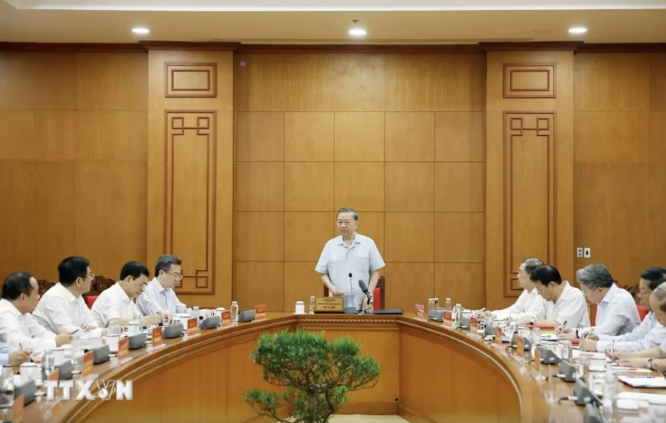
However, it must be frankly acknowledged that Viet Nam’s marine economy has not yet developed in line with the country’s potential, advantages, and development requirements. Therefore, the General Secretary and President called for an urgent review of Resolution No. 36 and the development of a new resolution that not only inherits and promotes achieved results but also creates a strong shift in thinking, institutions, and marine development models with a new vision.
He emphasized the need to renew thinking and vision for marine development in the new period, with the key focus on shifting from a maritime economy mindset to a mindset of national marine spatial development.
The sea is not only a place for resource exploitation or the development of certain economic sectors, but must be defined as a strategic national development space, where development interests converge with national defense, security, science and technology, and international integration.
The new resolution should not only answer how marine economic sectors should be developed, but also address a broader question: how Viet Nam will exploit, govern, and fully utilize its national marine space to serve long-term national development goals in the decades ahead.
The new resolution must also clearly define the shape of a strong maritime nation in the 21st century, and determine the role of the sea in achieving strategic goals toward 2030, 2045, and beyond.
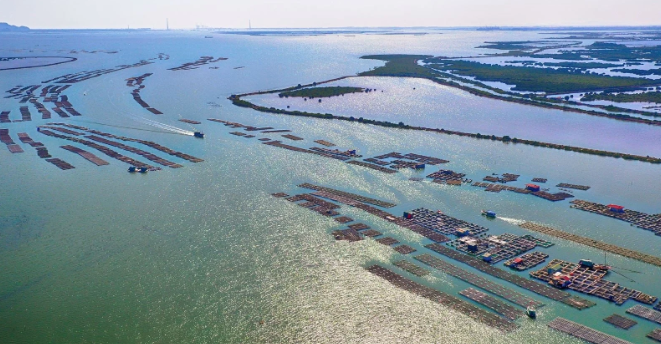
The General Secretary and President stressed the need to position the sea as one of the strategic development drivers in the implementation of the Resolution of the 14th Party Congress. He called for continued research to clearly define development orientations and breakthrough sectors; to approach maritime development through science and technology, innovation, and digital transformation; and to further study the incorporation of national marine data, a digital ocean map, and artificial intelligence in maritime governance.
He also noted the importance of closely combining development with the protection of the Fatherland early and from afar, including from the sea. All marine planning, strategies, and development programs must simultaneously serve the protection of national sovereignty, sovereign rights, and jurisdiction, while maintaining a peaceful and stable environment, enhancing defense capabilities, and safeguarding national interests at sea. Each maritime economic project must contribute to strengthening both development capacity and national defense.
The General Secretary and President emphasized the need to build a modern national maritime governance model. The new resolution should include orientations for researching and proposing a modern, unified, and interconnected maritime governance system based on data and national marine spatial planning.
From the early stages of drafting the resolution and action program, it is necessary to clearly define key tasks, national programs, breakthrough projects, specific measurable indicators, and the responsibilities of each agency, level, sector, and locality.
He requested the Central Policy and Strategy Commission to closely coordinate with the Party Committee of the Government, the Office of the Party Central Committee, and relevant agencies to urgently finalize the proposal and its accompanying action program, submit it to the Politburo for consideration, and report it to the Party Central Committee for further input.
He concluded that the objective is to develop a new resolution with a long-term strategic vision, breakthrough thinking, and strong implementation capacity, turning the sea into a strategic development space for the nation, creating new momentum for fast and sustainable growth, and contributing to the successful implementation of the 14th Party Congress Resolution and the aspiration to become a high-income developed country by 2045.
Khuong Trung