Naturland proposes organic agriculture development roadmap
A pilot organic farming project on cocoa and fruit trees has launched in Can Tho and Gia Lai, aiming to adapt to climate change and improve livelihoods.
Recently, the Vietnam Organic Agriculture Association (VOAA), in collaboration with Naturland, officially launched the Project "Piloting organic production applications on cocoa and fruit tree farms to enhance climate resilience and livelihoods of Vietnamese farmers".
Funded by the German Government through the International Climate Initiative (IKI), the project implements three components: building demonstration organic farms for cocoa and fruit trees; providing in-depth technical training for farmers and local staff; and enhancing market awareness while connecting sustainable product consumption.
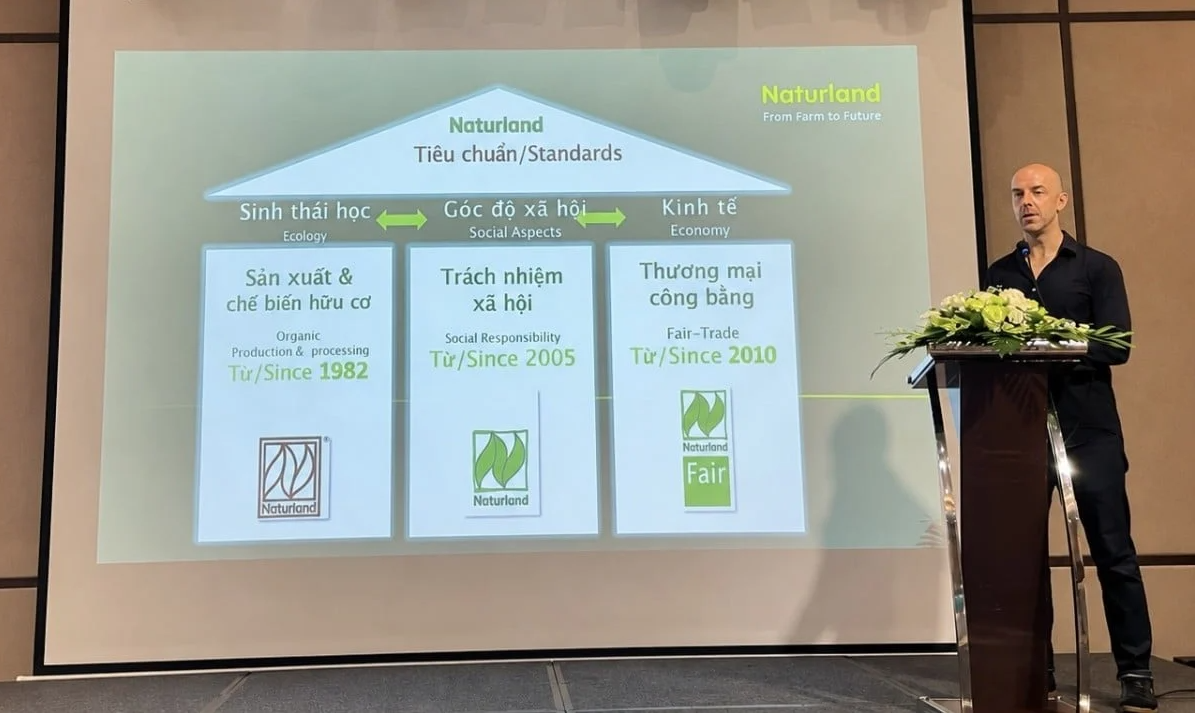
Mr. Albin Deforges, Director of Naturland in Viet Nam, stated that this organization possesses a certification network of over 100,000 farmers globally. The project is designed with a priority on mitigating the impacts of climate change. Specifically, the cocoa farming model will develop towards agroforestry, planting under forest canopies or forest restoration. Converting fruit orchards to organic will also help sharply reduce emissions and increase resilience against extreme weather.
At the discussion session, many delegates raised questions about transition costs and ensuring product outlets. Ms. Eva Gemmel, Naturland Project Manager, responded that funding will be maximally prioritized for training and technical transfer. Farmers will be supported in building buffer zones and guided to immediately utilize agricultural by-products to produce compost fertilizer.
A VOAA representative emphasized that the core of the project's success lies in closely linking the sponsor's interests with the practical needs of farming households. Only when farmers truly see the economic efficiency and have stable outlets can the organic farming model develop sustainably and be replicated in the future.
Hong Ngoc