Viet Nam has a comprehensive legal framework for international carbon credit trading
International partners are eagerly anticipating Viet Nam's emergence as a reliable supplier of high-quality carbon credits to the global carbon market.
This message was highlighted at the seminar "Promoting International Cooperation in Carbon Credit Trading Towards Achieving National and Corporate Emission Reduction Commitments," held on 23 July. The Department of Climate Change jointly organized the event under the MAE, the Energy Transition Partnership (ETP), the United Nations Office for Project Services (UNOPS), and the Viet Nam Association of Economic Sciences.

Connecting Viet Nam to the international carbon market
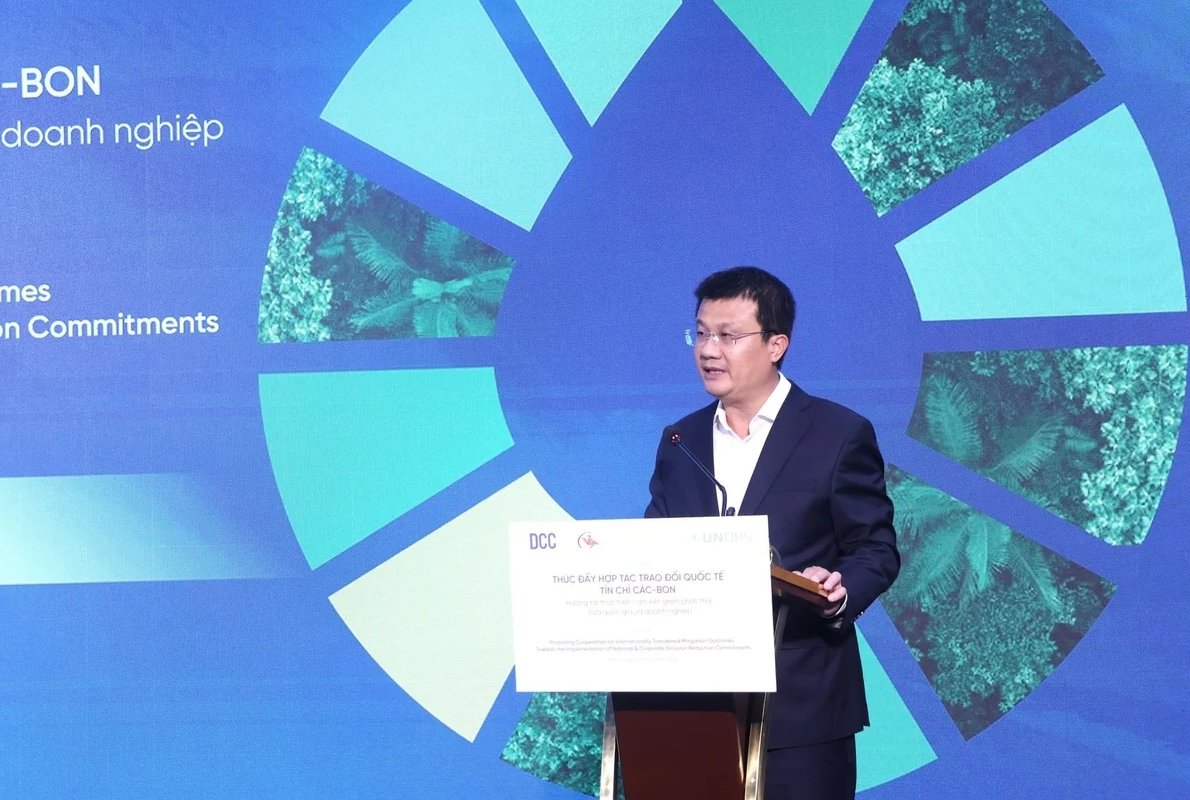
According to Mr. Nguyen Tuan Quang, Deputy Director General of the Department of Climate Change, Viet Nam has been working intensively to fulfill its commitment to achieving net-zero emissions by 2050. Over the past few years, the Government and relevant ministries have accelerated the development and refinement of legal and policy frameworks governing greenhouse gas mitigation, the domestic carbon market, and its integration with international carbon markets.
To date, Viet Nam's legal framework can be considered largely complete, following the issuance of several key legal instruments, including Government Decree No. 06/2022/ND-CP on greenhouse gas mitigation and ozone layer protection, as amended by Decree No. 119/2025/ND-CP and Decree No. 83/2026/ND-CP.
Most notably, on 1 April 2026, the Government promulgated Decree No. 112/2026/ND-CP on the international transfer of greenhouse gas emission reduction outcomes and carbon credits. This decree establishes the legal basis for transferring emission reductions between Viet Nam and foreign partners through cooperation mechanisms both under and outside the framework of the Paris Agreement. It is expected to contribute to Viet Nam's emission reduction targets while attracting investment and advanced low-carbon technologies.
Decree No. 112/2026/ND-CP provides comprehensive regulations governing procedures for bilateral and multilateral cooperation under Article 6.2 and Article 6.4 of the Paris Agreement, as well as independent carbon standards such as Verra and Gold Standard.
Recently, many Vietnamese enterprises - particularly those operating in export-oriented industries, energy, agriculture, and forestry - have begun exploring carbon credit project development. Several local authorities have also proactively sought opportunities to unlock their emission reduction potential in support of green economic development.
According to Mr. Nguyen Tuan Quang, the carbon market is no longer merely a policy instrument; it is becoming a new arena for international cooperation and economic competition. Early, proactive, and strategic participation will enable Viet Nam and its business community not only to fulfill national emission reduction commitments but also to seize new opportunities arising from the transition to a green economy.
Emphasizing that Viet Nam's carbon market has moved decisively from the design phase to implementation, Mr. John Robert Cotton, Deputy Director of the Energy Transition Partnership for Southeast Asia, noted that this progress has been driven primarily by the Vietnamese Government's clear and steadfast commitment to achieving net-zero emissions by 2050. This commitment has accelerated the transformation of legal instruments into an operational market infrastructure within a remarkably short period.
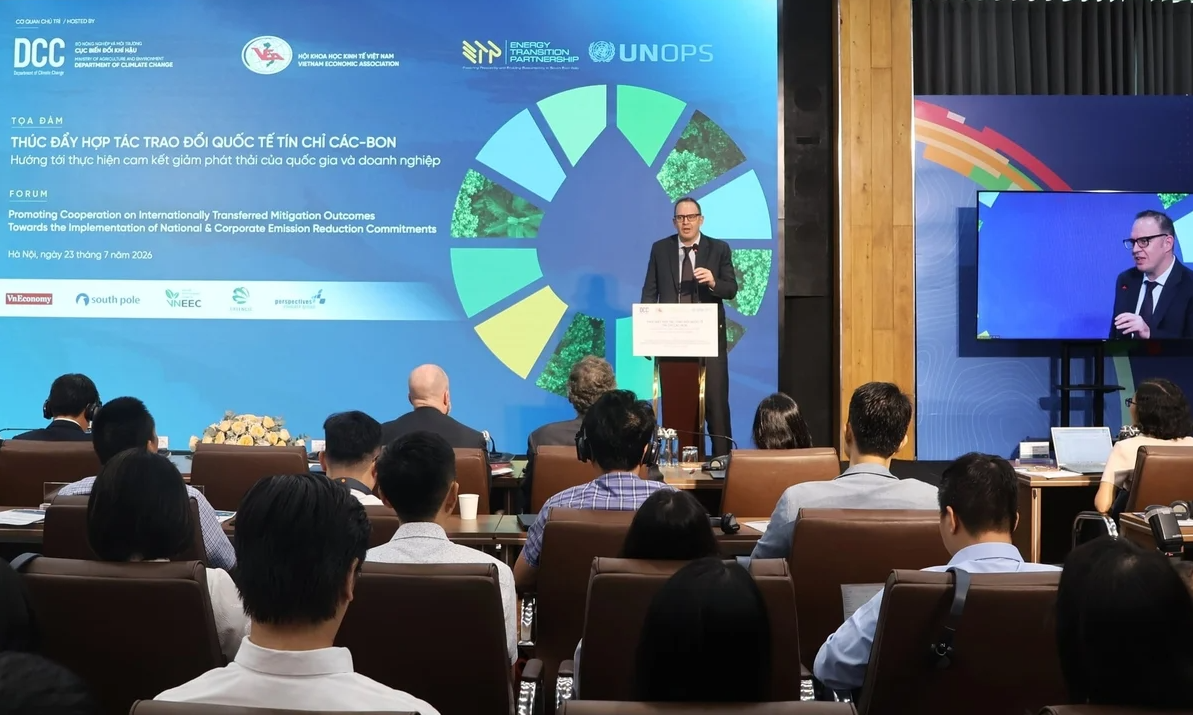
Over the past four years, ETP has provided extensive technical assistance, delivered training programs for businesses, and advised Vietnamese government agencies to support the development of the carbon market and strengthen confidence in emission reductions and carbon credits generated in Viet Nam. Building on these efforts, ETP and UNOPS are committed to continuing their support in translating policy into high-integrity emission reduction outcomes.
Viet Nam's practical experience in establishing institutional frameworks and combining strong political commitment with sound technical market design offers valuable lessons for other Southeast Asian countries.
High standards required for carbon credit quality
Discussing the provisions of Decree No. 112/2026/ND-CP, Mr. Nguyen Thanh Cong, Deputy Head of the Carbon Market Division at the Department of Climate Change, stated that international carbon credit transactions must fully comply with the Paris Agreement. Priority must be given to achieving Viet Nam's Nationally Determined Contribution (NDC) and other national emission reduction commitments, while ensuring a fair balance of interests among participating stakeholders and local communities where projects are implemented.
All transactions involving the transfer of emission reduction outcomes and carbon credits must be registered and recorded in Viet Nam's National Registry System. Emission reduction outcomes or carbon credits approved for international transfer, known as Internationally Transferred Mitigation Outcomes (ITMOs), must be subject to corresponding adjustments in accordance with the Paris Agreement.
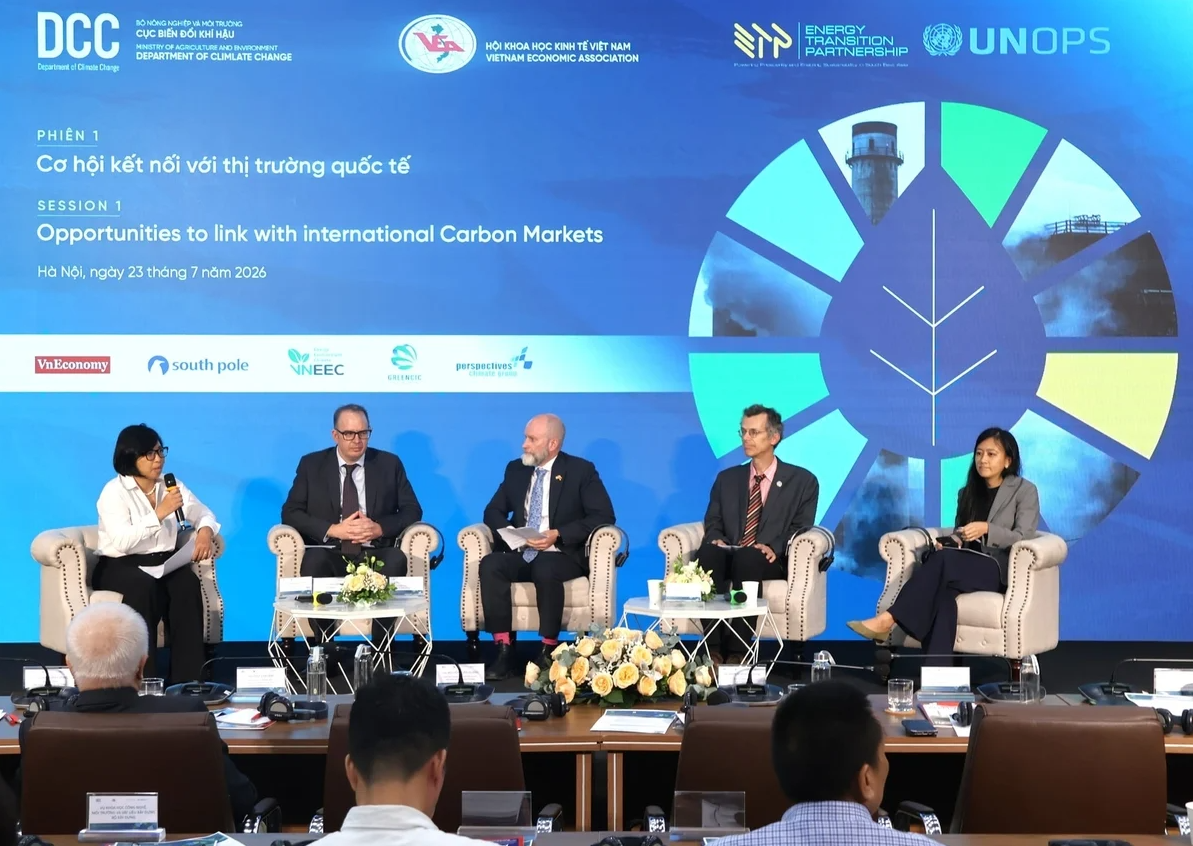
During the panel discussion on international market opportunities, many participants emphasized that ensuring the quality and environmental integrity of emission reduction outcomes and carbon credits is essential. Carbon trading under Article 6 of the Paris Agreement is closely linked to the implementation of each country's NDC. Applying robust methodologies, accurately establishing emissions baselines, and ensuring genuine contributions to NDC targets are all fundamental to generating high-quality carbon credits.
According to Mr. Gilles Dufrasne, Policy Expert with the International Carbon Pricing and Markets Team at the Directorate-General for Climate Action (DG CLIMA) of the European Commission, transparency and regulatory stability are critical to increasing the attractiveness of the carbon market. These factors give buyers confidence in the quality of carbon credits. The European Union is looking forward to Viet Nam's first ITMO transactions and to seeing how the country's policies are translated into practical market operations and quality assurance mechanisms.
From the perspective of a potential buyer, Mr. Fergus McBean, First Secretary for Climate and Nature at the British Embassy in Viet Nam, stressed that purchasing carbon credits should never replace companies' own efforts to reduce emissions. The key issue is not simply how many tonnes of CO₂ are available for sale, but whether buyers can trust that the reported emission reductions are genuine. Carbon credits must therefore be rigorously measured and independently verified to demonstrate their environmental benefits.
Highlighting Viet Nam's comparative advantages, Mr. Axel Michaelowa, Founder and Managing Director of Perspectives Climate Group, noted that Viet Nam has a dynamic business community and significant emission reduction potential across a wide range of sectors, unlike many countries where opportunities are concentrated in only a few industries. Furthermore, Viet Nam benefits from a highly experienced pool of experts who have developed over more than two decades through the Clean Development Mechanism (CDM). This strong domestic expertise enables the country to move forward independently without relying on imported experience.
Throughout the seminar, Vietnamese and international participants exchanged views on market opportunities, emerging trends, and the evolving requirements of the global carbon market. These discussions provided government agencies and businesses with timely insights into technical standards for carbon credit quality, data transparency, and increasingly stringent international requirements.
A corresponding adjustment refers to the process whereby the host country - where an emission reduction project is implemented - adds back to its national greenhouse gas inventory an amount of emissions equivalent to the volume of ITMOs transferred to an international partner. This accounting adjustment prevents the same emission reductions from being counted twice by both the transferring and receiving countries. In Viet Nam, the MAE, on behalf of the Government, will be responsible for carrying out corresponding adjustments for ITMOs transferred between Vietnam and its international partners.
Khanh Ly