Launch of Tram Chim's flood-season livelihood project
The 5-billion-VND FLOW project builds rice-fish and lotus-fish models to advance nature-based agriculture and climate adaptation in Tram Chim.
On July 31, in Dong Thap Province, Tram Chim National Park collaborated with the International Union for Conservation of Nature (IUCN Viet Nam) to launch the "Flood-season Livelihood" project, aiming to support the agricultural ecosystem in An Hoa, Phu Cuong, and Phu Tho communes (the FLOW Project), according to Dong Thap Newspaper.
The project is funded by the Coca-Cola Foundation through IUCN Viet Nam with a total budget of 5 billion VND and will be implemented from July 2026 to the end of 2029.
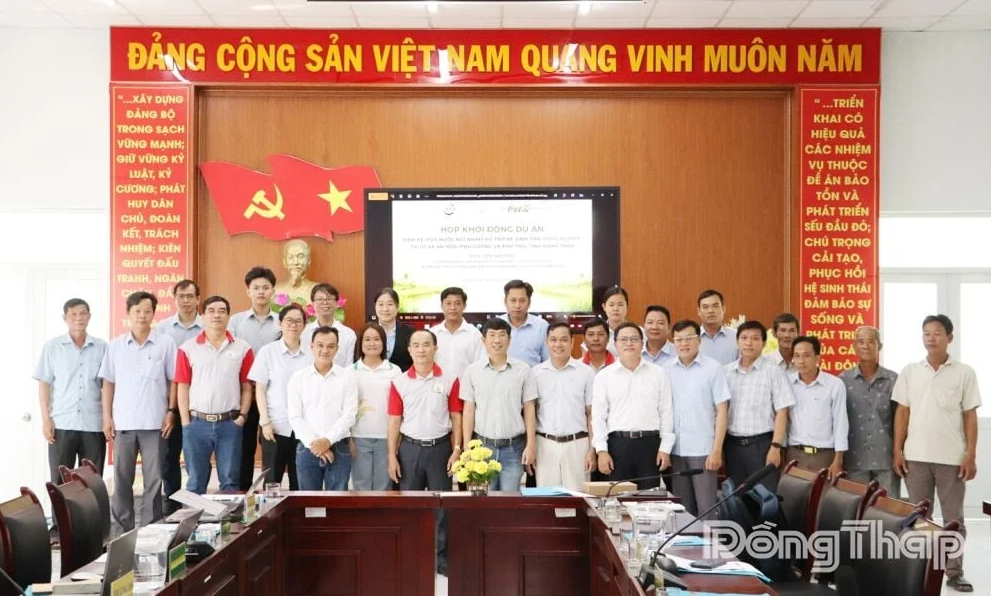
Executed in the buffer zone and adjacent areas of Tram Chim National Park, the project focuses on developing rice-fish and lotus-fish models based on natural flood conditions. This contributes to a gradual transition from three-crop rice production to nature-based agriculture, reducing production costs, increasing economic value, and enhancing climate change resilience.
In the long term, the project aims to restore hydrological and ecosystem connectivity between the two Ramsar sites of Tram Chim and Lang Sen, increase water retention capacity, replenish alluvial soils, restore biodiversity, and establish an ecological corridor in the Mekong Delta.
During the 2026-2029 period, the project is expected to involve around 150 households over an area of 200-300 hectares. In its first year alone, it will be deployed across approximately 100.5 hectares, including 99 hectares for the rice-fish model and 1.5 hectares for the lotus-fish model, with an expected expansion of an additional 10.5 hectares if conditions permit.
Besides providing fish seeds and agricultural inputs, the project also organizes technical training for farmers, builds capacity for about 150 households and 20 local officials, and develops a database to evaluate economic, social, and environmental efficiencies as a basis for scaling up the models in subsequent years.
This is a continuation of the collaborative conservation efforts between the Coca-Cola Foundation, WWF-Viet Nam, and Tram Chim National Park over the past years.
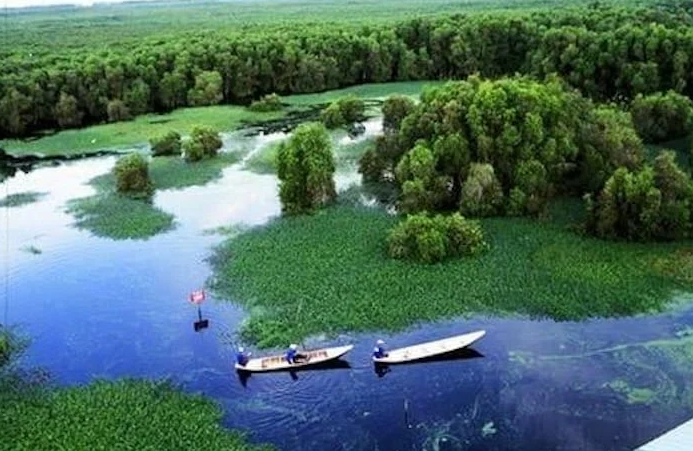
During the 2024-2027 phase, a WWF project with a $500,000 budget restored over 1,000 hectares of Eleocharis (spikerush) grasslands, replenished more than 31.44 billion liters of water, expanded 228.3 hectares of nature-based livelihood models, and generated hundreds of millions of VND in profit for participating cooperatives.
Over 7,300 people have benefited from the project's communication, educational, and livelihood development activities.
The project serves as a crucial link in implementing the Red-crowned Crane Conservation and Development Scheme at Tram Chim National Park. By restoring the ecosystem, expanding nature-based agricultural models, and creating a sustainable ecological foundation, this approach provides optimal conditions for red-crowned cranes and numerous other rare flora and fauna to return and thrive in the long term.
Hong Ngoc