IOM supports migration management in climate change adaptation
Amid growing climate change pressures, experts emphasize that strengthening evidence-based policies is key to ensuring the well-being of migrants in Viet Nam.
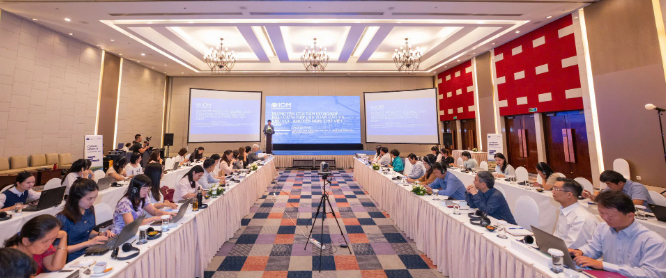
On September 28, the Institute of Strategy and Policy on Agriculture and Environment (ISPAE) and the International Organization for Migration (IOM) co-hosted a consultation conference themed “Climate Mobility in Viet Nam: From Evidence to Policy and Action.”
Held as part of the initiative “Building Knowledge and Capacity on the Migration and Climate Change Nexus in Southeast Asia,” funded by the EU and implemented by IOM, the conference brought together more than 70 participants from central and local authorities, development partners, and the private sector.
Migration can become an adaptation strategy
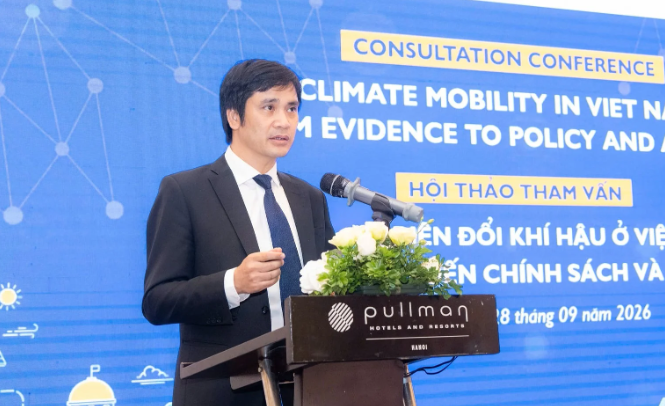
In his opening remarks, Dr. Tran Cong Thang, Director of ISPAE, said Extreme weather events are becoming more frequent and intense. Salinity intrusion and land subsidence in the Mekong Delta, coastal erosion in central Viet Nam, and flash floods and landslides in the northern mountainous regions are prompting more families to leave their homes. Some move voluntarily in search of new livelihoods; others are forced to relocate.
With adequate preparation, migration can be an effective adaptation strategy. Without it, unplanned migration can place considerable pressure on employment, social protection and public services in both areas of origin and destination,” Dr. Thang said.
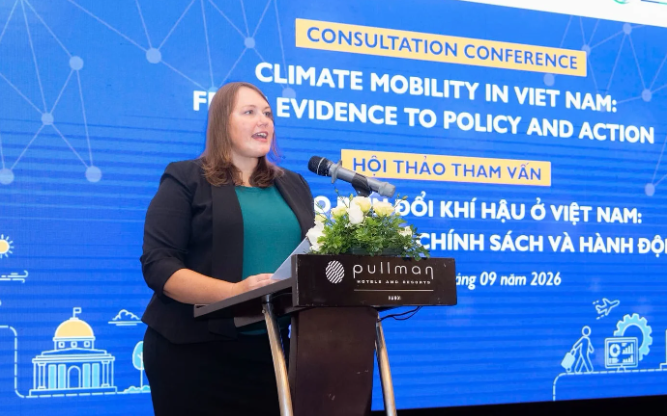
Meanwhile, Kendra Rinas, IOM Chief of Mission in Viet Nam, emphasized that addressing climate migration requires coordinated efforts among stakeholders, evidence-based policies, and cross-sectoral action.
She noted that stronger cooperation would help develop solutions to protect vulnerable communities, uphold the dignity of migrants, and ensure that climate change responses are grounded in data and the actual needs of affected people.
Building evidence on climate-induced migration
At the conference, participants discussed global and regional approaches to climate mobility, a proposed conceptual framework for Viet Nam, and findings from the review of evidence and relevant policies.
Reaching a common understanding of key concepts, terminology and analytical methods was identified as an important foundation for future research, while also supporting the development and implementation of evidence-based policies.
Other key topics included evidence on different forms of human mobility linked to climate change, identified groups most vulnerable to growing climate risks, and discussed livelihood restoration and access to services after people migrate, as well as community-led adaptation.
Participants also discussed priority actions for research and policymaking on climate change adaptation and disaster risk management, taking human mobility into account.
According to experts, key approaches that should be prioritized include: integrating climate mobility into adaptation plans; protecting populations at heightened risk from climate impacts; supporting livelihood restoration and access to essential social services during relocation; and promoting community-led adaptation initiatives.
The conference also discussed priority topics and areas for future research, mechanisms for collaboration between research institutions and policymakers, and a roadmap for the next steps
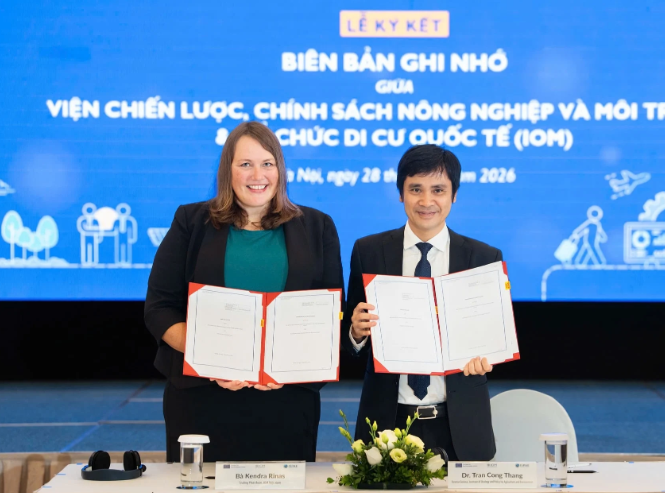
During the event, Dr. Tran Cong Thang and Kendra Rinas also signed a Memorandum of Understanding between ISPAE and IOM to strengthen collaboration on research and evidence to inform climate mobility policy in Viet Nam.
Climate risks can influence whether people remain in, move from, or return to their communities. In low-lying delta and coastal areas, salinity intrusion, erosion, flooding and land subsidence can compound existing pressures on livelihoods. Climate change is rarely the sole reason people move, however. Income, employment, family networks, and access to resources also shape their decisions. While some households can adapt where they live, others may remain in exposed areas because they lack viable alternatives.
A review of evidence published between 2015 and June 2026 identified 27 studies relevant to climate mobility in Viet Nam, including 12 focused on the Mekong Delta. It found comparatively limited research on other regions, as well as on displacement, seasonal labour migration, return migration, and people who remain in areas exposed to climate risks. The available evidence does not support a national estimate of the number of people who move because of climate change.
Phuong Linh