Sustainable supply chains enhance Viet Nam’s cashew industry
Viet Nam needs to establish a reliable cashew supply chain to maintain its position as the world’s largest cashew exporter.
Rising cashew kernel prices
Viet Nam’s cashew exports are expanding in both volume and value. According to the Viet Nam Cashew Association (VINACAS), across the first nine months of 2026, cashew exports surpassed 594,000 tons valued at nearly 4.2 billion USD, up 3.52% in volume and 7.35% in value year-on-year.
Higher export prices drove value growth more than double the volume increase.
At the 15th Viet Nam International Cashew Conference in late October in Ho Tram, Mr. Vu Thai Son, General Director of Long Son Joint Stock Company, said average export prices reached 3.20 USD/lb in the first nine months (up from 3.09 USD/lb in 2025).
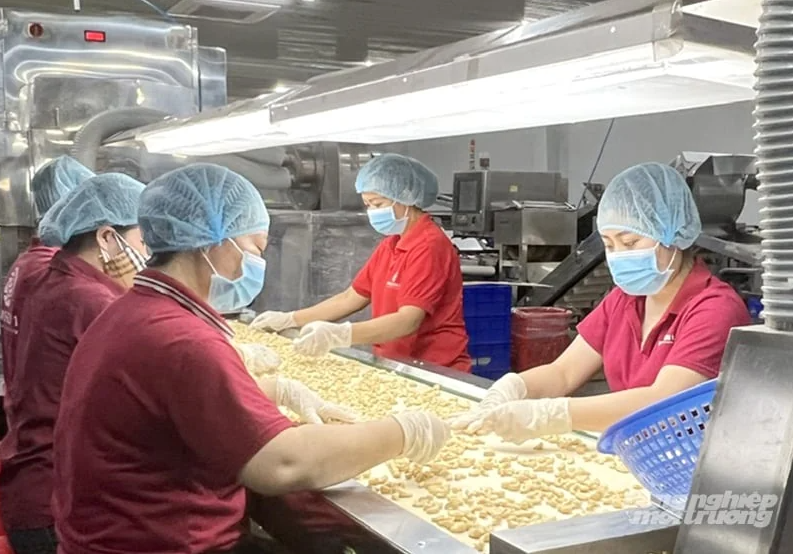
Near-term prices are projected to remain firm. Per Mr. Vu Thai Son, quotations for grades W240, W210, and W180 are climbing robustly amid firm demand; W320 prices are similarly rising as buyers substitute pistachios and almonds with cashews due to the former's steep price premiums.
According to the Agency of Foreign Trade (Ministry of Industry and Trade), early October 2026 saw modest upticks after months of sideways trading, with whole kernel grades W320 and W240 recording their first marked fluctuations since July.
This upward momentum is driven by stabilizing domestic raw cashew nut (RCN) prices paired with vigorous kernel demand in India and Europe. Recent updates indicate Viet Nam’s FOB prices for W320 and W240 have climbed due to rising RCN costs and sustained European interest.
Meanwhile, Viet Nam’s 2027 crop faces severe volatility from forecasted El Niño conditions deemed the strongest in 40 years. Elevated Tanzanian RCN prices (~2,000 USD/ton CIF Viet Nam) prevent steep kernel declines, while Lunar New Year 2027 demand provides further market support.
OFI Viet Nam estimates a 2026 global supply deficit of roughly 316,000 tons in RCN equivalent, supporting kernel prices into early 2027.
Substantially higher price tags on alternative tree nuts also anchor cashew quotations. Mr. Gyana Ranjan Das, Head of Edible Nuts and Pulses at Crown Point Limited (USA), noted October 2026 US import prices (FOB) for W320 stood at 3.24 USD/lb, compared to 3.88 USD for 13–15 hazelnuts, 4.10 USD for almonds, 6.40 USD for whole macadamias, 6.65 USD for pecan halves, and 13.50 USD for shelled pistachios.
Structuring reliable supply chains
China represents Viet Nam's premier cashew export outlet this year. VINACAS reports nine-month exports to China reached 125,000 tons valued at 907 million USD, up nearly 11% in volume and over 28% in value, capturing 21% of total shipments.
Chinese consumption continues rising. OFI Viet Nam notes Chinese kernel imports grew 12.6% in the first nine months, with annual consumption projected to expand 14.5%.
In Russia, cashew penetration across supermarkets is accelerating. Mr. Khusrav Radzhabov, Import Manager at MASTERFOOD (Russia), indicated cashew's value share across 12 major Russian retail chains rose from 8.18% in Q1 2025 to 9.44% in Q1 2026.
Globally, consumption is trending upward. Mr. Jayant Babani of OFI Viet Nam reported international cashew trade expanded 4.7% in the first nine months of 2026, with annual consumption projected up 4.9%, propelled by Asia and recovering North American shipments.
However, retaining market share demands that Vietnamese processors guarantee food safety, consistent quality, and order fulfillment.
Mr. Tran Ngoc Long, General Director of Nut Division at Tan Long Group, noted buyers require cross-batch consistency across moisture levels, color, defect rates, freshness, and microbial safety. Oversight must be system-based, documented, and traceable from raw material to finished lots.
On-time delivery, accurate documentation, responsiveness, and collaborative scheduling remain vital. As buyers gain alternative supplier options, a risk-mitigating vendor secures long-term partnerships.
Mr. Long affirmed that having established processing dominance, Viet Nam's next imperative is forging dependable cashew supply chains to defend global competitiveness.
Son Trang