Japan supports VNUA on food safety management
The VNUA and the JFSM Association cooperate to train human resources, connect enterprises and support the adoption of JFS Standards.
The Viet Nam National University of Agriculture (VNUA) and the Japan Food Safety Management Association (JFSM) recently signed a Memorandum of Understanding (MoU) to advance the development of food safety human resources for Viet Nam and ASEAN nations.
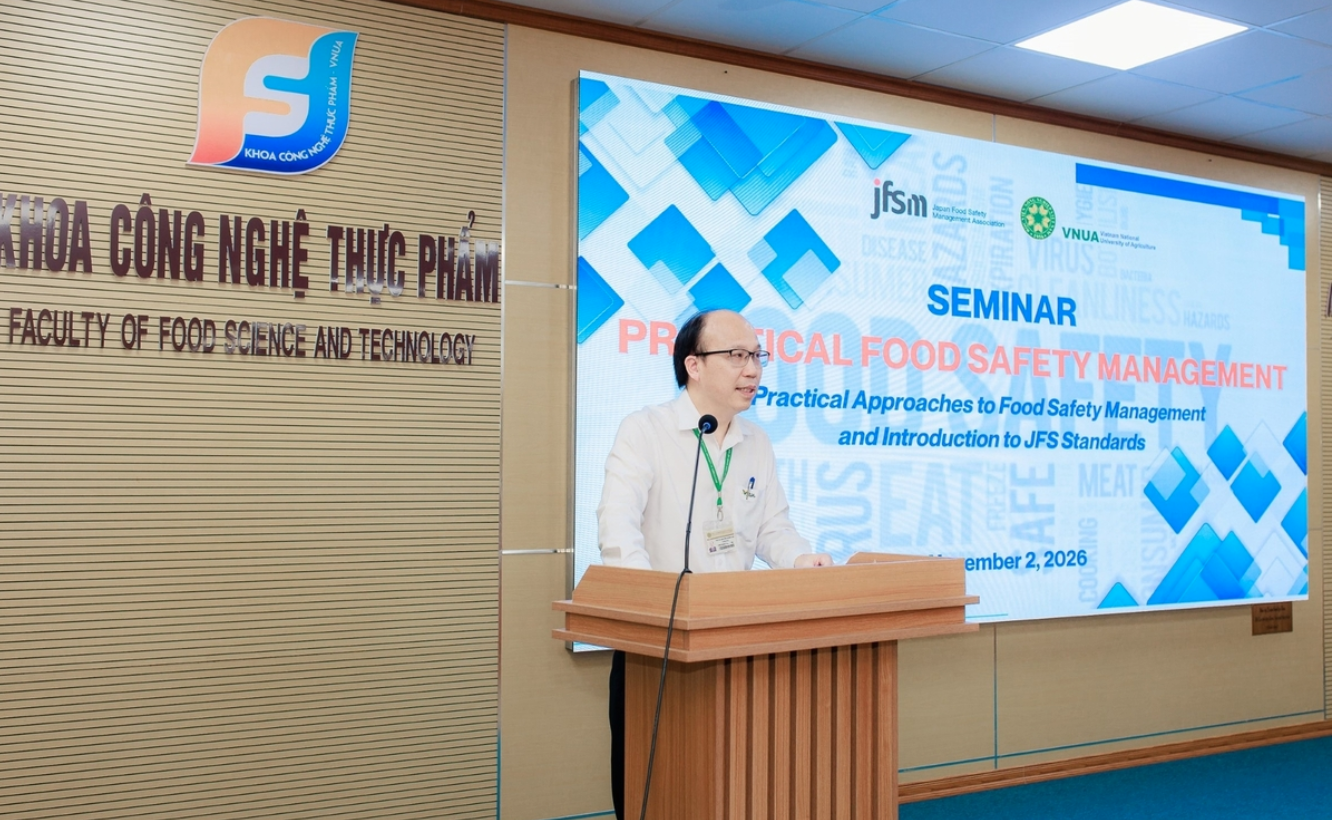
The signatories were Prof. Dr. Nguyen Thi Lan, President of VNUA, and Mr. Masanori Kotani, President of JFSM. The University designated the Faculty of Food Science and Technology as the lead focal agency to coordinate and implement cooperative activities. The signing ceremony coincided with the scientific seminar titled "Food Safety Management Practices," jointly organized by JFSM and the Faculty of Food Science and Technology.
The MoU outlines potential cooperation in educating and upskilling technical personnel and food safety auditors, as well as advancing curricula, training materials, and institutional instructional capacity. Both parties also plan to exchange knowledge, expertise, and jointly organize seminars, workshops, and lectures.
A primary highlight centers on enterprise linkages and professional career development support for students and alumni. Cooperative models in industrial training and research with agribusinesses will be rolled out under signed agreements on the principles of equality, mutual respect, and shared benefit. Concurrently, the partnership seeks to support the adoption and operationalization of JFS Standards, Japan's proprietary food safety management certification framework.
The bilateral relationship between VNUA and JFSM originated through the project "Human Resource Development in the Food-related Areas through Partnership with Universities in the ASEAN Region" (ASEAN-MAFF-HRD). The project is financed by Japan's Ministry of Agriculture, Forestry and Fisheries (MAFF) via the ASEAN Secretariat.
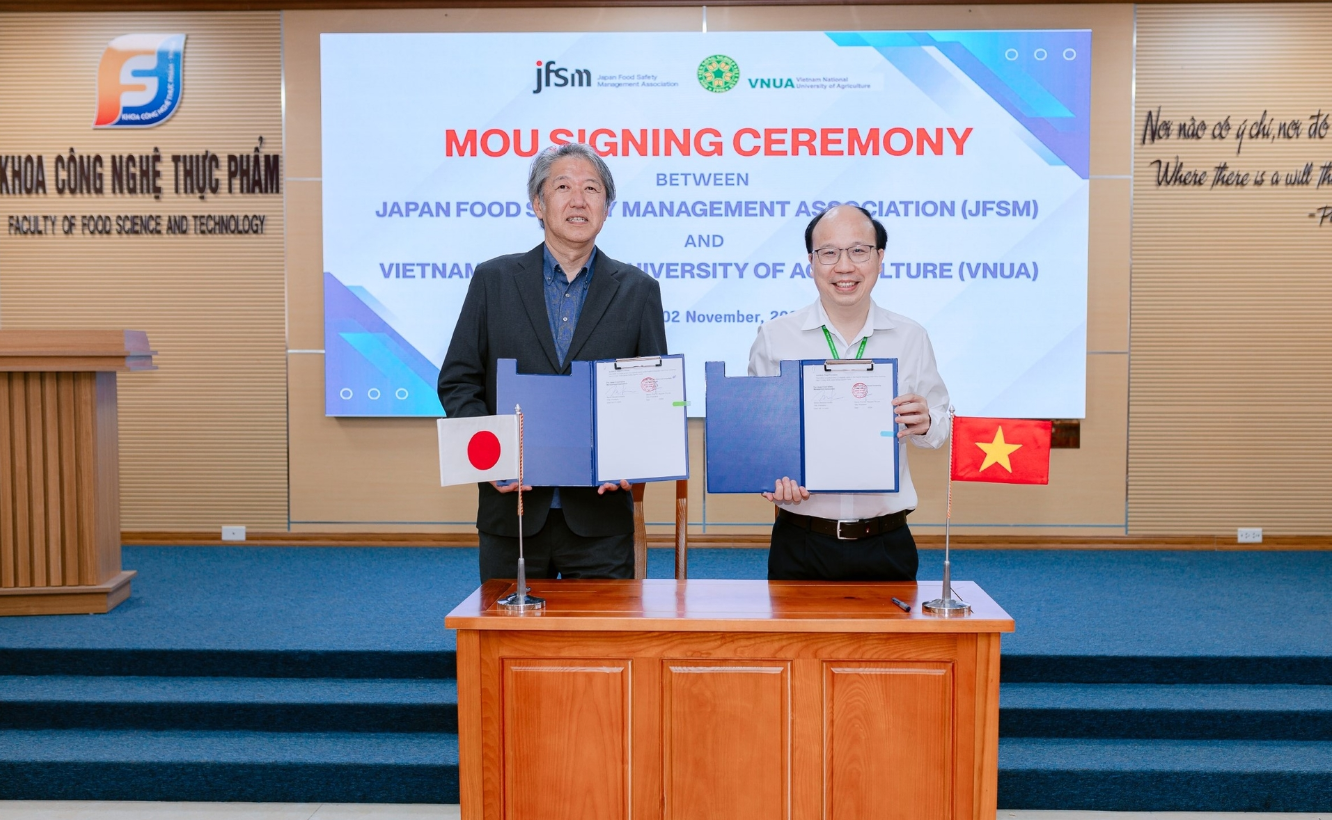
Following 12 years of implementation, VNUA has organized 23 out of the project's 127 total courses, attracting 2,506 out of 9,274 total student participations. This corresponds to roughly 18% of all organized courses and 27% of total trainees across the entire regional project. Curricular content concentrates across three core fields: food value chains, food analysis, and food safety management.
Among these, food safety management was integrated starting from Phase 2. The Faculty of Food Science and Technology collaborated with JFSM to organize five training workshops, engaging 422 trainee enrollments and accounting for nearly 38% of total trainees specialized in this discipline across the entire project.
The training courses received constructive feedback regarding professional instructional quality, practical expertise from Japanese specialists, and the operational applicability of course modules. This coordinated momentum established the foundation for both entities to construct a formalized partnership framework as Phase 4 of the project concludes in 2026.
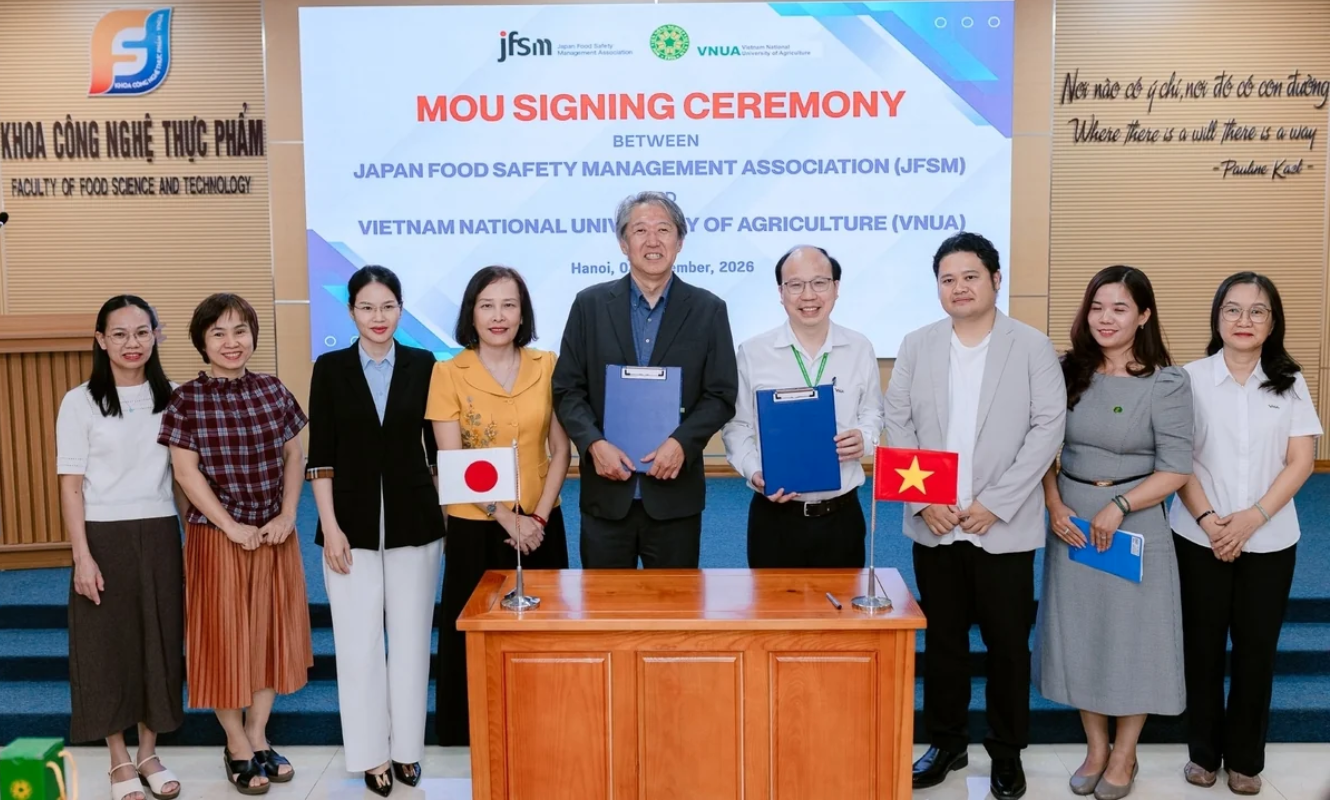
Over the next five years, both parties aim to contribute to establishing a knowledge-based food safety management ecosystem. Japanese practices and insights will be adapted to align with Viet Nam's domestic production conditions while being disseminated across ASEAN member states.
Elevating and harmonizing food safety benchmarks across the region will empower Vietnamese enterprises to integrate deeper into regional and global supply chains, reinforce consumer protection, and foster safe, transparent, and resilient food systems. Anchored by this established partnership foundation, VNUA expects to continue serving as an institutional bridge connecting Japan, ASEAN, and Viet Nam, delivering concrete contributions toward regional food safety, food security, and sustainable development mandates.
Mai Dan