Transforming hard recycled waste paper into soil
Applying the fungus Trichoderma Tv-911 to convert waste paper into cultivation substrate unlocks resource valorization pathways for circular agriculture.
The High-Performing Research Group on Sustainable Crop Cultivation Technology under the Faculty of Agronomy, Viet Nam National University of Agriculture (VNUA), recently organized a specialized seminar with experts regarding research, microbial applications, and resource circularity in agriculture. The program convened Prof. Dr. Masaru Matsumoto from the Faculty of Agriculture, Kyushu University (Japan), alongside domestic and international scientific faculty.
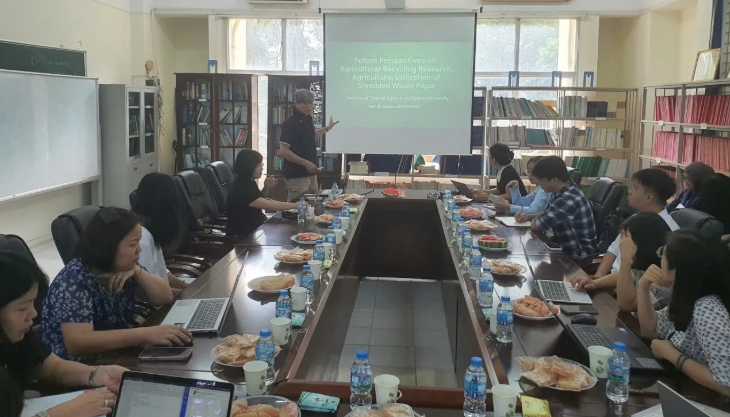
At the technical seminar, Prof. Dr. Masaru Matsumoto delivered a presentation on transforming discarded paper into circular bio-growing media utilizing the fungal strain Trichoderma Tv-911. The research demonstrates utilizing microorganisms to biologically convert hard-to-recycle paper fractions into value-added substrates serving agricultural production.
According to Prof. Dr. Masaru Matsumoto, this research trajectory has progressed from laboratory benchmarking to commercial-scale implementation. The technological protocol encompasses waste paper pre-treatment, fungal biodegradation, and composite growing media formulation. Through this sequence, non-recyclable paper waste serves as raw feedstock for horticultural substrate products.
Notably, the commercialized product "Minonarū Yasai no Tsuchi" (fruiting vegetable soil), engineered from recycled organic matter derived from hard-to-recycle paper inoculated with Trichoderma Tv-911, has successfully penetrated the retail market. This milestone illustrates the viability of translating applied microbiological research into industry practice, bridging solid waste upcycling with agricultural input manufacturing.
The Japanese specialist also illustrated broader frameworks for closed-loop resource recovery. Rather than terminating the lifecycle in incineration plants or landfills, refractory paper waste is reconstituted into plant-growing media, re-entering productive bioeconomic cycles.
Introducing the strategic mandates of the High-Performing Research Group on Sustainable Crop Cultivation Technology, Dr. Nguyen Thi Ngoc Dinh from the Faculty of Agronomy noted that the group concentrates on engineering agronomic interventions that optimize resource efficiency, safeguard agroecosystems, and fulfill sustainable agricultural development mandates.
Alongside advanced farming systems, crop husbandry, and low-emission paddy cultivation, the research team prioritizes agro-byproduct valorization, soil health regeneration, and the deployment of beneficial microbial consortia. These research vectors directly anchor the development of circular production models and resource-use efficiency across agricultural sectors.
Dr. Nguyen Thi Ngoc Dinh’s presentation provided Kyushu University specialists with actionable clarity regarding the team’s research orientations, institutional competencies, and active field trials. On this basis, the scientists obtained baseline data to explore collaborative joint-research frameworks in the forthcoming period.
The technical exchange recorded numerous inquiries and discussions surrounding the presented findings. The deliberations centered on sustainable crop management technologies, resource recovery, and the catalytic role of microbial agents in modern agricultural systems.
Through the exchange, scientists from both institutions shared peer-reviewed findings, broadened institutional links, and explored collaborative opportunities between VNUA and Kyushu University, advancing toward circular and sustainable agricultural solutions.
Mai Dan