Hanoi promotes international cooperation to develop craft villages
Hanoi is accelerating international cooperation to elevate the standing of the capital's craft villages.
On the morning of November 12, ahead of the inaugural Global Craft Village Preservation and Development Festival 2026, the Hanoi Department of Agriculture and Environment held a working session with a delegation from the World Crafts Council (WCC) to discuss and advance cooperation in preserving and developing craft villages, aiming to expand international market reach.

Chuong traditional conical hat craft village. Photo: Viet Anh.
Briefing the working session, Mr. Nguyen Dinh Hoa, Deputy Director of the Hanoi Department of Agriculture and Environment, stated that the city currently comprises 337 craft villages, traditional craft villages, and traditional crafts officially recognized by the Municipal People's Committee. In 2025, revenue generated by craft villages exceeded 25,000 billion VND, providing regular employment for nearly 250,000 rural workers with an average monthly income of 7-8 million VND per person. Alongside this, Hanoi boasts 415 recognized artisans, including 19 People's Artisans, 72 Meritorious Artisans, and 324 Hanoi Artisans.
Beyond contributing substantially to the rural economy, Hanoi's craft villages have progressively enhanced product value through brand building and intellectual property (IP) protection. To date, the city has assisted 84 craft villages in registering collective trademarks and certification marks, with over 200 products granted protection titles by the Intellectual Property Office of Vietnam. Notably, out of 3,531 evaluated and ranked OCOP items, 1,006 originate from craft villages.
Alongside quality upgrades and branding, Hanoi prioritizes broadening international partnerships. Specifically, the recognition of four local craft villages as members of the World Craft Cities Network has injected fresh momentum for production facilities to transition from conventional contract processing toward developing high-value creative products, fulfilling market demands and deepening global integration.
Building upon these milestones, over the 2026-2030 period, Hanoi is orienting craft village economic development toward multi-value creation, linking production with value chains, the circular economy, open innovation, and heritage tourism. Within this roadmap, the city prioritizes perfecting support mechanisms, developing green infrastructure, preserving traditional craftsmanship, training successor generations, and accelerating digital transformation, green transition, and international cooperation.
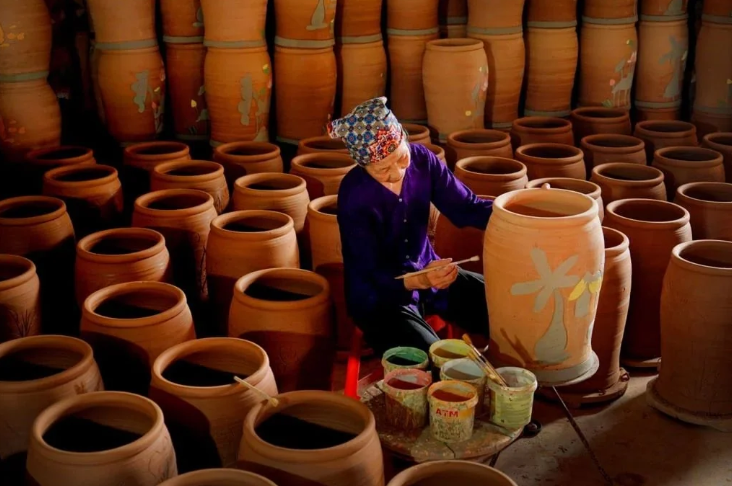
Aligned with this orientation, the inaugural Global Craft Village Preservation and Development Festival 2026 is envisioned as a strategic bridge connecting Vietnamese craft villages with the international artisan community. Beyond showcasing the quintessence of traditional crafts, the event fosters cultural exchange and links artisans, contemporary designers, and enterprises, thereby widening cooperation pipelines, expanding markets, and promoting Hanoi's image to international friends.
At the working session, representatives from Hanoi’s craft villages expressed a strong desire to deepen collaboration with the World Crafts Council (WCC), particularly in connecting international design specialists, mentoring young artisans, developing exhibition and craft demonstration spaces, and adopting eco-friendly production technologies.
Discussing cooperation pathways, Ms. Zhang Hong, President of the China Arts and Crafts Association and President of the WCC Asia-Pacific Region, noted that founded in 1964, the WCC currently operates a network spanning over 108 countries, serving to unite institutions, artisans, and enterprises to preserve and advance the handicraft sector.
According to Ms. Zhang Hong, despite possessing rich artisanal heritage, the Asian handicraft sector confronts pressing challenges, including a shortage of successor generations, the risk of losing traditional skills, counterfeit and imitation goods, and limited access to contemporary industrial design. Consequently, integrating heritage conservation with creative innovation, market development, and sustainable production is an essential pathway to elevate handicraft value.
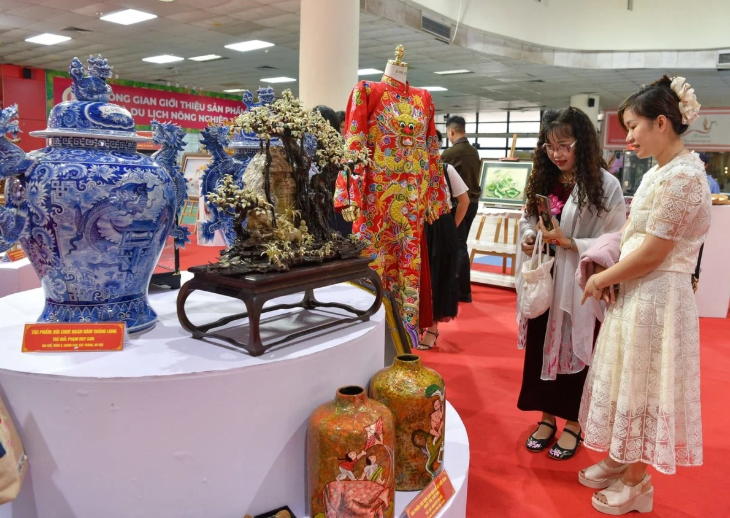
Sharing this perspective, Mr. Sundeep Kumar, Vice President of the WCC Asia-Pacific Region and Co-Chair of the World Craft Cities Sub-Committee, highly commended the potential of Hanoi’s craft villages and expressed optimism for continued expansion of bilateral ties. Building on the foundation of the four already recognized craft villages, the WCC aims to support additional high-potential villages in joining the World Craft Cities Network.
$ 1 = VND 25,910 - Source: Vietcombank.
Viet Anh