Students carry water bottles, practice plastic waste reduction
Western Hanoi Primary and Secondary School aims to cultivate lasting environmental protection habits among students.
If environmental campaigns, competitions, or launch ceremonies ceased to exist, would students continue practicing green behaviors? That was the central question posed by Mr. Nguyen Van Chap, Principal of Western Hanoi School (WHS), while sharing his institution's experience in building an ecoschool at the ASEAN Eco-school Network Conference in Viet Nam.
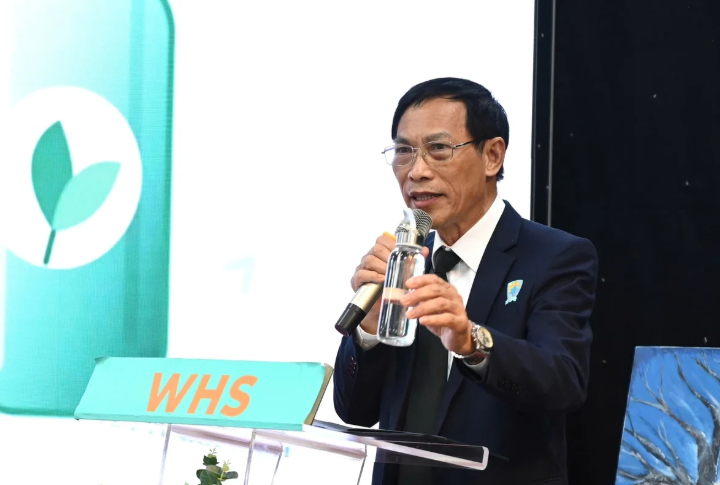
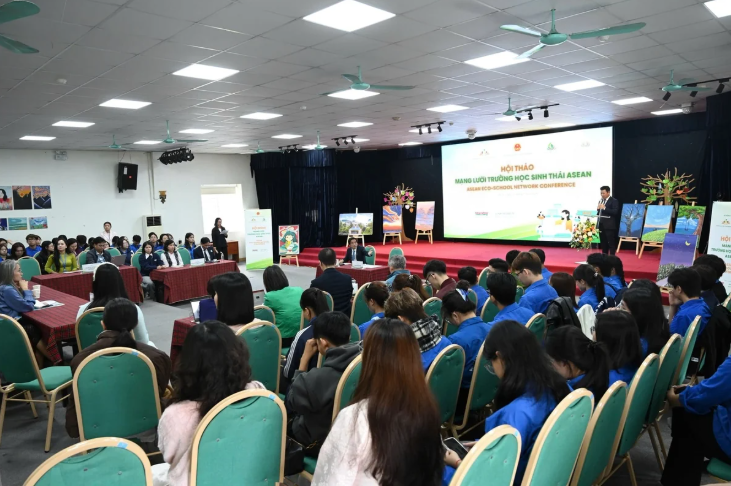
The workshop was assigned by the Ministry of Agriculture and Environment to the Agriculture and Environment Newspaper, in coordination with the Department of International Cooperation, and took place on the afternoon of November 13 at WHS.
According to Mr. Chap, the success of an ecoschool must be demonstrated through self-awareness and sustainable daily habits across students, teachers, and the broader school community. Consequently, environmental education must become a long-term strategic orientation deeply embedded in the school’s development plan and institutional culture.
Starting with Personal Water Bottles and Tree-Planting Sessions
At WHS, the "No Plastic Bottles" pledge has been rolled out to curb single-use plastic bottles. The school encourages both students and faculty to carry personal reusable bottles and substitute single-use plastic items with cloth and paper bags.
Inside classrooms, the school provides drinking glasses and stainless-steel water dispensers. In the school canteen, disposable trays, cups, spoons, and food containers are progressively being replaced with reusable stainless-steel tableware.
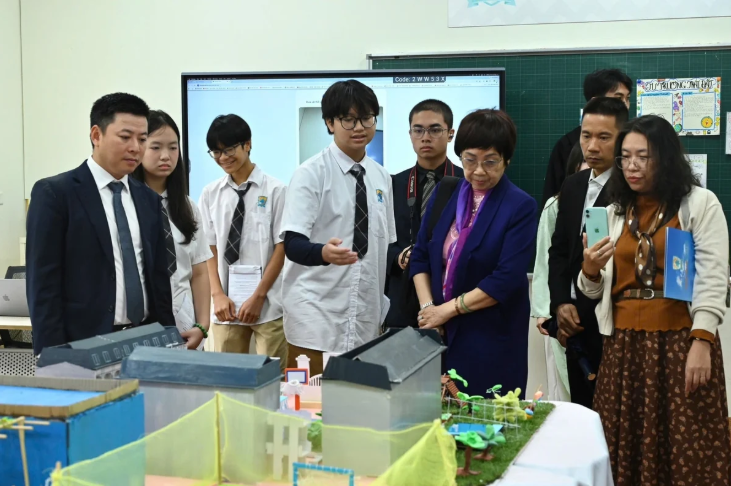
According to Mr. Chap, a single personal water bottle cannot resolve the entire plastic waste crisis. However, when small choices are practiced consistently, they generate meaningful systemic change. The school’s overarching objective is for students to recognize that environmental stewardship begins within their daily routines.
The school also integrates environmental education across subjects including Science, Fine Arts, Mathematics, History, Geography, English, and Life Skills. Alongside classroom lessons, students participate in the "From Waste to Flowers" competition, crafting creative items from discarded materials.
During the plastic-free Mid-Autumn Festival program, banana leaves, old newspapers, and bamboo were utilized for decorations and festival crafts. Students also plant trees, tend vegetable gardens, sort waste, and practice organic composting using the Eco Bokashi model.
Hands-on experience in the school garden has helped Pham Minh Khang, an 8C1 student, deepen his comprehension of classroom lessons. Khang shared that he gets to practice planting, tending crops, and propagating plants via stem cuttings or air layering during Biology classes. He recalled using a rake to till the soil, sowing seeds, covering them with earth, and watering them to help the plants thrive.
"Tree-planting and experiential activities at school help me love nature more, learn how to protect the environment, and conserve natural resources," Khang shared.
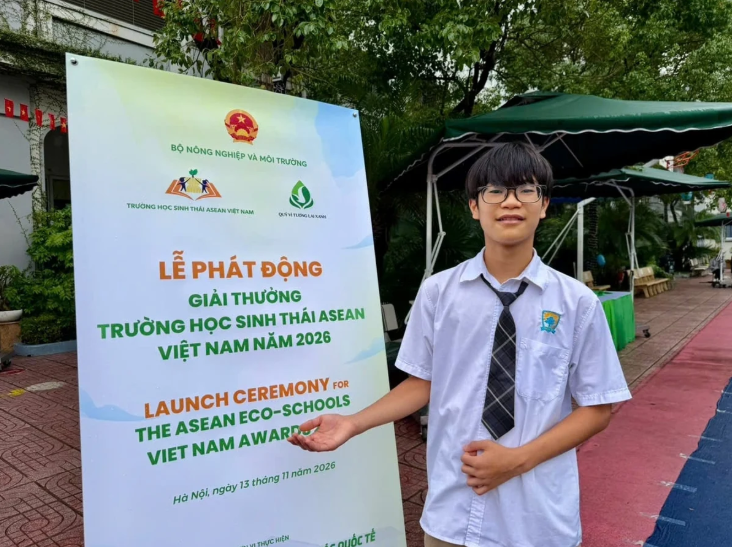
Beyond the school garden, Khang participates in picking up litter around campus, watering plants, and bringing potted greenery into his classroom to make the learning environment greener and more vibrant. He also shares these lessons with his parents and peers, rallying everyone around him to protect the environment.
According to Mr. Chap, when students directly tend a vegetable bed, sort waste, or craft upcycled products, they gain a deeper appreciation for the value of labor, natural resources, and their responsibility toward the living environment.
Empowering Students, Measuring Substantive Impact
To foster student agency, the school encourages learners to propose ideas, design products, care for campus greenery, and advocate among their peers. The WHS Green Club provides a platform for students to design awareness banners, craft recycled items, and organize environmental initiatives.
However, Mr. Chap acknowledged that club activities have occasionally lacked regularity. The school needs to strengthen institutional mechanisms to ensure students can participate continuously, exercise true empowerment, and receive formal recognition for their contributions.
"If every activity is decided by adults and students merely follow instructions, it is extremely difficult to cultivate long-term initiative and a sense of accountability," he emphasized.
Alongside empowering students, the school stipulates that teachers, administrators, and staff must lead by example before instructing learners. Faculty members carrying personal bottles, sorting waste, and conserving electricity and water serve as vivid visual lessons.
Initiatives such as "Batteries for Trees - Preserving a Green Environment," secondhand swap fairs, tree planting, campus cleanups, and "Green Saturdays" have progressively engaged parents and the local community. Through this connection, habits formed at school have the opportunity to be sustained at home.
In 2024, the school won an Encouragement Prize at the ASEAN Eco-schools Award Vietnam; in 2025, it captured the National First Prize in the Secondary School category. According to Principal Nguyen Van Chap, the value surpassing any award is the tangible shift in student awareness and behavior, as well as the school's pedagogical organization.
Nevertheless, the school still lacks a comprehensive tracking and statistical system to quantify reductions in waste volume, participation rates, and the long-term efficacy of each initiative. The school will progressively construct evaluation metrics while sustaining existing models, elevating student proactiveness, and strengthening parental partnership.
Drawing from this practical experience, Mr. Chap proposed establishing pragmatic, user-friendly assessment methodologies and enabling students to participate from initial ideation through to outcome evaluation. The Eco-Schools network should also facilitate peer-to-peer experience sharing and introduce initiatives tailored to the specific conditions of each school.
According to him, an educational model only achieves genuine success when it is sustained over the long term, evaluated regularly, and continuously improved.
The ASEAN Eco-Schools Award is an ASEAN environmental cooperation initiative, first held in 2012 in Malaysia, to honor exemplary schools in environmental education and protection.
The year 2026 marks its third edition in Vietnam, chaired by the Ministry of Agriculture and Environment and coordinated by the Agriculture and Environment Newspaper, with the partnership and sponsorship of the Foundation for a Green Future (Vingroup).
The launch ceremony for the ASEAN Eco-Schools Award Vietnam 2026 took place on November 13 at Western Hanoi School in Xuan Phuong Ward, Hanoi, attracting 25,000 participants both in-person and online.