How can eco-schools stay 'green' beyond the award competition?
The ASEAN Eco-Schools Network in Viet Nam aims to connect schools, share initiatives, mobilize resources and make environmental protection a regular part of school life.
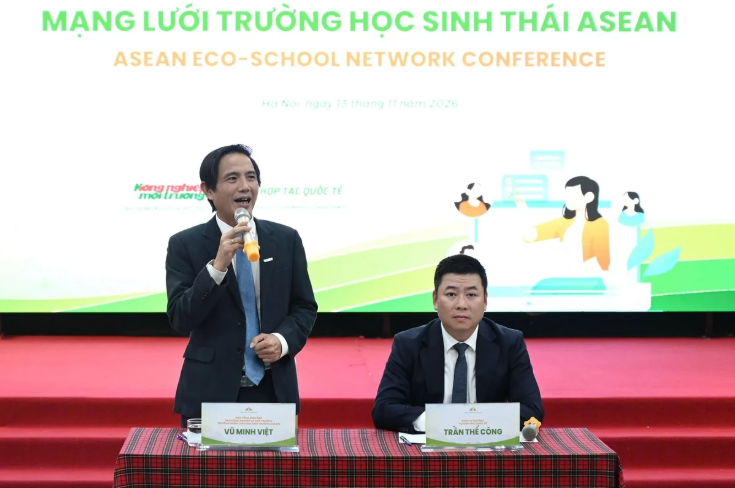
On the afternoon of November 13 in Hanoi, Viet Nam Agriculture and Nature News (VAN News), in coordination with the Department of International Cooperation under the Ministry of Agriculture and Environment, held a workshop on the ASEAN Eco-Schools Network in Viet Nam.
Participants discussed the need for the network, its objectives and expected benefits, as well as coordination mechanisms among government agencies, schools and partners. They also explored priority activities and the conditions needed to ensure the network's long-term and sustainable operation.
Sustaining green practices and scaling up school initiatives
Opening the discussion, Mr. Vu Minh Viet, Deputy Editor-in-Chief of Van News, highlighted the role of the ASEAN Eco-Schools Network in Viet Nam in connecting schools and helping them sustain environmental protection activities after participating in the award programme.
According to Mr. Viet, experience from Singapore and several other ASEAN countries shows that establishing a network is essential for schools to exchange knowledge, develop effective environmental education models and replicate successful practices. This is also the direction the Ministry of Agriculture and Environment is pursuing in its efforts to establish the network in Viet Nam.
Drawing on their practical experience, a representative from a lower secondary school raised a question: How can eco-school criteria serve not only as a basis for award assessment but also as a tool for schools to evaluate their own performance and improve their activities each year?

In response, Prof. Dang Thi Kim Chi said the award should not simply recognize achievements. More importantly, it should guide schools in gradually meeting environmental education and protection requirements.
The criteria should therefore be incorporated into schools' regular activities, helping students develop environmental awareness and adopt environmentally responsible habits. The true value of the award lies not only in the assessment results but also in schools' ability to sustain and build on the positive changes they have made.
Sharing this view, Associate Professor Nguyen Thi Kim Cuc, a member of the Award Selection Council, said the ASEAN Eco-Schools Network in Viet Nam should help schools maintain activities in line with the national award criteria while gradually aligning their practices with ASEAN eco-school standards.
According to her, the key objective is to turn environmental awareness into action, thereby fostering environmental protection habits and a culture of environmental responsibility within schools.
To achieve this, the network needs to strengthen connections and create more opportunities for teachers and students from different schools and regions to meet and exchange experiences. This will allow effective models and practical initiatives to be shared, adapted and replicated, helping spread environmental awareness among younger generations.
On this occasion, on behalf of VAN News, Deputy Editor-in-Chief Vu Minh Viet acknowledged and commended the active participation and commitment of teachers and representatives from educational institutions throughout the program. He also expressed his sincere appreciation to Tay Ha Noi School for its cooperation and support, which contributed to the successful organization of the 2026 ASEAN Eco-Schools Viet Nam Award launch ceremony and the workshop on the ASEAN Eco-Schools Network in Viet Nam.
The Organizers hopes that educational institutions will continue to engage with the initiative, contribute constructive feedback, and share practical experience and ideas. The aim is to make environmental protection a regular part of daily life in schools and families, while extending its impact to communities and society as a whole, helping create a greener, cleaner and more sustainable living environment.
Thuy Chi - Dan Ly