On October 28, the Ministry of Agriculture and Environment and the Food and Agriculture Organization of the United Nations (FAO) launched the project “Emergency support to control and manage banana wilt disease caused by Fusarium spp. TR4 in Vietnam.”
The FAO-funded project, worth 120,968 USD (about 3.2 billion VND), will run from September 2025 to May 2026 and will be implemented in 15 provinces and cities from Hanoi, Hung Yen, Lao Cai, Lai Chau to Dong Nai, Tay Ninh, Can Tho and Ca Mau. The goal is to reduce the area infected with TR4 by 40% and develop a sustainable disease management process, while identifying 1-2 disease-resistant banana varieties and at least 1 effective antagonistic microorganism strain.
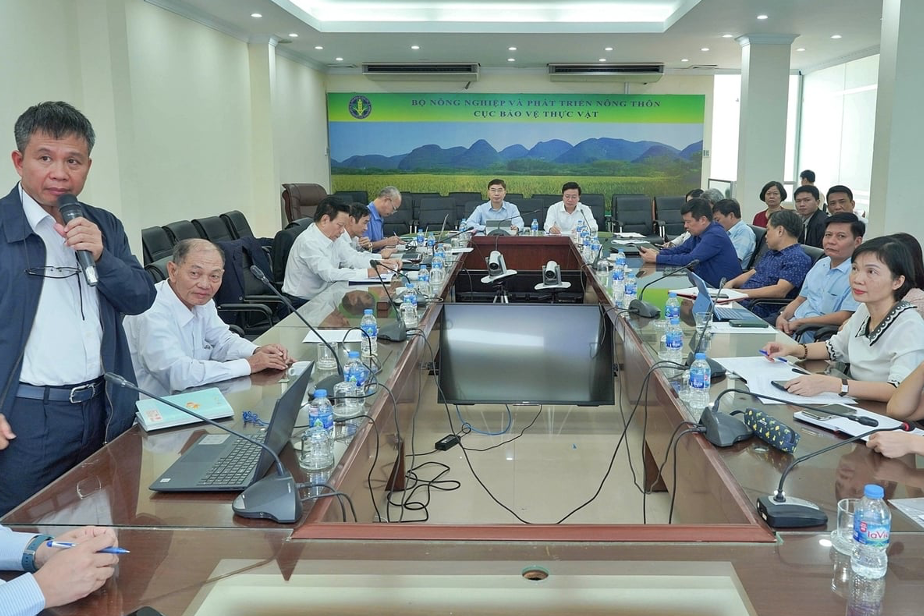 The workshop attracted the participation of many local people in person and online. Photo: Bao Thang.
The project focuses on five main outputs. First, the establishment of a TR4 disease monitoring and early warning system, with 300 samples collected, analyzed, and a national disease distribution map created, along with a network of trained technicians in key growing areas.
Second, improve disease diagnosis capacity using PCR and LAMP techniques, form a team of experts and 20 laboratory staff capable of early detection, accurate diagnosis and reporting according to international standards.
Third, select 1-2 TR4-resistant or -tolerant banana varieties, through evaluation of native and imported genetic resources, as a scientific basis for crossbreeding and replication in production.
Fourth, identify microbial groups antagonistic to TR4 fungus, develop screening, evaluation and application processes in biological control, helping to reduce dependence on chemical drugs.
Fifth, develop a process for producing disease-free banana seedlings using tissue culture, and at the same time issue a sustainable management process for TR4 disease suitable for Vietnam's conditions, making it easy for localities to apply and replicate.
Upon completion, the project will deliver a set of TR4 disease management procedures, a list of disease-resistant varieties, a disease-free tissue culture process, and a group of tested antagonistic microorganisms ready for application in production. These results not only serve plant protection but also aim to develop a sustainable banana value chain, contributing to increasing farmers' income and stabilizing exports.
According to Deputy Director of the Department of Crop Production and Plant Protection Nguyen Quy Duong, this is the first time Vietnam has had a project to investigate, monitor and manage TR4 according to international standards, simultaneously combining epidemiological maps, resistant varieties and antagonistic microorganisms. The project will create a premise for localities to proactively respond to epidemics and improve biological control capacity for technical staff, while being able to replicate biological pest control methods to other crops, ensuring farmers' livelihoods and food security.
Vietnam currently exports bananas to more than 10 markets, with China, South Korea and Japan being the main markets. High-end markets such as Japan, South Korea and the EU all require certification of safe growing areas, traceability and disease-free.