On November 26 in Hanoi, the 2025 Conference on Environmental Protection in Fisheries was held under the coordination of the Directorate of Fisheries and Fisheries Surveillance (Ministry of Agriculture and Environment), the United Nations Development Programme (UNDP), and the Embassy of Canada in Viet Nam.
The event was part of the “Climate-Smart Coastal Communities” (VN-CSCC) project funded by the Government of Canada, and marked a key milestone in the mid-term review of the Government’s Decision No. 911/QD-TTg on environmental protection in fisheries for the 2021–2030 period.
An inevitable path forward
In his keynote address, Deputy Minister of Agriculture and Environment Phung Duc Tien emphasized that fisheries has grown into one of the country’s most important economic sectors, ranking third in export value and identified as one of the five key marine economic pillars under Viet Nam’s Marine Strategy to 2030.
In the first nine months of 2025, total fisheries output reached 7.26 million tons, up 3.2% year-on-year. In the first ten months, exports were estimated at USD 9.5 billion, up 16% year-on-year and accounting for more than 7% of the global seafood trade.
 Deputy Minister of Agriculture and Environment Phung Duc Tien delivers a keynote speech at the conference. Photo: Hong Ngoc.
However, the sector remains heavily dependent on natural resources and ecosystems and is facing increasingly complex challenges, including the IUU “yellow card,” market volatility, international competition, the impacts of climate change, and especially environmental pollution. These risks directly affect aquatic resources and fishermen’s livelihoods, while pollution can also stem from production activities themselves if not properly controlled.
Against this backdrop, developing fisheries in a sustainable, responsible, and environmentally friendly manner is an inevitable path. Strengthening waste control, upgrading technologies, accelerating digital transformation, and mobilizing broad social participation will lay the foundation for high-quality, high-value Vietnamese seafood products at reasonable costs, ensuring both economic efficiency and environmental protection.
During the 2022–2025 period, Viet Nam recorded significant achievements in implementing Decision 911, with contributions from government agencies, local authorities, associations, research institutes, and businesses. Pollution control in aquaculture, fishing, and processing has gradually improved; innovative environmental models have been deployed, ranging from waste monitoring and aquaculture management to environmental treatment technologies. Environmental monitoring, early warning, and pollution source research have been strengthened, while a modernized environmental data system for the fisheries sector has begun to take shape.
At the same time, the conference also candidly pointed out persistent challenges, including incomplete environmental infrastructure, limited pollution control capacity in some localities, slow adoption of waste treatment technologies, and the need for greater public awareness.
Preparing for the 2026–2030 acceleration phase
Representatives from Hanoi, Gia Lai, Hue, Can Tho and other localities shared their perspectives and proposed solutions for the 2026–2030 period in line with the prevention–monitoring–treatment–restoration framework under Decision 911.
Ms. Ramla Khalidi, UNDP Resident Representative in Viet Nam, affirmed that a sustainable marine economy is not only a moral choice but also a smart economic investment for the future. UNDP will continue to accompany Viet Nam in protecting marine ecosystems, improving governance effectiveness, and safeguarding the livelihoods of millions who depend on the sea. She stressed that to move further, Viet Nam should prioritize long-term investment in modern monitoring infrastructure, strengthen inter-sectoral coordination, expand the role of communities, and enable stronger private-sector participation, viewing sustainable development as a new growth driver.
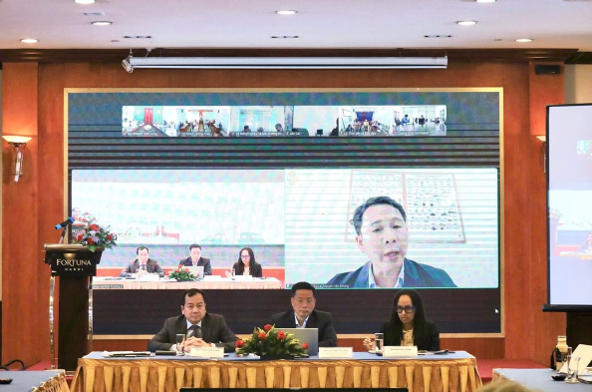 A delegate from the Gia Lai Department of Agriculture and Environment proposes solutions for marine pollution for the 2026–2030 period.
The afternoon session focused on a globally pressing issue: marine plastic waste management in the fisheries sector. Representatives from IUCN, WWF-Viet Nam, the Research Institute for Marine Fisheries, local authorities, and international organizations shared practical experiences in plastic waste reduction projects, collection and recycling initiatives, community-based solutions, and pilot models in Khanh Hoa, Gia Lai, Can Tho, and Hue.
The “Climate-Smart Coastal Communities” (VN-CSCC) project, implemented from 2024 to 2030, includes several components closely aligned with Decision 911 and Decision 687. These activities are helping Viet Nam move closer to its international commitments on biodiversity conservation, ecosystem restoration, and sustainable fisheries development.
The conference concluded with broad consensus that environmental protection in fisheries is not only a task of state management agencies but a shared responsibility of the entire society.
The 2026–2030 period is identified as an acceleration phase, in which governance capacity, technological innovation, the role of local authorities, and the active participation of fishing communities will be decisive to the success of building a “green, clean, and responsible” fisheries sector.