At a press briefing, Mr. Nguyen Van Long, Director General of the Department of Science and Technology under the Ministry of Agriculture and Environment, said that by June 12, 2026, the agricultural traceability system had been applied to 18,500 products across 112 product categories. The platform currently manages 919 product batches from 547 farming households, 255 growing areas and 149 enterprises in 26 of the country’s 34 provinces and cities.
For durian exports, as of May 10, 2026, three containers had been successfully shipped to China with complete traceability information attached.
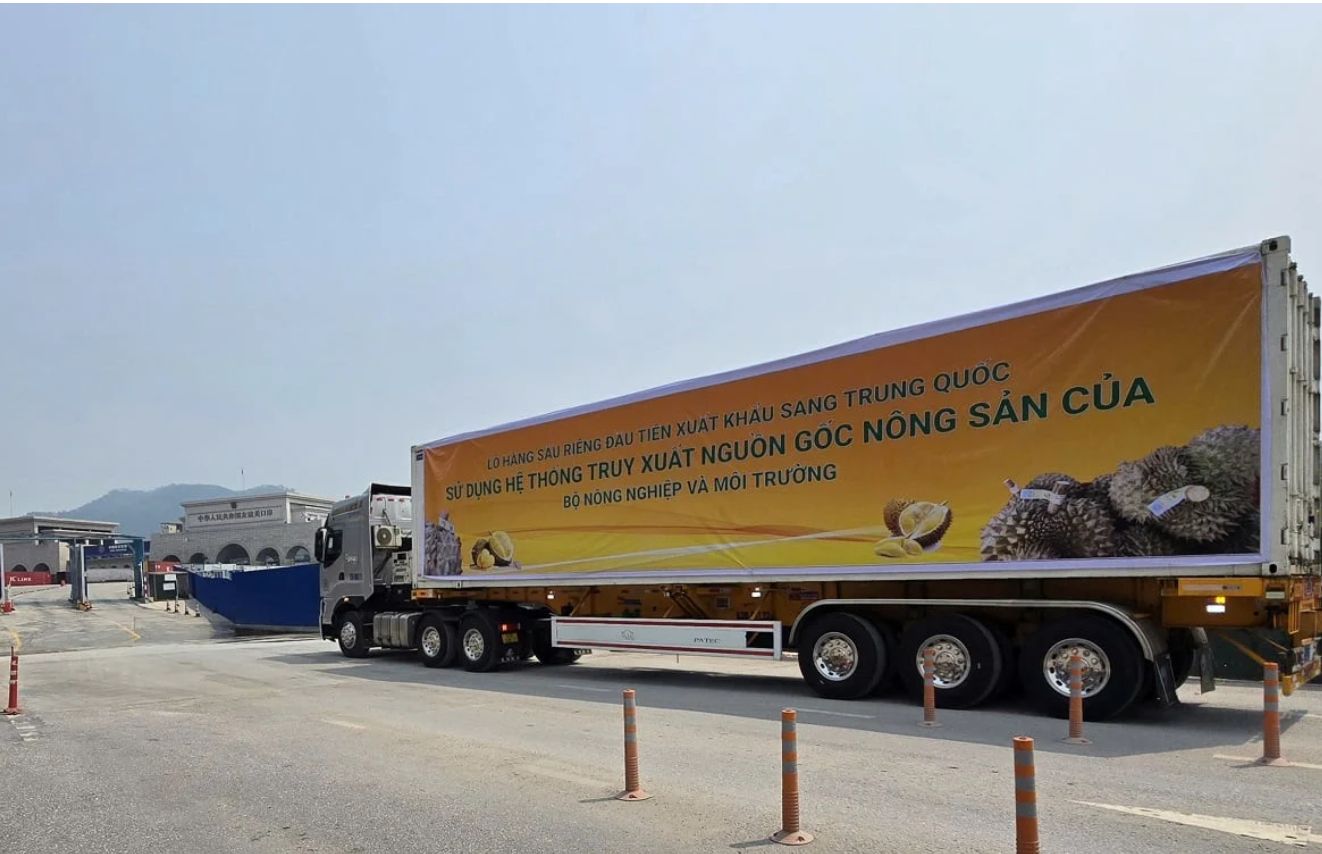 Durian has been successfully exported to China with full traceability information. Photo: Hoang Nghia.
According to Mr. Nguyen Van Long, the Ministry of Agriculture and Environment is working with businesses to expand the traceability system from July 1, 2026, to a number of key agricultural commodities, including rice, meat, eggs, milk, pineapple, passion fruit and tea.
Participating enterprises include major companies such as Thaibinh Seed, Loc Troi, Masan, Dabaco, Thien Vuong, Doveco, Nafoods and tea producers in Thai Nguyen Province.
The agricultural traceability system was officially launched by the Ministry of Agriculture and Environment on December 26, 2025. It is currently operating stably through two online portals, while a mobile application is under development to facilitate participation by farmers, businesses and consumers.
In the coming period, the ministry will report to and propose that the Prime Minister direct ministries, sectors, local authorities and enterprises to implement agricultural traceability nationwide in a coordinated manner. At the same time, efforts will continue to improve the system by strengthening connectivity, interoperability and data verification, as well as refining operational procedures, data standards and information-sharing mechanisms.
The ministry also plans to expand traceability coverage to major agricultural sectors to support supply chain management, domestic consumption and exports. Training programs for local authorities, enterprises, cooperatives and producers will be intensified, while cooperation with domestic and international partners on traceability data recognition and integration will be promoted to enhance the competitiveness of Vietnamese agricultural products.
In particular, the Ministry of Agriculture and Environment will coordinate with the Ministry of Public Security, the Ministry of Science and Technology, the Ministry of Industry and Trade, and the Ministry of Health to connect the agricultural traceability system with relevant national platforms and databases in accordance with regulations.
To support implementation, the ministry has issued comprehensive technical guidance documents and organized numerous training courses for local authorities, enterprises, cooperatives and producers across the country.