Viet Nam's DCC and Canada's IISD sign an agreement on carbon pricing and the development of carbon market.
On September 25, 2026, as part of Viet Nam’s high-level visit to Canada, the Department of Climate Change under the Ministry of Agriculture and Environment and the International Institute for Sustainable Development (IISD) signed a MoU to strengthen cooperation on carbon pricing and the development of Viet Nam’s carbon market.
Representing the Department of Climate Change, Nguyen Tuan Quang, Director General of the Department of Climate Change, signed the MoU. On behalf of IISD, Anne Hammill, Vice President, Resilience, signed the agreement.
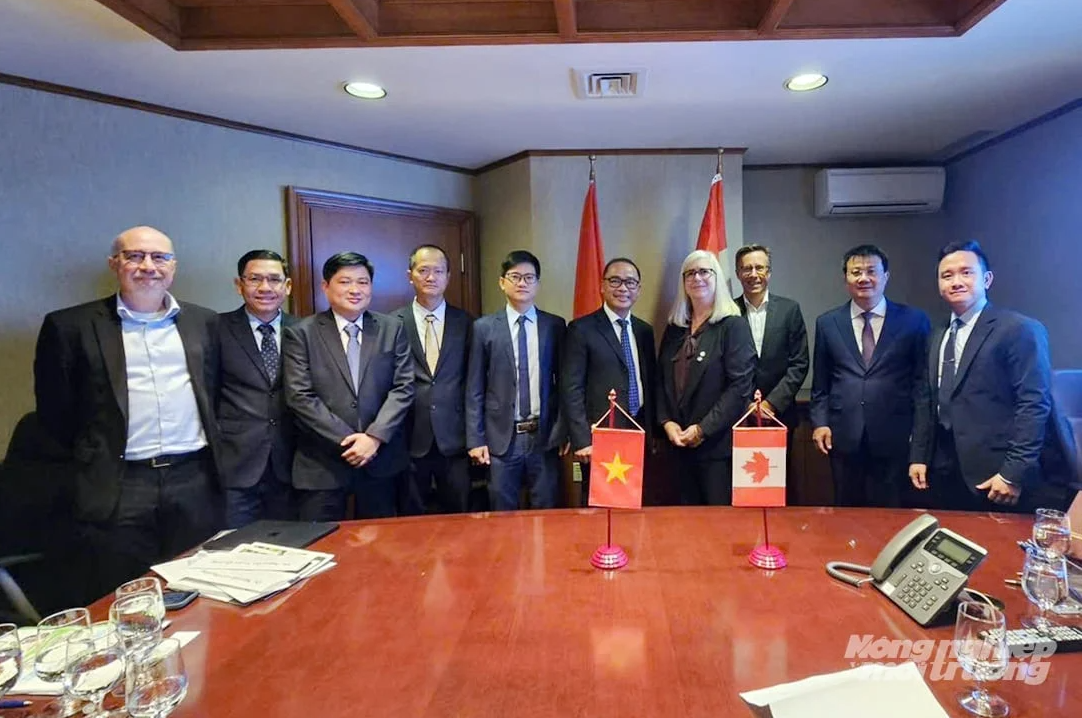 The delegation from the Ministry of Agriculture and Environment meets with the International Institute for Sustainable Development (IISD) and signs a MoU to strengthen cooperation on carbon pricing and the development of Vietnam’s carbon market. Photo: Hong Hanh.
The MoU establishes a framework for cooperation between the two sides to promote research, experience sharing, and support for developing and implementing carbon pricing instruments and carbon markets. Through this cooperation, the two sides aim to contribute to Viet Nam’s green transition and its goal of achieving net-zero emissions by 2050.
Under this framework, the two sides plan to focus on research into carbon market development, as well as conducting research, modeling, and scenario analysis to assess the socioeconomic and environmental impacts of carbon markets.
They will also jointly organize technical workshops and facilitate the exchange of knowledge, experience, and information, while strengthening connections and cooperation among government agencies, the private sector, research institutions, and relevant organizations.
Another area of cooperation is research into new international standards and requirements related to climate change and carbon markets, including international standards and requirements for carbon credits. The two sides will also promote capacity-building activities and professional exchanges.
As part of the cooperation framework, IISD is expected to provide international experts, modeling support, technical research, and coordination with the Department of Climate Change in consultations, workshops, and knowledge-sharing activities.
The two sides will maintain regular communication and periodically review progress in implementing the cooperation activities.
 Director General of the Department of Climate Change Nguyen Tuan Quang (fourth from right) at a meeting between Minister of Agriculture and Environment Trinh Viet Hung and Canadian international partners. Photo: Hoai Nam.
Speaking about the significance of the MoU, Director General Nguyen Tuan Quang emphasized: “This cooperation will help promote technical exchanges and combine domestic and international experience to strengthen Viet Nam’s capacity to organize and operate its carbon market. It will also support stakeholders in proactively adapting to carbon pricing mechanisms and emerging requirements, thereby contributing to Viet Nam’s low-emission transition and its net-zero emissions target.”
The MoU signing, part of Viet Nam’s high-level visit to Canada, helps translate bilateral cooperation on climate change and low-emission development into concrete action.
The agreement also provides a basis for the Department of Climate Change and IISD to implement practical cooperation activities in the coming period, particularly in carbon pricing and the development of Viet Nam’s carbon market.