At COP31, Viet Nam highlighted the role of businesses in the green transition, promoting financial and technological solutions alongside emissions reductions to achieve its net-zero target.
On November 14, during COP31 in Antalya, Türkiye, the Department of Climate Change under the Ministry of Agriculture and Environment hosted an event titled "The Era of Action: Real-World Experiences from Businesses in Viet Nam." The event aimed to share practical experiences and solutions while encouraging greater business participation in the green transition.
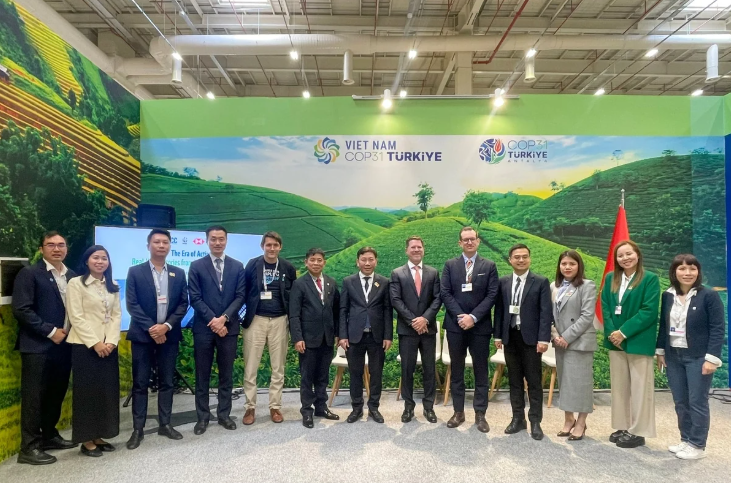 The Department of Climate Change organized the event "The Era of Action: Real-World Experiences from Businesses in Viet Nam" to share experiences, solutions, and encourage business participation in the green transition. Photo: Nga Huong.
Participants included Richard Sotney, Energy Programme Director at the World Wide Fund for Nature (WWF); Van Ngoc Thinh, CEO of WWF-Viet Nam; Tim Evans, CEO of HSBC Viet Nam; and representatives of relevant agencies and organizations.
In her opening remarks, Tran Thi Thanh Nga, Head of the Climate Change Adaptation Division at the Department of Climate Change, said the world was entering a decisive period for achieving the goals of the Paris Agreement.
According to the United Nations Environment Programme's Emissions Gap Report 2026, global temperatures could rise by as much as 2.8°C this century if current policies remain unchanged. To limit warming to below 1.5°C, global greenhouse gas emissions must fall by approximately 45% by 2035 compared with 2025 levels.
 Tran Thi Thanh Nga, Head of the Climate Change Adaptation Division at the Department of Climate Change, speaks at the event. Photo: Nga Huong.
This underscores the urgent need for countries to translate climate commitments into action and scale up emissions reduction solutions that have demonstrated practical effectiveness.
For Viet Nam, the commitment to achieving net-zero emissions by 2050, announced by the Prime Minister at COP26, has been incorporated into the National Climate Change Strategy to 2050. The energy sector alone aims to reduce greenhouse gas emissions by 91.6% by 2050 compared with the business-as-usual scenario.
To achieve this goal, Viet Nam is gradually strengthening its legal and policy framework for greenhouse gas emissions reductions and energy transition.
Resolution No. 70-NQ/TW of the Politburo on ensuring national energy security sets a target of reducing total final energy consumption by approximately 8-10% by 2030, while cutting greenhouse gas emissions from the energy sector by around 15-35% compared with the business-as-usual scenario.
Meanwhile, the 2024 Electricity Law, the revised Power Development Plan VIII, and policies promoting renewable energy and energy efficiency are laying the foundation for a green and sustainable energy transition.
 Tim Evans, CEO of HSBC Viet Nam, presents financial solutions to support Viet Nam's transition. Photo: Nga Huong.
Notably, several new mechanisms have been introduced to enable businesses to take a more proactive role in the transition. The direct power purchase mechanism under Decree No. 57/2025/ND-CP expands access to renewable electricity. Meanwhile, the 2025 amendments to the Law on Economical and Efficient Use of Energy encourage technological innovation and improved energy efficiency.
In particular, the issuance of Decree No. 29/2026/ND-CP and the launch of Viet Nam's domestic carbon trading exchange in 2026 mark important steps in developing the carbon market, providing additional economic instruments to support businesses in reducing greenhouse gas emissions.
Viet Nam is also continuing to implement the Just Energy Transition Partnership (JETP), strengthening international cooperation and mobilizing financial and technological resources to support a fair, effective, and sustainable energy transition.
According to Tran Thi Thanh Nga, the green transition is no longer simply a matter of complying with environmental regulations. It has become essential to business competitiveness and participation in global supply chains.
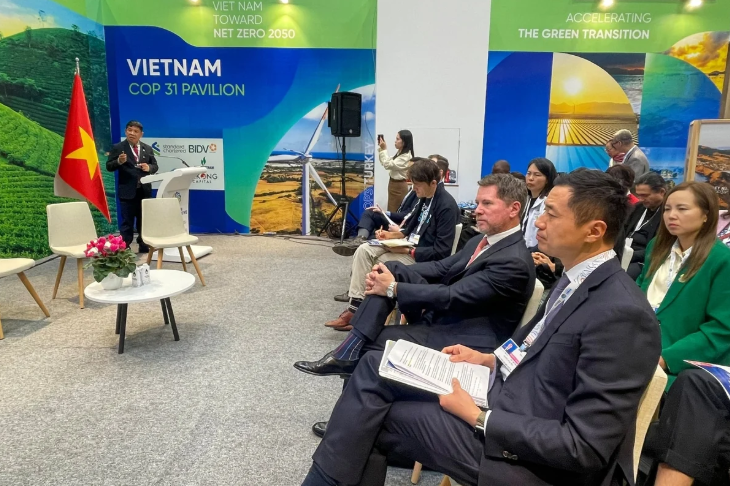 Van Ngoc Thinh, CEO of WWF-Viet Nam, presents key solutions to help businesses achieve net-zero emissions through the green transition. Photo: Nga Huong.
At the 2026 World Energy and Environment Forum in Viet Nam, government leaders also emphasized the crucial role of the business community in achieving net-zero emissions, identifying energy transition, green finance, and carbon markets as key priorities.
However, significant challenges remain in bridging the gap between policy objectives and practical implementation. Businesses face high initial investment costs, difficulties accessing technology and long-term financing, and limited capacity for greenhouse gas emissions management and inventories.
The challenge, therefore, is not only determining what businesses should do to reduce emissions, but also finding effective ways to connect policies, technologies, and financial resources to enable the transition in practice.
From this perspective, the Department of Climate Change identified three priority areas: further improving the policy framework to ensure consistency, transparency, and feasibility; promoting technological innovation and scaling up effective models; and mobilizing and efficiently utilizing financial resources.
Particular attention should be given to electrifying industrial production using low-emission electricity, improving energy efficiency, and reducing emissions throughout supply chains.
Financial institutions, development partners, and the private sector should also play a stronger role in supporting investment, sharing risks, and transferring technology, especially by helping small and medium-sized enterprises access resources for the green transition.
Tran Thi Thanh Nga stressed that the world has entered an era of implementation and concrete action. The success of climate commitments must be demonstrated through practical programmes and projects that deliver measurable and verifiable emissions reductions while providing tangible benefits to businesses and communities.
The Department of Climate Change under the Ministry of Agriculture and Environment reaffirmed its readiness to cooperate with relevant agencies, organizations, and partners in supporting businesses to implement emissions reduction solutions, contributing to Viet Nam's net-zero emissions target by 2050.
During the event, participants also shared perspectives on the green transition and opportunities for cooperation in Viet Nam.
 Justin Wu, Head of Sustainability and Climate Change for Asia-Pacific and the Middle East and North Africa (APAC & MENA) at HSBC, moderates the discussion. Photo: Nga Huong.
Dr. Nguyen Hoang Nam, Senior Policy Advisor and National Coordinator of the Climate Compatible Growth (CCG) Program, presented an overview of Viet Nam's climate transition, including progress, priorities, and opportunities for cooperation.
Le Thanh Tung from the Department of Climate Change under the Ministry of Agriculture and Environment discussed the development of infrastructure to support the implementation of Viet Nam's carbon market and its future direction.
From a financial perspective, Tim Evans, CEO of HSBC Viet Nam, outlined financing solutions to support the country's transition. Meanwhile, Van Ngoc Thinh, CEO of WWF-Viet Nam, highlighted key measures to help businesses pursue the green transition and achieve net-zero emissions.
Through expert presentations and practical discussions, the event emphasized the importance of linking policies with financial resources, technology, and business activities to turn emissions-reduction commitments into meaningful action.