Viet Nam and the UK agreed to strengthen trade cooperation in agriculture, forestry, and fisheries, promote sustainable supply chains.
On the afternoon of November 11, Deputy Minister of Agriculture and Environment Nguyen Quoc Tri held a working session with Baroness Hayman of Ullock, Parliamentary Under-Secretary of State at the Department for Environment, Food and Rural Affairs (Defra) of the UK, and her delegation.
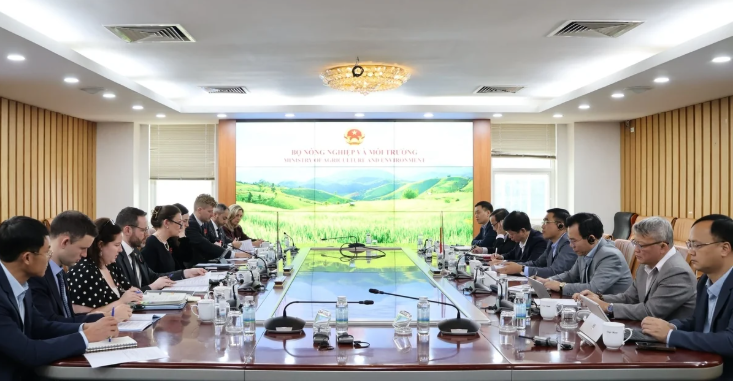 Both sides exchanged cooperation orientations in agriculture, the environment, and agricultural trade between the two countries. Photo: Trung Nguyen.
At the meeting, leaders of both sides commended recent cooperative outcomes and agreed on the need to concretize commitments within the framework of the Viet Nam-UK Comprehensive Strategic Partnership, particularly in agro-forestry-fishery trade, nature conservation, and climate change response.
According to Deputy Minister Nguyen Quoc Tri, Viet Nam possesses approximately 27 million hectares of agricultural production land with favorable conditions to develop diversified commodity agriculture. Agriculture currently contributes roughly 12% of the national GDP. In 2025, Viet Nam’s agricultural export turnover surpassed 71 billion USD. Viet Nam is eager to cooperate with the UK to leverage these comparative advantages.
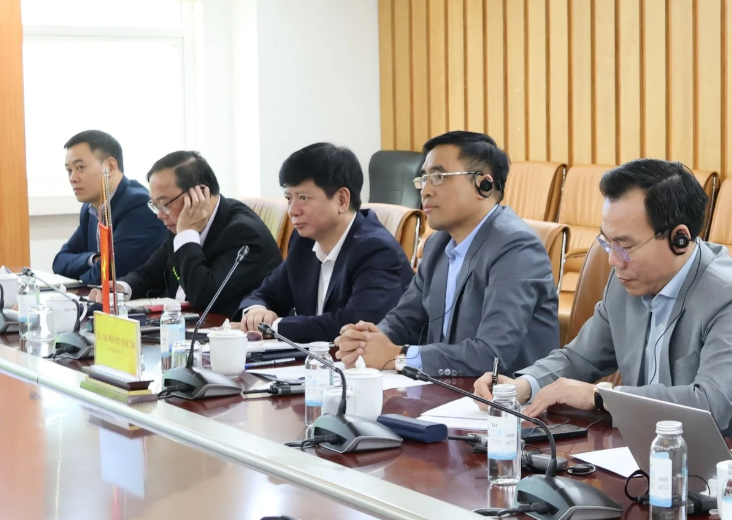 Deputy Minister Nguyen Quoc Tri shares insights on Viet Nam’s agricultural advantages. Photo: Trung Nguyen.
Highly evaluating cooperative potential with Viet Nam, the Parliamentary Under-Secretary of State noted that bilateral trade turnover between the two nations reached 1 billion USD for the first time in 2025, propelled by favorable provisions under the UK-Viet Nam Free Trade Agreement (UKVFTA) and the Comprehensive and Progressive Agreement for Trans-Pacific Partnership (CPTPP).
Notably, Vietnamese agricultural exports to the UK generated substantial value, including roughly 250 million GBP from seafood, over 200 million GBP from coffee, and more than 100 million GBP from cashew nuts. Particularly in 2026, the first shipment of Vietnamese guavas arrived at a UK port, unlocking new opportunities for Vietnamese fresh fruits to penetrate this market.
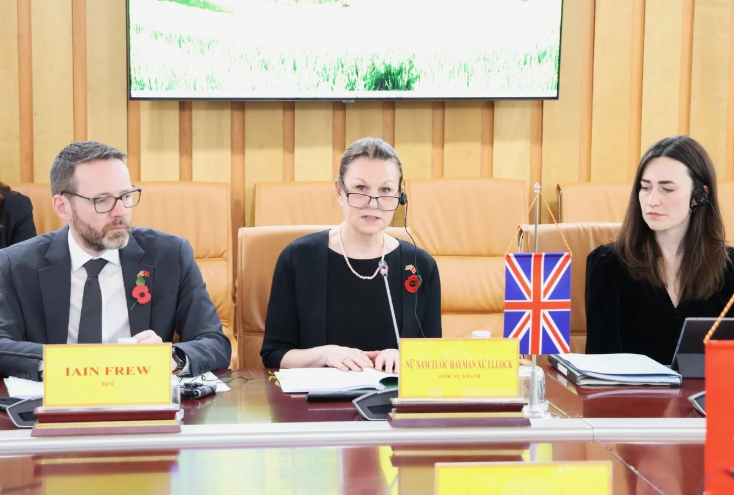 Baroness Hayman of Ullock, Parliamentary Under-Secretary of State at the UK Department for Environment, Food and Rural Affairs, notes that the two agricultural sectors are mutually complementary. Photo: Trung Nguyen.
Deputy Minister Nguyen Quoc Tri said the Ministry of Agriculture and Environment will assign specialized agencies to coordinate with the British side to review individual dossiers, identify missing elements, and process them promptly in accordance with regulations. On this occasion, Deputy Minister Nguyen Quoc Tri requested the UK side to address analogous bottlenecks regarding Viet Nam’s market-opening proposals.
Both parties also discussed establishing specialized technical working groups to resolve technical issues in agricultural trade. These groups will focus on identifying priority import-export commodities, harmonizing interpretations of quarantine, testing, and quality criteria, and facilitating business-to-business connections between the two nations.
Beyond agricultural trade, both sides dedicated time to discussing forestry cooperation, biodiversity conservation, climate change response, and sustainable development.
The Parliamentary Under-Secretary of State stated that the UK wishes to continue sharing experience, expertise, and technical assistance with Viet Nam in these areas. The British side also welcomed the Vietnamese Government’s feedback on the draft UK Forest Risk Commodities (FRC) regulation.
Regarding forest governance cooperation, the UK is formulating a new phase of collaboration with Viet Nam under the Forest Governance, Markets and Climate (FGMC) program. The program focuses on supporting forest governance, timber legality, and traceability, including the Viet Nam Timber Legality Assurance System (VNTLAS), as well as developing sustainable supply chains.
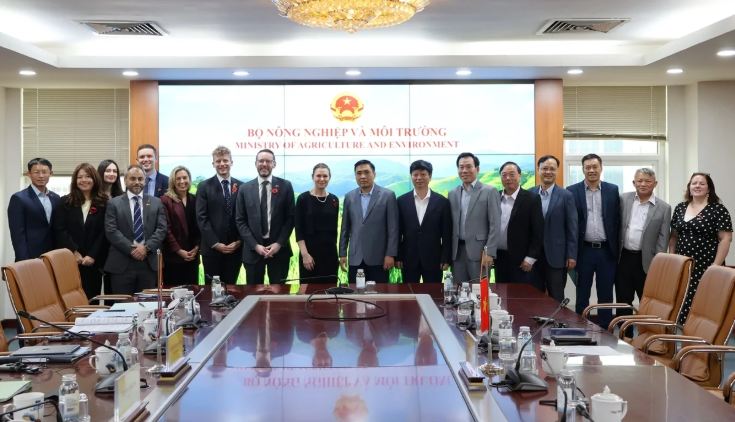 Both sides also agreed to continue promoting cooperation across diverse sectors. Photo: Trung Nguyen.
Deputy Minister Nguyen Quoc Tri expressed interest in exploring a Voluntary Partnership Agreement (VPA) with the UK, urging forestry agencies of both countries to conduct concrete exchanges to promptly determine implementation pathways. Vietnam also stands ready to share proven experiences and models, including its Payment for Forest Environmental Services (PFES) policy, which mobilizes resources for forest management and protection.
Both sides also agreed to continue advancing cooperation on just energy transition, forestry finance, climate change adaptation, food safety, and sustainable supply chain development. The core priority centers on shifting from isolated pilot projects toward scalable programs aligned with each nation’s development priorities and investment needs.