On the afternoon of April 1, Politburo Member and Secretary of the HCMC Party Committee Tran Luu Quang chaired the 5th (expanded) Conference of the 1st HCMC Party Executive Committee, term 2025-2030. The conference focused on assessing the socio-economic situation in the first quarter of 2026 and on discussing solutions for Party and political system building, as well as the orientation for agricultural and rural development in the new period.
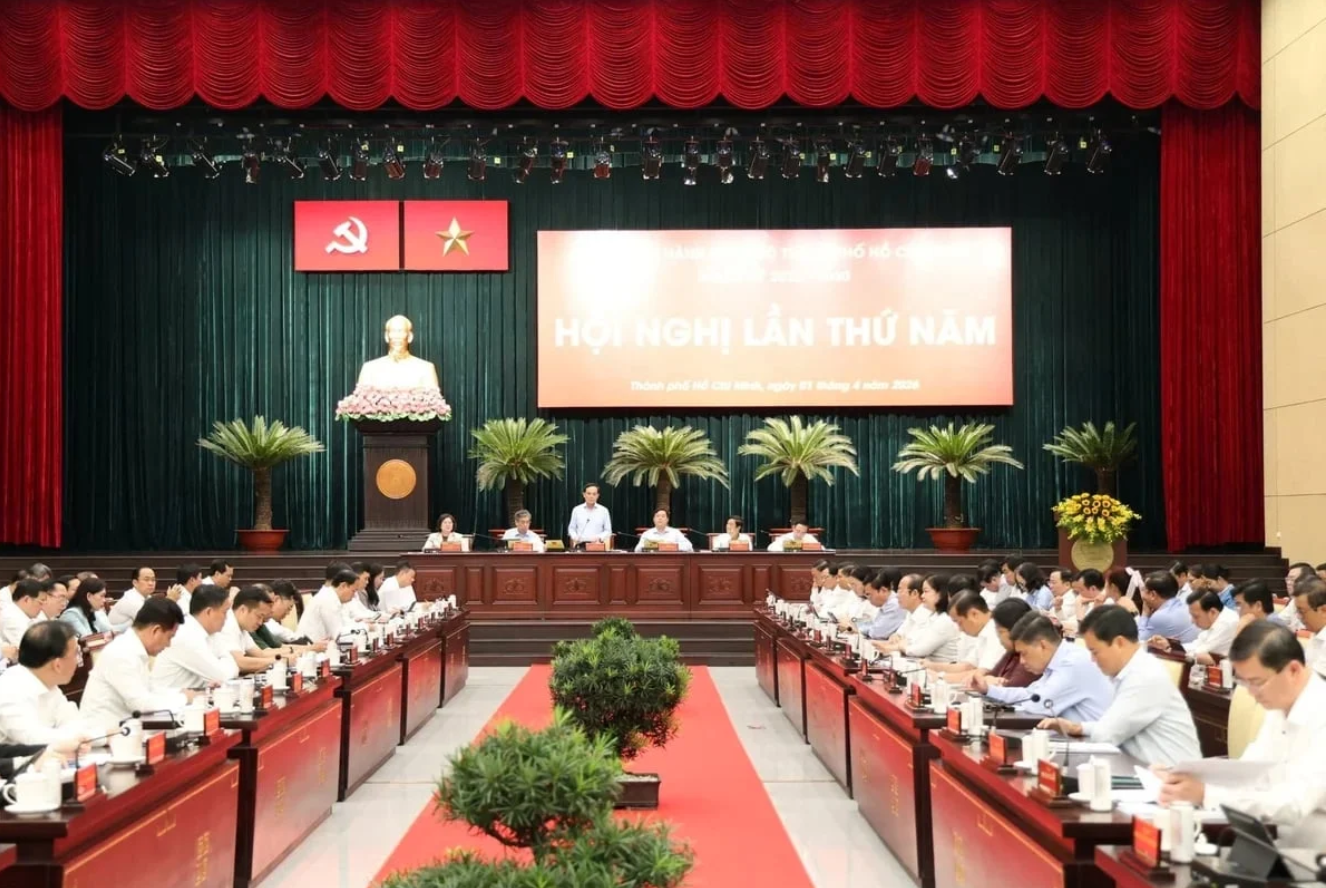 Secretary of the HCMC Party Committee Tran Luu Quang chairs the conference. Photo: Ngo Tung.
Additionally, the conference will seek feedback on the HCMC Party Executive Committee's action program regarding Resolution 19 on agriculture, rural areas, and farmers.
HCMC Party Secretary Tran Luu Quang noted that, in reality, issues of agriculture, farmers, and rural areas are rarely mentioned in HCMC. However, this sector still contributes significantly to the city's growth, especially since many areas continue to maintain agricultural production. The city's orientation is to develop high-tech agriculture, linked with post-harvest technology, based on the application of science and technology.
Leveraging the "golden window" towards sustainable growth
Presenting a paper at the conference, Director of the HCMC Institute for Development Studies Truong Minh Huy Vu stated that the global economy continues to be uncertain. Particularly, Middle East tensions have increased energy and logistics costs, creating an intertwined landscape of opportunities and challenges.
In this context, HCMC entered its first year of operating the two-tier urban government model, aiming for a GRDP growth of over 10%. In Q1/2026, the economy is estimated to grow by about 8.2%, but growth drivers are polarizing. Exports grew slowly by only 1.12%, while investment and consumption flourished with FDI reaching nearly 2.9 billion USD, new businesses increasing by 47% and total retail sales rising by 13.7%.
According to Mr. Vu, the 150-day US tariff suspension is a "golden window" for businesses to boost exports and diversify markets. However, to achieve the annual growth target of over 10%, the first six months must reach at least 10.3%, with Q2 needing to grow by over 11.5%.
The Director of the HCMC Institute for Development Studies also emphasized that, in the 2026-2030 period, institutions will be a key driver of breakthroughs, with new mechanisms helping to streamline procedures and improve the investment environment. In the long term, HCMC aims to develop a multi-center urban model, promoting new fields such as green finance, the maritime economy, and the cultural industry, and building an International Financial Center, thereby elevating its status amid the global capital shift to Asia.
Spatial restructuring towards an integrated megacity
Director of the HCMC Department of Planning and Architecture Vo Hoang Ngan stated that amid the implementation of Resolution 260, the city faces an urgent need to comprehensively restructure its development model, in which spatial planning plays a central role.
A landmark innovation is the formation of a development space following the HCMC - Binh Duong - Ba Ria Vung Tau merger, creating an integrated megacity with an entirely new scale and structure.
Accordingly, the development orientation will shift from thinking based on administrative boundaries to organizing by functional space and value chains, forming a multi-center model with tight linkages between development poles. Therein, HCMC is the financial - service - innovation center; Binh Duong is the high-tech industrial center; Ba Ria - Vung Tau is the maritime economic gateway.
The city also establishes strategic development corridors, enhances inter-regional connectivity, and orients transit-oriented development (TOD) to improve land use efficiency and quality of life.
Additionally, the planning emphasizes green infrastructure, ecological space, and climate change adaptability, while aiming for balanced development to reduce regional disparities.
"The new development space is the decisive factor for the city's future competitiveness and position. The city needs a strong shift from administrative-boundary development to functional space and value chain development.
This master plan is not just a project, but a strategic tool to reshape the entire urban development model, creating a foundation for HCMC to become a modern, smart and sustainable megacity in the region", Mr. Vo Hoang Ngan emphasized.
Launching a Venture Capital Fund
Director of the HCMC Department of Science and Technology Lam Dinh Thang said that in Q1/2026, HCMC stepped up numerous activities to promote innovation. Notably, it completed preparations to launch a public-private partnership Venture Capital Fund with a maximum state capital of 40%, having mobilized about 250 billion VND, scheduled to debut in April.
The city is also piloting new models such as UAV applications in delivery; implementing commercialization support policies for 54 products with a total capital of over 500 billion VND, of which the budget supports more than 200 billion VND. The technology trading platform has also gone into operation, connecting nearly 2,000 businesses and 150 institutes and schools, initially recording actual transactions.
Regarding investment attraction, the 2.1 billion USD AI Data Center project in Tan Phu Trung Industrial Park is expected to start construction in April. Alongside this, digital transformation continues to achieve positive results, with 432 administrative procedures digitized, the rate of online applications exceeding 88%, and 5G infrastructure covering 95% of the entire city.
In the second quarter, HCMC will focus on perfecting mechanisms and policies, launching the Venture Capital Fund, starting construction on the AI Data Center, and simultaneously continuing to attract investment and develop the innovation ecosystem.