A COP30 side event co-organized by Viet Nam, WWF, IKEA, and H&M explored how private-sector investment, green finance, and renewable energy solutions can accelerate Viet Nam’s climate commitments.
On November 11, WWF-Viet Nam, in coordination with the Ministry of Agriculture and Environment, IKEA Group, and H&M Group, co-organized a side event at the COP30 Conference with the theme "Promoting Public-Private Partnership in Implementing Climate Commitments in Viet Nam". The event opened up further cooperation opportunities to support Viet Nam in reducing greenhouse gas (GHG) emissions and enhancing resilience to climate change.
Since updating its Nationally Determined Contributions (NDC) in 2022, Viet Nam has made significant strides in shaping domestic policies and ensuring implementation efforts align with commitments to the international community.
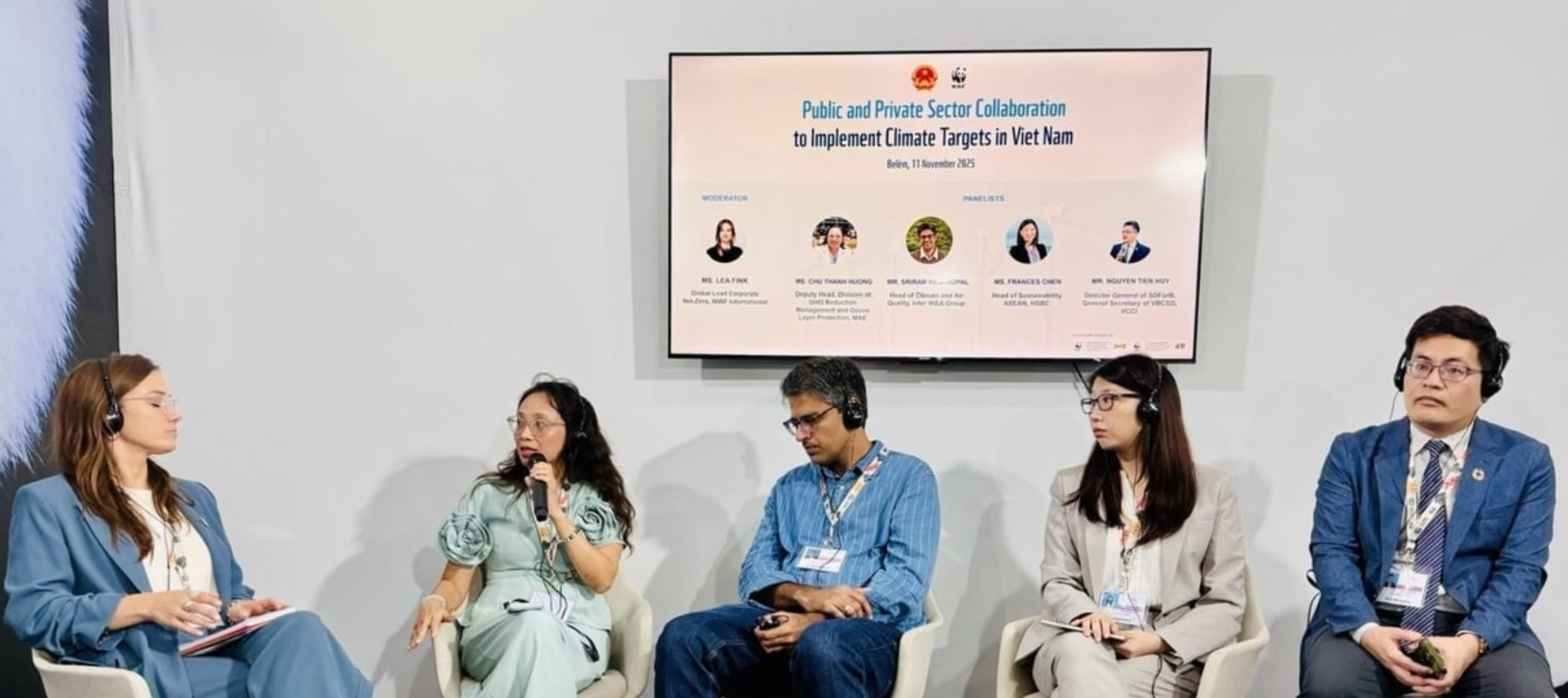 On November 11, WWF-Viet Nam, in coordination with the Ministry of Agriculture and Environment, IKEA Group, and H&M Group, co-organized a side event at the COP30 Conference with the theme "Promoting Public-Private Partnership in Implementing Climate Commitments in Viet Nam". Photo: Chu Huong.
 According to Mr. Le Ngoc Tuan, Deputy Director of the Department of Climate Change under the Ministry of Agriculture and Environment, the Government has recognized the proactive role of many domestic and international enterprises in Viet Nam in recent years. These businesses have built sustainable development strategies consistent with sustainable development goals, aiming toward the nation's carbon neutrality. Many enterprises have been pioneering investments in new technologies, optimizing resources, and transforming value chains toward greener and more circular models.
In Viet Nam, leveraging years of experience in green finance across various countries, HSBC Bank and WWF-Viet Nam have implemented numerous solutions to expand private capital flows into renewable energy applications and nature-based solutions. Through the project "Energy Transition Towards the 1.5°C Global Warming Limit," HSBC and WWF-Viet Nam have coordinated to pilot financial tools supporting innovation, accompanying domestic industries in the transition to low-carbon production models while protecting Vietnam's critical ecosystems. This approach contributes to strengthening climate resilience and emphasizes the financial sector's role in promoting the national green transition.
On the other hand, multinational corporations such as IKEA and H&M are collaborating with WWF to support the Vietnamese Government in promoting electrification solutions using renewable energy in the textile and wood processing industries. Mr. David Dahl, Head of Climate and Nature at H&M Group, stated that H&M believes electrification is the only path to achieving long-term international climate goals. By combining this solution with the use of electricity from renewable sources, the company aspires to be a living testament to the application of electrification from renewable energy and hopes to replicate this solution across the entire textile industry.
Building strong public-private partnerships is a prerequisite for mobilizing resources and promoting innovation to respond effectively to climate change challenges. In this relationship, WWF-Viet Nam plays the role of connecting national climate goals with science-based development goals of enterprises while designing cooperative initiatives that can simultaneously meet the priorities of both parties. For the 2026-2030 period, WWF-Viet Nam aims to consolidate cooperation between the Government and the private sector to promote energy transition, restore freshwater ecosystems, protect forest carbon sinks, and replicate nature-based solutions.
According to the Global Stocktake results, current efforts by the international community are insufficient to achieve the goal of limiting global temperature rise to 1.5°C. Therefore, countries need to accelerate more effective solutions rapidly to fulfill international climate commitments. This underscores the urgency of mobilizing and strengthening the participation of the private sector, as this force holds significant advantages in technology, investment capital, and innovation in the global supply chain transformation process.