Countries are integrating gender equality indicators into their Nationally Determined Contributions (NDCs) and evaluating implementation effectiveness.
On November 14, at the Viet Nam Pavilion during the 31st Conference of the Parties to the United Nations Framework Convention on Climate Change (COP31), the Department of Climate Change under the Ministry of Agriculture and Environment, in collaboration with the United Nations Entity for Gender Equality and the Empowerment of Women (UN Women), organized a side event titled “Lima Work Programme on Gender: From Global Plans to Practice.”
Participants included Ngin Lina, Secretary of State at Cambodia's Ministry of Environment; representatives of UN Women in Viet Nam and the Asia-Pacific region; the UNFCCC Regional Collaboration Centre for Asia and the Pacific; the Women's Environment and Development Organization (WEDO); the NDC Partnership (NDCP); and the Asian-Pacific Resource and Research Centre for Women (ARROW). The event also brought together representatives of government agencies, international organizations, and civil society organizations from Viet Nam, Cambodia, and Bangladesh.
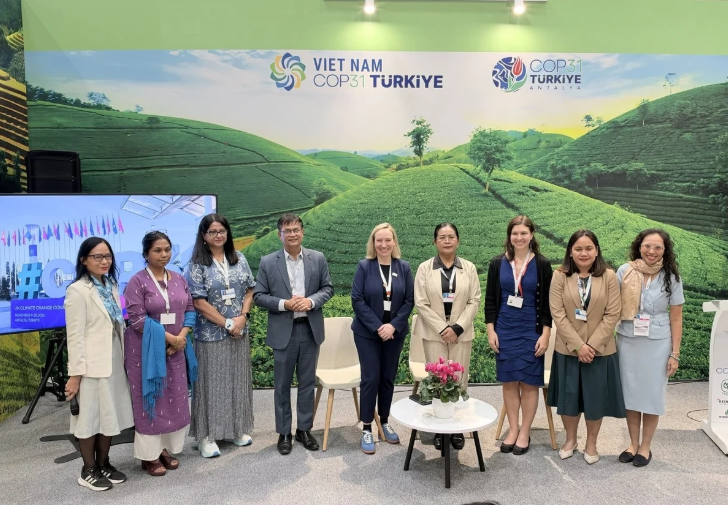 Ngin Lina, Secretary of State at Cambodia's Ministry of Environment (center, in white), joins representatives of international organizations and Vietnamese agencies at the event. Photo: Huong Linh.
COP31 marks the first conference to begin implementing the Belém Gender Action Plan (2026-2034) under the Lima Work Programme on Gender. Countries must now establish clear implementation mechanisms and measurable indicators to assess progress.
Viet Nam emphasized that equity and the principle of Common but Differentiated Responsibilities and Respective Capabilities (CBDR-RC) must translate into concrete action, with gender considerations integrated across emissions mitigation, climate adaptation, financial support, technology transfer, and capacity building.
This is essential to maintaining mutual trust among countries and ensuring fairness in achieving global climate goals.
According to Bui Duc Hieu, Deputy Director General of the Department of Climate Change, Viet Nam has committed to achieving net-zero emissions by 2050 and is implementing its National Climate Change Strategy to 2050 and National Adaptation Plan for 2021–2030, with a vision to 2050.
The country is also developing its Nationally Determined Contribution (NDC) for 2026–2035, with gender equality and social inclusion gradually being integrated into these policies.
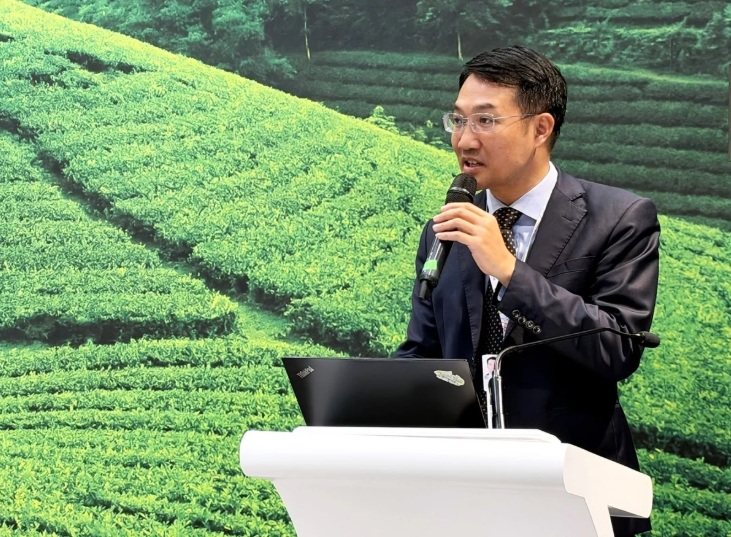 Bui Duc Hieu, Deputy Director General of the Department of Climate Change, speaks at the event. Photo: Huong Linh.
To translate these commitments into action, Viet Nam has identified 3 priorities: ensuring a just transition that creates meaningful opportunities for women to participate in and lead the green economy; introducing gender-responsive budgeting supported by data disaggregated by sex, age, and disability status; and strengthening international cooperation to improve access to climate finance for women-owned businesses.
Notably, the approach to gender equality is shifting from viewing women primarily as a vulnerable group requiring support to recognizing them as active participants in designing, implementing, and monitoring climate policies.
Sharing Cambodia's experience, Secretary of State Ngin Lina said the country conducted consultations from national to local levels while updating its Nationally Determined Contribution (NDC), with particular attention to women from disadvantaged groups.
Of the 136 key indicators used to assess NDC implementation, 131 incorporate gender equality considerations. With targets and indicators established, the next challenge is mobilizing cooperation among government agencies, development partners, and civil society organizations to turn commitments into action.
According to Julie Amoroso-Garbin, Regional Lead of the UNFCCC Regional Collaboration Centre for Asia and the Pacific, achieving gender equality in climate action requires participation across society, from local communities to national institutions.
Grassroots women's organizations, in particular, must work closely with government agencies, with continued support from development partners.
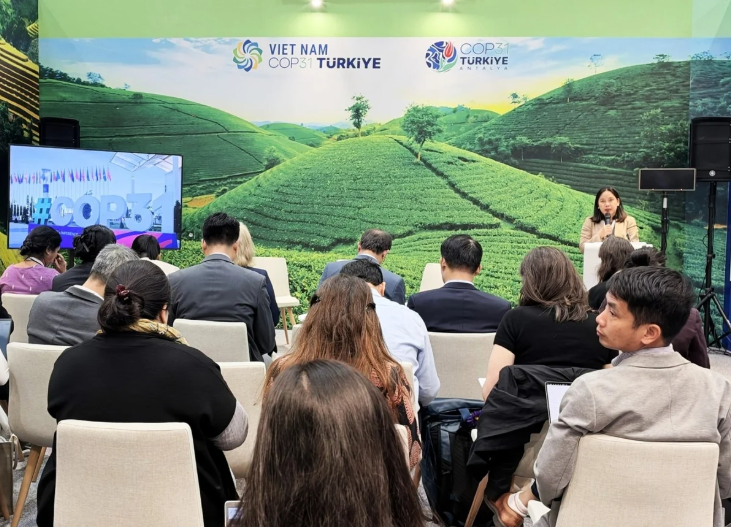 Julie Amoroso-Garbin, Regional Lead of the UNFCCC Regional Collaboration Centre for Asia and the Pacific, shares perspectives on regional cooperation. Photo: Huong Linh.
The UNFCCC Secretariat is working closely with UN Women, UNEP, and UNDP to develop a joint regional work plan. Amoroso-Garbin urged countries to use the March 2027 submission deadline for the Belém Gender Action Plan and the second Global Stocktake process to bring local experiences into global climate negotiations.
Citing a three-and-a-half-hour ministerial dialogue on climate finance in which only two countries mentioned women, girls, and gender equality, Tara Daniel from the Women's Environment and Development Organization (WEDO) argued that gender considerations remain insufficiently reflected in climate finance allocation decisions.
She emphasized that gender equality is relevant to every climate issue, as climate change affects different population groups in different ways. Countries should promptly assess existing conditions, paying particular attention to Indigenous women and those on the front lines of disaster response, to inform the development of national action plans.
Sharing results from the "EmPower: Women for Climate-Resilient Societies" programme implemented in five countries, Dilruba Haider, a UN Women representative, said the initiative had strengthened the capacity of more than 4,600 policymakers, supported 15 countries in integrating gender into climate policy frameworks, and helped over 22,000 women access green livelihood financing.
In Viet Nam alone, between 2023 and 2026, the programme mobilized USD 4.5 million for renewable energy and entrepreneurship, helped 847 women entrepreneurs access financial products, and provided skills training for more than 2,200 women.
Discussing domestic challenges, Dr. Chu Thi Thanh Huong, Deputy Head of the Emissions Management and Ozone Layer Protection Division under the Department of Climate Change and Viet Nam's National Gender and Climate Change Focal Point, noted that despite a comprehensive legal framework, the process of updating the country's Nationally Determined Contribution (NDC) had revealed significant gaps in policies, gender-related data and indicators, workforce inequalities, and implementation arrangements.
To address these challenges, Viet Nam proposed integrating seven groups of gender-responsive indicators into its NDC and measurement, reporting, and verification (MRV) system from the planning stage, rather than adding them after programmes have been implemented.
The seven groups cover employment and labour; income and green jobs; access to resources and green finance; social protection; skills and technology; participation and leadership; and gender equality in policymaking and budgeting.
 Tara Daniel, an expert from the Women's Environment and Development Organization (WEDO), offers recommendations on gender mainstreaming. Photo: Huong Linh.
Sharing Bangladesh's experience in public administration, Dharitri Kumar Sarkar, Joint Secretary at the Ministry of Environment, Forest and Climate Change, said the country uses a Climate Fiscal Framework to track climate-related spending across 25 ministries and agencies, measuring the share of funding that actually reaches women.
Bangladesh's experience shows that when empowered, women can independently manage rainwater harvesting systems in saltwater-affected coastal areas. They also account for half of the country's 78,000 cyclone response volunteers, contributing to Bangladesh's emergence as a model for climate adaptation.
From a technical assistance and international coordination perspective, Hannah Girardeau, an expert from the NDC Partnership (NDCP), commended Viet Nam's policy framework.
Looking ahead, the NDC Partnership will continue supporting Viet Nam in integrating gender considerations into its NDC implementation plan, strengthening whole-of-government coordination, incorporating gender into climate budgeting, and mobilizing private-sector resources.