The Ministry of Agriculture and Environment is finalizing a draft decree to be submitted to the Government, detailing several provisions of the Law on Environmental Protection related to Extended Producer Responsibility (EPR) for recycling products and packaging, as well as waste treatment responsibilities of producers and importers.
Clear regulations to ensure smooth implementation of EPR
According to the Ministry of Agriculture and Environment, the draft decree is being developed on the principle of not altering existing policies, while inheriting and integrating current regulations. At the same time, it introduces mechanisms to provide financial support - sourced from the contributions of producers and importers - for recycling and waste treatment activities.
Deputy Minister Le Cong Thanh said the draft clearly defines beneficiaries and forms of support, principles for managing, allocating, and disbursing financial resources, as well as procedures for implementation.
Recycling support packages will be identified for each type of product and packaging, based on the actual capacity of recycling facilities. This is intended to encourage the participation of small- and medium-sized enterprises and capable private businesses, thereby fostering a diverse, competitive, and transparent domestic recycling network.
Funding for waste treatment support will be allocated to localities based on quantitative criteria such as population size and disadvantaged areas. Provincial People’s Committees will have authority to decide on the use of funds and bear full responsibility in accordance with the law.
The draft also sets out specific regulations on the national EPR Information System, along with mechanisms for management, monitoring, and support for EPR implementation.
 Deputy Prime Minister Tran Hong Ha emphasized that the core focus of EPR policy is the circular economy - recycling waste into valuable resources. Photo: Minh Khoi/VGP.
Toward a circular economy
Speaking at a consultation meeting on December 24, Deputy Prime Minister Tran Hong Ha emphasized that waste recycling and treatment should not be understood simply as landfilling or destruction. The core objective of the EPR policy, he stressed, is to advance the circular economy - recycling waste to turn it into valuable resources.
He noted that any new policy must strictly comply with the law while carefully assessing real-world impacts and ensuring a reasonable roadmap. It is essential, he said, to avoid policy “shocks” that could disrupt production chains or create compliance difficulties for enterprises.
The drafting agency, he added, needs to fully cover all affected stakeholders, update emerging practical issues that the 2020 Law on Environmental Protection has yet to address, and propose appropriate mechanisms. He highly appreciated the participation of domestic and international business associations, stressing that this is a policy directly affecting the business community and therefore must be widely, transparently, and professionally consulted.
According to the Deputy Prime Minister, EPR is a “special and distinctive” policy tool that is supplementary in nature and does not replace existing legal waste treatment obligations. The list of EPR-covered products should prioritize waste types that are difficult to collect and treat, pose high environmental risks, and then be gradually expanded over time.
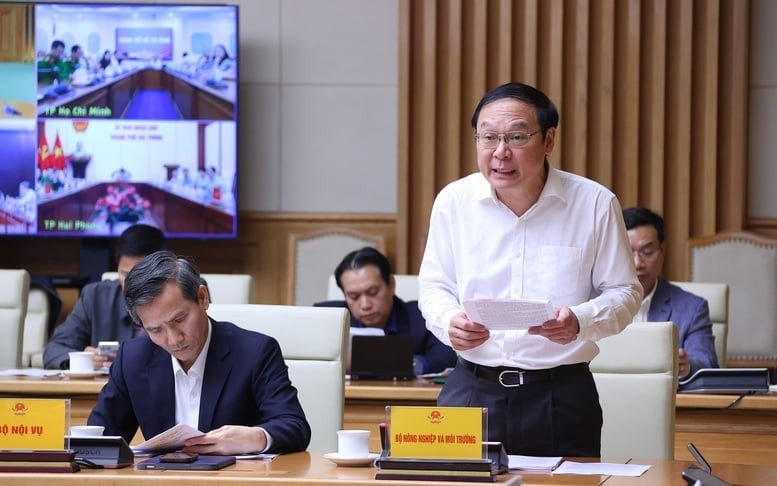 Deputy Minister of Agriculture and Environment Le Cong Thanh delivers a report at the meeting on December 24. Photo: VGP/Minh Khoi
In the long run, EPR aims to encourage businesses and consumers to shift toward environmentally friendly products, gradually phasing out unsuitable products and promoting sustainable consumption behavior.
He also stressed that EPR funds must be managed based on the principles of voluntariness, transparency, and openness, and must not be administratively managed like the state budget. The State will not impose rigid spending quotas or establish new administrative bodies. Instead, “those who contribute funds must have the right to participate in decision-making and monitoring fund usage,” through a council that includes businesses and relevant stakeholders.
Only when responsibilities, beneficiaries, and operational mechanisms are clearly defined, he said, can EPR truly become an effective tool that links producer and consumer responsibility to the entire product life cycle and meaningfully protects the environment.
Clarifying concepts and aligning responsibilities with capacity
At the meeting, representatives of associations such as VAMA, PRO Viet Nam and VBA proposed clarifying key concepts related to collection and recognition of recycled products; ensuring transparency in EPR fund management; and clearly defining principles for calculating FS fees, while avoiding simultaneous adjustments of mandatory recycling rates and fees within the same year.
Associations also recommended early policies to support domestic recycling infrastructure development and expand incentives for businesses that pioneer waste reduction initiatives and recycled material use.
Dr. Phung Chi Sy suggested clearly distinguishing between “waste” and “scrap materials” to avoid legal complications, while also ensuring smoother mechanisms for EPR funds to support businesses.
From the local perspective, Pham Nam Son, Director of the Da Nang Department of Agriculture and Environment, welcomed exemption provisions for small businesses (with revenue under VND 30 billion) and the flexibility allowing multiple EPR compliance options. However, he noted that calculation formulas, documentation requirements, and emission auditing remain technically complex and require detailed guidance and training.
Many localities expressed concern about potential gaps between legal requirements and actual recycling capacity - particularly for batteries, electronic devices, and vehicles. A representative of Hai Phong recommended carefully reviewing regulations on end-of-life vehicles and enhancing resource allocation down to commune-level authorities.