At GX Week, Deputy Minister Le Cong Thanh emphasized that green transformation is an essential requirement in Vietnam’s efforts to reform growth model.
From April 18-21, a delegation from the Ministry of Agriculture and Environment, led by Deputy Minister Le Cong Thanh, attended Green Transformation Week (GX Week) in Yeosu, South Korea.
GX Week is an important global cooperation forum that promotes green transformation, bringing together leaders from governments, international organizations, businesses, and stakeholders from many countries to exchange solutions to address climate change, protect the environment, and transform growth models.
Within the framework of the event, Deputy Minister Le Cong Thanh participated in and delivered remarks at the High-level Policy Dialogue on Energy Transition (April 20), where he shared Viet Nam’s orientations and policies to promote green transformation in association with ecological agriculture development, circular economy, natural resource management, and environmental protection.
Viet Nam is prioritizing a clean, sustainable energy transition, treating energy efficiency and conservation as the “first source of energy.” At the same time, the country is promoting sustainable forest protection and development, advancing the circular economy, and gradually establishing a domestic carbon market. In addition, Viet Nam is focusing on low-emission, ecosystem-based agriculture, as well as effectively mobilizing green finance, technology, and human resources for the transition process.
The Deputy Minister reaffirmed Viet Nam’s strong commitment to achieving sustainable development goals, while emphasizing the essential role of international cooperation in sharing technology, experience, and resources, thereby advancing a more equitable, inclusive, and effective global green transition.
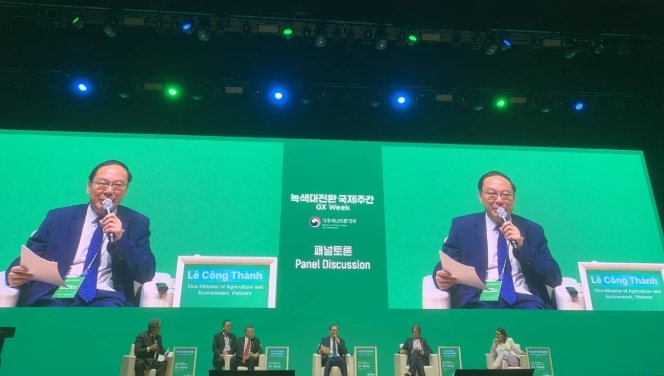 Deputy Minister Le Cong Thanh participates in discussions at the High-level Policy Dialogue on Energy Transition. Photo: ICD.
The delegation actively participated in thematic discussions on climate change, clean energy, industrial transformation, and sustainable finance, while exchanging experiences and updating on emerging trends, models, and advanced technological solutions in the fields of environment and sustainable development.
On the sidelines of the event, Deputy Minister Le Cong Thanh visited and worked at the Busan Resource Circulation Center (BRC) to learn about the city’s exemplary model of waste management and circular economy development.
At the center, the delegation was given an overview of its operations, notably its system for coordinating, collecting, and analyzing waste data, as well as connecting recycling and treatment facilities with businesses involved in the resource circulation chain. The BRC model clearly reflects the concept that “waste is a resource,” where waste is sorted, recycled, and transformed into materials or energy to support urban development.
In addition to the technical aspects, the delegation also explored community education programs, public awareness campaigns, and experiential activities aimed at promoting green, zero-waste lifestyles among young people.
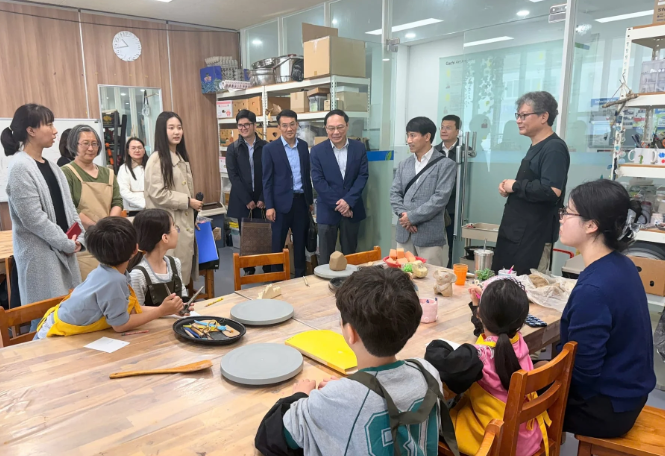 Deputy Minister Le Cong Thanh visits the Busan Resource Circulation Center. Photo: ICD.
Subsequently, Deputy Minister Le Cong Thanh held a working session with Mr. Kim Young Ki, Acting President of the Korea Environmental Industry and Technology Institute (KEITI). At the meeting, both sides reaffirmed their increasingly close partnership, reflected through frequent high-level exchanges. The Deputy Minister highly appreciated KEITI’s role in providing technical assistance, actively supporting Viet Nam in institutional development, sharing policy experience, and promoting the implementation of specific environmental projects.
Notable cooperation outcomes include support in sharing experience in developing and refining legal frameworks, including the Law on Water Resources and the revised Law on Environmental Protection; assistance in building and implementing Extended Producer Responsibility (EPR); and proposals for developing a Resource Recycling Industrial Park project. Both sides agreed to continue implementing the 2023 Memorandum of Understanding, particularly in the areas of circular economy, climate change, and waste management.
Viet Nam proposed that KEITI continue supporting experience sharing to further improve the revised Law on Environmental Protection, and to develop key projects such as recycling industrial parks, waste-to-energy initiatives, and emission reduction programs involving Korean-invested enterprises in Viet Nam.
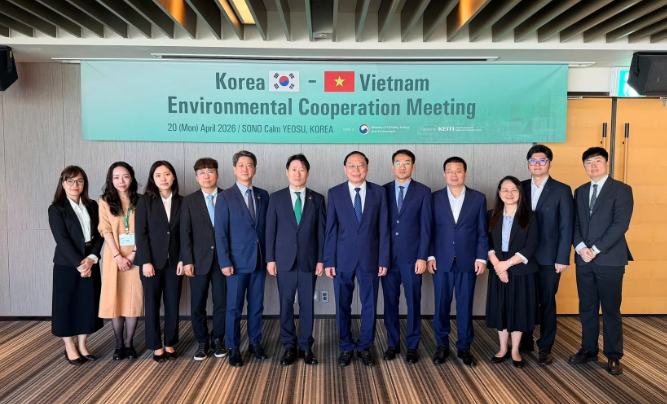 Deputy Minister Le Cong Thanh holds a working session with Mr. Kim Young Ki, Acting President of the Korea Environmental Industry and Technology Institute (KEITI). Photo: ICD.
In the field of water resources, both sides emphasized the importance of water security, river basin management, and the application of digital data systems. They also proposed directions for developing projects related to the management and treatment of marine waste, as well as electronic waste and electric vehicle batteries, pressing issues of shared concern for both countries. The meeting concluded with a commitment to strengthening substantive cooperation toward the sustainable development goals of both nations.
The delegation also took part in exhibitions showcasing green technologies and solutions, thereby gaining insights into innovative models and promoting connections between Vietnamese authorities, businesses, and international partners.