Viet Nam and Brazil discussed addressing technical barriers, expanding agricultural market access, and fostering cooperation in processing, science and technology, and biofuels.
On November 11 in Hanoi, Deputy Minister of Agriculture and Environment Nguyen Hoang Hiep received Brazilian Ambassador to Viet Nam Marcelo Paz Saraiva Câmara and his delegation. During the meeting, the Deputy Minister welcomed the positive development of bilateral cooperation, particularly since the two countries upgraded their relationship to a Strategic Partnership in November 2024.
 Deputy Minister of Agriculture and Environment Nguyen Hoang Hiep speaks at the meeting. Photo: Mai Dan.
Viet Nam and Brazil have complementary strengths in agricultural, forestry, and fisheries trade. Viet Nam imports corn, soybeans, cotton, beef, poultry, and animal feed ingredients from Brazil, while exporting seafood, rubber, coffee, pepper, cashews, rice, tropical fruits, and processed agricultural products.
“Bilateral agricultural, forestry, and fisheries trade reached approximately USD 3.54 billion in 2025 and USD 3.09 billion in the first nine months of 2026. Both sides have actively cooperated on quarantine, food safety, and market access,” the Deputy Minister said.
However, Hiep noted that significant potential remains untapped due to trade imbalances and unresolved technical barriers. Opportunities also exist in investment, deep processing, technology, environmental protection, and climate change adaptation.
Regarding market access, he requested Brazil to provide phytosanitary requirements and market demand information for Vietnamese durian, mangosteen, pomelo, and passion fruit, helping Viet Nam prioritize products for market access applications. He also called for continued facilitation of rice, coffee, and processed agricultural exports.
For seafood, Viet Nam urged Brazil to finalize heat-treatment regulations and exporter registration procedures for processed shrimp, resolve import code issues for phosphate-treated shrimp in line with Codex standards, and consider allowing whole shrimp imports.
For pangasius, Hiep proposed reviewing, revising, or removing unnecessary physicochemical testing requirements to align with international standards and reduce customs clearance costs. Regarding tilapia, both sides should address import restrictions through transparent, consistent, and risk-based regulations.
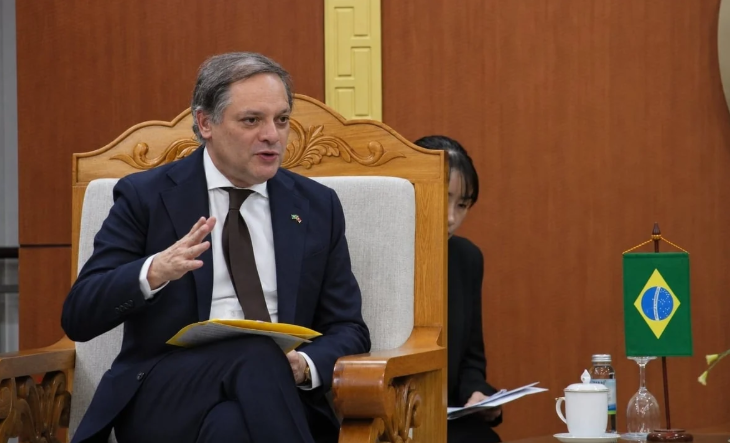 Brazilian Ambassador to Viet Nam Marcelo Paz Saraiva Câmara speaks at the meeting. Photo: Mai Dan.
Ambassador Marcelo Paz Saraiva Câmara said Brazil is finalizing its review of regulations on phosphate-treated frozen fish, including pangasius. Brazil is also ready to accept heat treatment at 100°C for six seconds for cooked shrimp. He acknowledged Viet Nam's request regarding whole shrimp and pledged to forward it to the relevant Brazilian authorities.
Deputy Minister Nguyen Hoang Hiep said that in early November 2026, Vietnamese authorities agreed on a veterinary health certificate template for Brazilian beef and red offal. Applications from exporting establishments remain under review, while other products, particularly bovine meat and bone meal, require careful disease risk assessments.
Beyond trade, Hiep proposed closer cooperation between research institutions and businesses in technology transfer, crop breeding, biotechnology, livestock, aquaculture, and low-emission agriculture. Improving coffee quality and expanding deep processing were identified as immediate priorities.
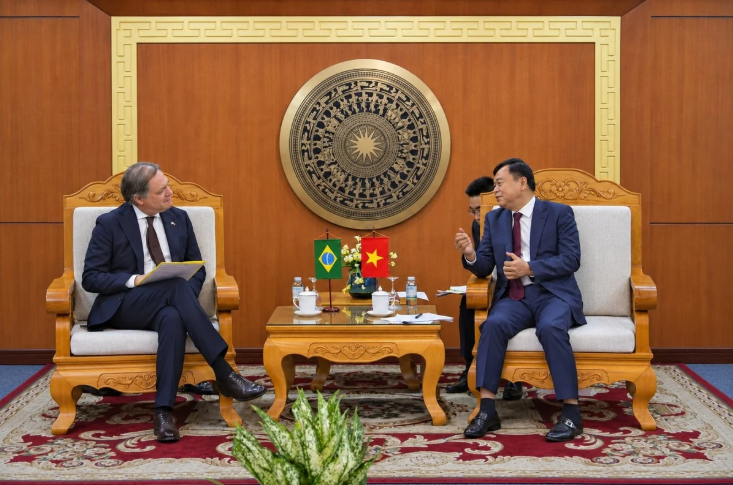 Deputy Minister Nguyen Hoang Hiep discusses expanding bilateral agricultural market access with Brazilian Ambassador to Viet Nam Marcelo Paz Saraiva Câmara. Photo: Mai Dan.
The Brazilian Ambassador emphasized that strengthening business connections, particularly in the food sector, is a key priority of his tenure. Brazil is ready to support Viet Nam's ethanol production through technology transfer and supply cooperation, while facilitating partnerships with the Brazilian Agricultural Research Corporation (Embrapa).
Deputy Minister Hiep also expressed interest in exchanging expertise on biodiversity conservation, tropical forest restoration, satellite-based deforestation monitoring and wildfire early warning systems, as well as cooperation in biofuels, low-carbon agriculture, and carbon markets.