Viet Nam and the United Kingdom have significant potential to expand agricultural trade cooperation, particularly through market expansion, stronger business linkages, and the development of sustainable supply chains.
On the morning of 12 November, in Hanoi, the British Embassy and Viet Nam’s Ministry of Agriculture and Environment jointly organised the “United Kingdom - Viet Nam Bilateral Agri-Food Trade Seminar” on the occasion of the visit to Viet Nam by Baroness Hayman of Ullock, Parliamentary Under-Secretary of State at the UK Department for Environment, Food and Rural Affairs (Defra).
In his opening remarks, British Ambassador to Viet Nam Iain Frew said that agriculture and food already matter a great deal to the UK-Viet Nam relationship. Two-way agri-food trade is now over $1bn.
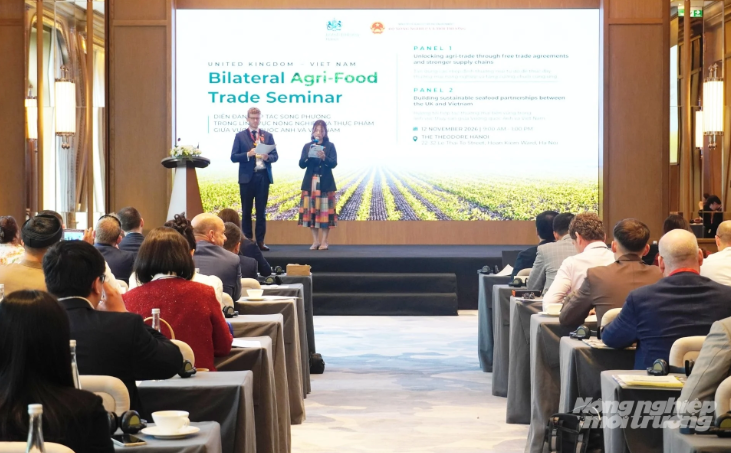 Overview of the “United Kingdom - Viet Nam Bilateral Agri-Food Trade Seminar”. Photo: Hong Tham.
Viet Nam is a major exporter of coffee, cashews, rice and seafood. These products, and newer ones from guavas to basa catfish fillets, are increasingly familiar to consumers in the UK.
“British products are also gaining ground here. Over my four years as Ambassador, I have seen the commercial relationship grow. More British products are reaching Vietnamese consumers. More companies are building partnerships. And our governments are working together to remove barriers that make trade harder than it needs to be”, British Ambassador to Viet Nam Iain Frew added.
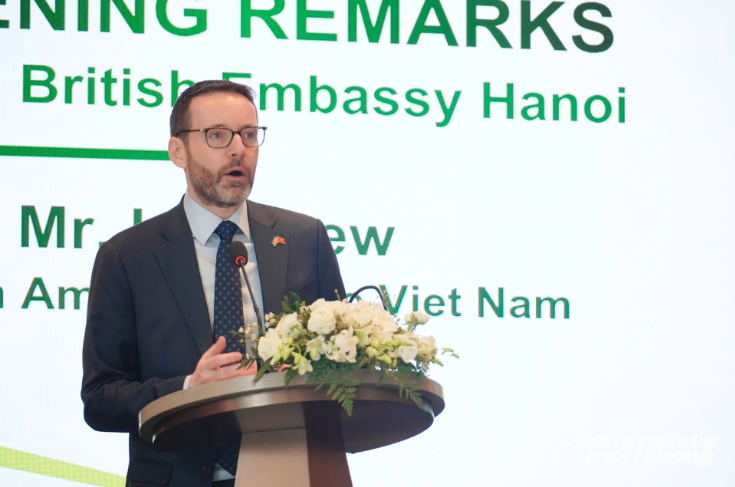 British Ambassador to Viet Nam Iain Frew said that bilateral trade in agricultural and food products between the UK and Viet Nam has now exceeded USD 1 billion. Photo: Hong Tham.
Baroness Hayman of Ullock, Parliamentary Under-Secretary of State at the UK Department for Environment, Food and Rural Affairs (Defra), said that the UK and Viet Nam share a strong and enduring partnership, underpinned by mutual respect.
We are also both nations with a strong heritage in forestry, farming, fisheries and food production and we have a shared vision of a prosperous and sustainable future for these industries.
Our trade in agricultural, food and drink is mutually beneficial and has gone from strength to strength.
The UK-Viet Nam Free Trade Agreement and our shared membership of the Comprehensive and Progressive Agreement for Trans-Pacific Partnership offer significant opportunities to grow bilateral trade and build stronger, more resilient supply chains.
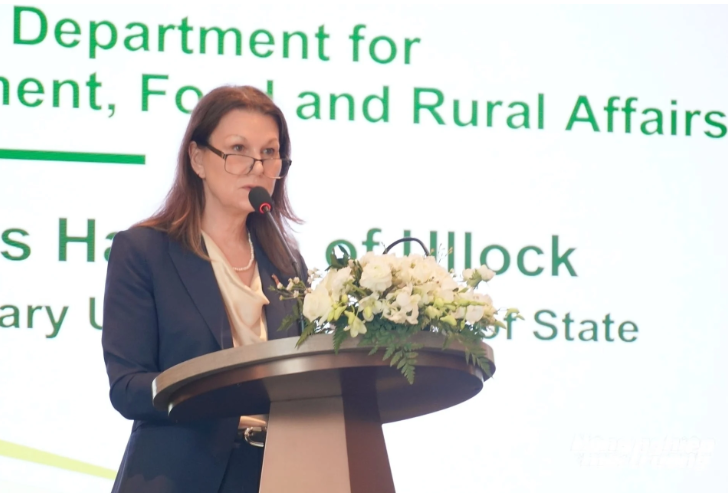 Baroness Hayman of Ullock, Parliamentary Under-Secretary of State at the UK Department for Environment, Food and Rural Affairs (Defra), highlighted the complementary strengths of the two countries. Photo: Hong Tham.
Our strengths complement one another: The UK offers high-quality food and drink, rigorous traceability and food-safety controls. Viet Nam also values high-quality, safe and nutritious food and plays a very valuable role in UK food security and consumer choice through products including seafood, coffee, nuts, spices and rice.
“Together, we can go further - not simply selling more but combining these strengths in more resilient supply chains”, Baroness Hayman of Ullock, Parliamentary Under-Secretary of State at the UK Department for Environment, Food and Rural Affairs (Defra) emphasized.
Mr Pham Ngoc Mau, Deputy Director General of the International Cooperation Department under Viet Nam’s Ministry of Agriculture and Environment, said that Viet Nam and the United Kingdom have long enjoyed friendly and cooperative relations. The elevation of bilateral ties to a Comprehensive Strategic Partnership in October 2025 marked a new phase in their relationship, providing a favorable foundation for deeper, more substantive and effective cooperation across all sectors, including agriculture, trade and sustainable development.
Agriculture is an area of considerable potential in bilateral economic and trade relations, with the two countries possessing complementary strengths. Viet Nam has advantages in producing and exporting tropical agricultural products, seafood, timber and wood products, coffee, pepper, cashew nuts, and fruit and vegetables. Meanwhile, the UK has strengths in technology, science, supply chain management and high-value agricultural products.
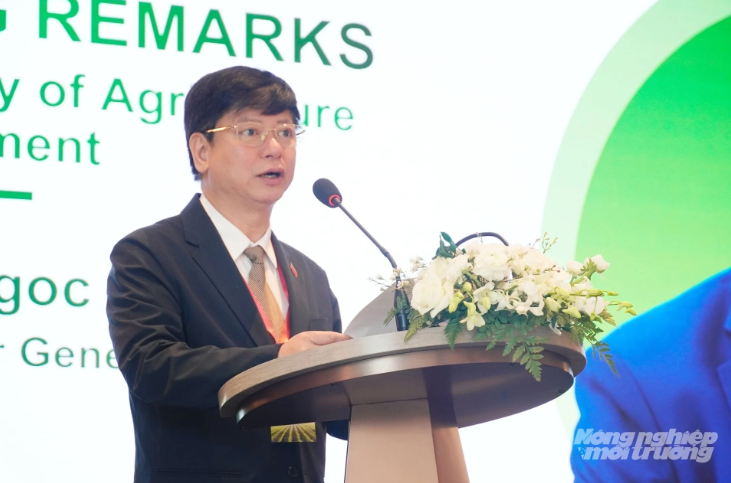 Mr Pham Ngoc Mau, Deputy Director General of the International Cooperation Department under Viet Nam’s Ministry of Agriculture and Environment, said that bilateral agricultural trade continues to grow, although significant untapped potential remains and needs to be harnessed more effectively. Photo: Hong Tham.
In 2025, Viet Nam’s exports of agricultural, forestry and fishery products to the UK reached USD 1.09 billion, up 20%, while imports stood at USD 74 million, up 33%. During the first nine months of 2026, exports reached USD 850 million, up 1%, while imports totaled USD 56 million, an increase of 1.2% year-on-year. These figures demonstrate that bilateral agricultural trade continues to grow, although substantial untapped potential remains.
“An important foundation for realising this potential is the UK-Viet Nam Free Trade Agreement (UKVFTA) and the Comprehensive and Progressive Agreement for Trans-Pacific Partnership (CPTPP). These agreements have created favourable conditions for tariff reductions, market access and cooperation between the business communities of both countries. We need to continue making effective use of these commitments to expand markets, diversify products, enhance competitiveness and increase the value of agricultural trade”, Mr Mau emphasised.
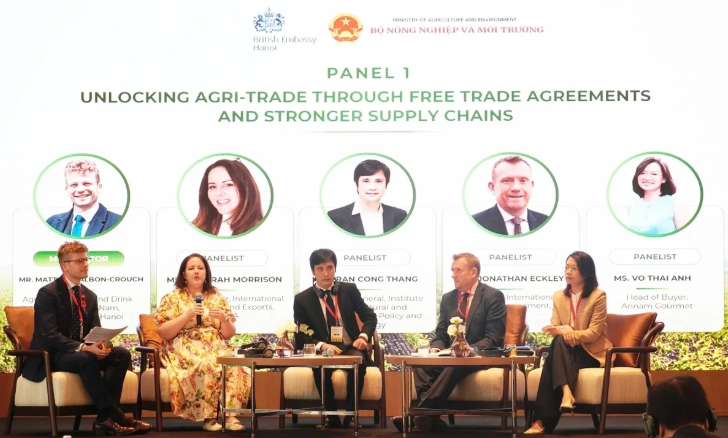 Panel discussion: Unlocking Agri-Trade through free trade agreements and stronger supply chains. Photo: Hong Tham.
To further promote stronger and more sustainable agricultural trade between Viet Nam and the UK, the Deputy Director General outlined four key priorities for cooperation.
First, strengthen market access and facilitate trade. Both sides should continue working closely to address issues relating to animal and plant quarantine, food safety, technical standards and trade barriers. They should also enhance information exchange and transparency in import and export regulations, facilitating access to each other's markets for high-quality agricultural products.
Second, enhance business connectivity and develop agricultural value chains. Mr Mau called on industry associations, businesses and distributors from both countries to strengthen exchanges, establish direct connections and explore opportunities for cooperation in production, processing, preservation, logistics and distribution. In particular, greater efforts are needed to bring high-quality Vietnamese agricultural products with established brands and clear origins into UK supermarkets, retail chains and distribution networks, while also facilitating the expansion of competitive UK products in the Vietnamese market.
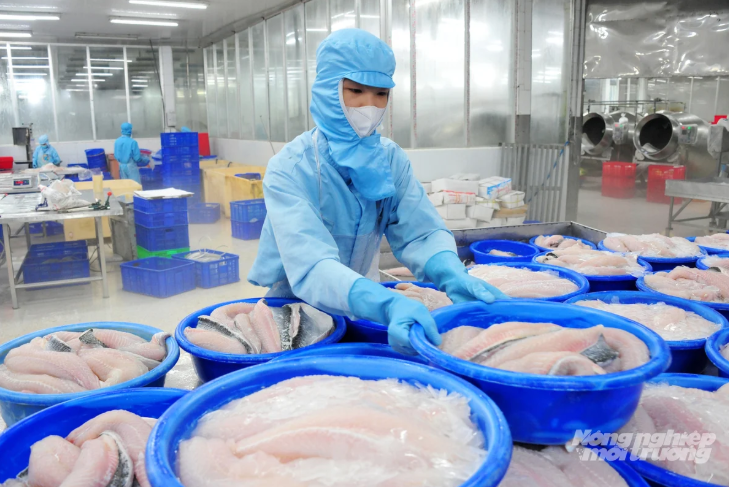 In the first nine months of 2026, Viet Nam’s exports of agricultural, forestry and fishery products to the UK reached USD 850 million, up 1% year-on-year. Photo: NNMT.
Third, improve product quality, standards and added value. Businesses in both countries should prioritize investment in advanced processing technologies, traceability and food safety, while meeting environmental and sustainability standards and responding to increasingly diverse consumer preferences. These factors are essential to enhancing competitiveness and establishing a lasting position for agricultural products from both countries in international markets.
Fourth, expand cooperation in investment, science and technology, and the green transition in agriculture. Viet Nam seeks stronger cooperation with UK partners to apply science and technology, promote innovation, develop low-emission agriculture and the circular economy, advance digital transformation, and establish sustainable production models. Such cooperation would not only boost trade but also strengthen production capacity, product quality and the resilience of the agricultural sectors in both countries.