On December 12-13, 2025, the Viet Nam Marine Economic Sustainable Development Forum 2025 was held in Quang Ninh province, a locality considered a successful example of the transition from a "brown economy" to a green growth model.
The event, organized by the Ministry of Agriculture and Environment in coordination with the Central Policy and Strategy Committee and the People's Committee of Quang Ninh province, was attended and directed by Deputy Prime Minister Tran Hong Ha and experts and organizations from both domestic and international backgrounds. This was not only a forum to assess the results after 7 years of implementing Resolution 36/NQ-TW and 5 years of implementing Resolution 26/NQ-CP on sustainable marine economic development, but also a starting point for strategic orientation for the new development phase up to 2030 and a vision for 2045.
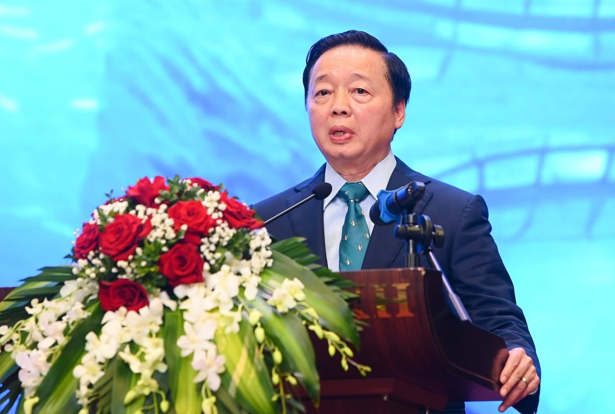 Deputy Prime Minister Tran Hong Ha speaking at the forum.
Maritime economy: a strategic development space for the nation
Speaking at the forum, Deputy Prime Minister Tran Hong Ha emphasized: The maritime economy is not simply a combination of industries related to the sea, but a strategic development space directly related to economic growth, ensuring livelihoods for tens of millions of people, maintaining national sovereignty, and enhancing Viet Nam's position in the region and internationally.
After more than 7 years of implementing Resolution No. 36-NQ/TW on the Strategy for Sustainable Development of Viet Nam's Marine Economy to 2030, with a vision to 2045, and 5 years of implementing Government Resolution No. 26/NQ-CP, the understanding of the role of the sea has fundamentally changed. Many coastal localities have gradually adjusted their development models, paying more attention to environmental protection, ecosystem restoration, and linking economic development with resource conservation.
Undeniably, Viet Nam's maritime economy has achieved significant results: the policy and legal system has been gradually improved; coastal infrastructure, seaports, and logistics have been invested in; and sectors such as marine tourism, aquaculture, and maritime services continue to make a major contribution to growth.
However, the forum also frankly pointed out existing limitations. In many areas, marine economic development remains heavily focused on exploitation, lacking regional and inter-sectoral linkages; marine environmental pollution, plastic waste, and biodiversity loss remain major challenges. In particular, scientific and technological capacity, marine data, and financial resources are still bottlenecks for emerging fields such as offshore renewable energy, high-tech aquaculture, and the marine carbon economy.
According to Deputy Prime Minister Tran Hong Ha, without a change in mindset and approach, Viet Nam will find it difficult to fully utilize the enormous potential of its seas. Developing the marine economy in the coming period needs to shift strongly towards a model based on knowledge, technology, modern governance, and scientific data, instead of relying solely on the exploitation of existing resources.
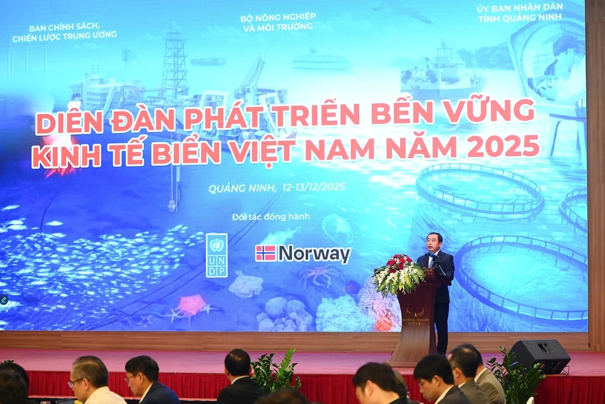 Minister of Agriculture and Environment Tran Duc Thang speaks at the forum.
No country can stand outside of international cooperation
A recurring message emphasized at the forum was that no single nation can solve ocean challenges alone. The sea has no hard borders, and issues such as climate change, sea-level rise, ocean acidification, plastic pollution, and ecosystem degradation are all global in nature.
In this context, international cooperation is not just an option, but a prerequisite. International partners, development organizations, research institutions, and foreign business communities are expected to continue to work alongside Viet Nam in technology transfer, data sharing, financial support, and capacity building in marine governance.
Deputy Prime Minister Tran Hong Ha emphasized that Viet Nam is ready to participate more deeply in regional and global initiatives on ocean protection, blue economy development, ensuring freedom of navigation, and sustainable use of marine resources. This is both a responsibility and an opportunity for Viet Nam to affirm its role as a responsible, proactive, and integrated coastal nation.
Regarding the development of marine economic sectors, he agreed with the view of promoting high-tech aquaculture, a field that can be combined with tourism and opens up great prospects in the context of challenges facing traditional agriculture.
He hopes that European partners, especially Norway, will support Viet Nam with technology and investment mechanisms to help improve its capacity for sustainable assessment and exploitation of marine resources.
Regarding offshore wind power, he suggested that international organizations collaborate with the Government. The Minister of Agriculture and Environment will connect with PVN to implement several pilot projects, from surveying, exploration, and planning to technology investment, with the commitment and responsibility of the Government, businesses, and financial institutions.
The development of the marine economy must be based on a foundation of sustainable governance
Speaking at the Forum, Minister of Agriculture and Environment Tran Duc Thang stated that sustainable marine economic development is a long-term process requiring steadfast thinking, consistency in policy, and decisive implementation. According to the Minister, the achievements made so far are commendable, but only represent the initial steps compared to the potential and requirements.
Minister Tran Duc Thang emphasized that Viet Nam's marine economy is facing great opportunities but also many intertwined challenges, especially the increasingly evident impacts of climate change, resource degradation, marine environmental pollution, and pressure for coastal development. Without a strong shift towards an integrated governance model based on science, technology, and data, the risk of unsustainable development is very clear.
According to the Minister, one of the key tasks in the coming period is to perfect the institutional framework for integrated management of marine and island resources and the environment, ensuring consistency between marine spatial planning, coastal zone planning, and sectoral planning. This is a prerequisite for avoiding conflicts of interest, efficiently utilizing resources, and creating long-term development opportunities for marine economic sectors.
Minister Tran Duc Thang also affirmed that the Ministry of Agriculture and Environment will continue to closely coordinate with ministries, sectors, and localities in promoting marine economic sectors towards green, circular, and low-emission directions; while strengthening the capacity for monitoring, forecasting, and supervising the marine environment, proactively responding to natural disaster risks, sea level rise, and extreme weather phenomena.
In particular, the Minister emphasized the role of science and technology and human resources in the development of the marine economy. The marine economic growth model, suitable for the new context, is based on science and technology, data, and innovation. Simultaneously, it requires the synchronized development of the marine economic ecosystem, including infrastructure, energy, logistics, coastal cities, human resources, and centers for ocean research and forecasting. Furthermore, it is necessary to enhance modern marine governance with effective and efficient institutions, advanced monitoring, pollution control, and ecosystem restoration.
Shaping a modern marine economic ecosystem
One of the key themes of the forum was the orientation towards building a modern marine economic ecosystem, in which economic sectors, development spaces, and infrastructure systems are synchronously connected. Accordingly, marine economic development cannot be separated from marine spatial planning, integrated coastal zone management, and ecosystem conservation.
The key areas identified as drivers for the coming period include: offshore renewable energy, especially wind power; high-tech aquaculture; logistics and maritime services; high-quality marine tourism; and a circular economy linked to marine environmental protection. Simultaneously, there is a need to improve the quality of human resources, invest in marine science research, and apply digital technology in resource management and monitoring.
The forum also emphasized the role of coastal localities in proactively innovating their thinking, strengthening regional linkages, and avoiding fragmented and localized development. Sustainable marine economic development is only possible when economic, social, and environmental benefits are harmonized, and coastal residents benefit and become key players in the development process.