On September 29 in Hanoi, the United Nations Entity for Gender Equality and the Empowerment of Women (UN Women), in collaboration with the United Nations Environment Programme (UNEP), held the EmPower Partner Dialogue on Promoting Gender Equality in Climate Change Response.
The event was held as part of a joint monitoring mission by UN Women’s Asia-Pacific Regional Office, UNEP and development partners to identify priorities for collaboration in 2026–2027 and prepare for the program’s next phase in Viet Nam.
Three criteria measuring gender mainstreaming effectiveness
According to UN Women, during Phase I of the EmPower program (2018-2022), 11 policies incorporating gender considerations were adopted, more than 1,000 women received support to develop renewable energy-based livelihood models, and more than 50 civil society organizations and Women’s Union officials strengthened their professional capacity.
In Phase II (2023–2027), the program focuses on gender-responsive climate risk governance, promoting women’s leadership and participation in decision-making on climate change and disaster risk reduction, and supporting climate-resilient livelihood models.
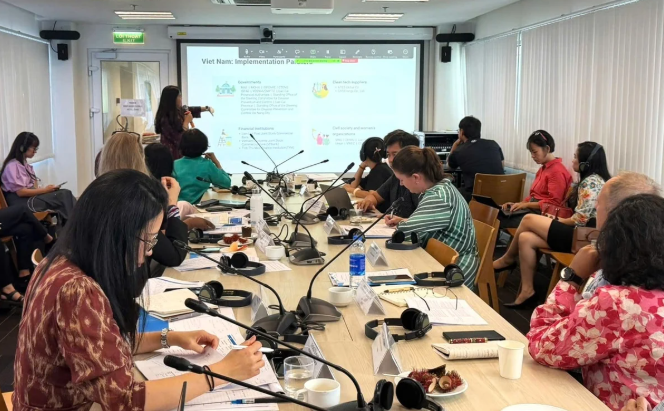 Representatives of UN Women, UNEP and partner organisations attend the dialogue. Photo: Trung Nguyen.
Highlighting gender-related challenges in Viet Nam’s efforts to achieve net-zero emissions by 2050, Caroline T. Nyamayemombe, UN Women Representative in Viet Nam, said that data show significant gender gaps remain, particularly in rural and remote areas. Women in these areas continue to earn significantly less than men. Women’s access to credit stands at only 18.2%, compared with 23.2% for men; 65% of ethnic minority women work in agriculture; and losses caused by gender-based violence are estimated at around 1.81% of GDP.
“If the green and digital transitions do not address these barriers, existing inequalities risk widening,” Caroline stressed. She proposed three criteria for measuring the effectiveness of solutions: the extent to which women benefit; the extent to which women’s participation is strengthened; and the sustainability and scalability of the results achieved.
Promoting women’s empowerment
Affirming that the green transition and a just energy transition are important pillars of Viet Nam’s development orientation, Nguyen Tuan Quang, Director General of the Department of Climate Change under the Ministry of Agriculture and Environment, said the gradual reduction of fossil fuel use, development of the carbon market and expansion of renewable energy must create genuine opportunities for women and vulnerable groups, rather than merely ensuring that these groups are “not negatively affected.”
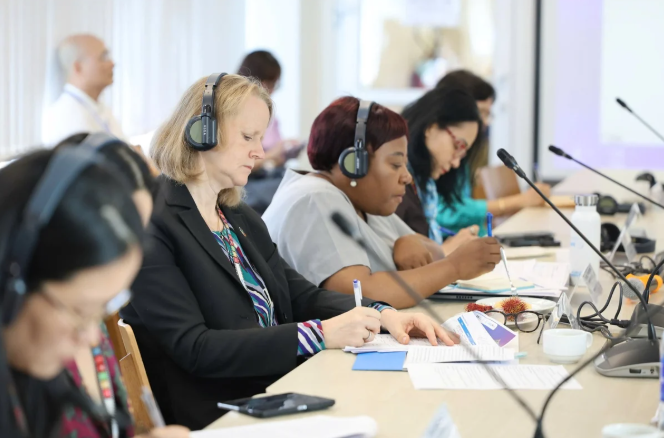 UN Women calls on Viet Nam to translate policies into action and empower women at the grassroots level. Photo: Trung Nguyen.
According to Quang, in a just transition, women need to be recognised as active participants in the green economy - as clean energy entrepreneurs, leaders of cooperatives and owners of small-scale production businesses - rather than simply as a group requiring protection from the risks of the transition. At the same time, the benefits of new jobs and markets, as well as access to clean technologies and climate finance, need to reach rural, mountainous and disaster-prone communities, where women already play a central role in household agricultural production and disaster resilience.
Cooperation between the Department of Climate Change and UN Women helps ensure that gender equality is integrated from the outset into the design of technical tools for the green and energy transitions, including the carbon market, greenhouse gas inventory/MRV systems and climate adaptation plans. In the coming period, the Department of Climate Change proposed that partners continue to focus on three priorities: strengthening institutions alongside implementation capacity; supporting low-emission economic initiatives and climate-resilient livelihoods; and establishing gender-responsive monitoring and evaluation mechanisms through the collection and analysis of sex- and age-disaggregated data (SADD).
During the roundtable discussion, participants examined barriers to translating policy commitments into practical action, challenges women face in accessing green financial products, and solutions to strengthen women’s roles.
Maria Holtsberg, Deputy Regional Director of UN Women for Asia and the Pacific, said Viet Nam is shifting its focus from raising awareness to implementing gender-equality solutions on a broader scale. Going forward, Viet Nam needs to accelerate the translation of policies into practice by narrowing funding gaps, strengthening local capacity and providing women with meaningful decision-making power at the grassroots level. In particular, support for small-scale business models needs to be scaled up to build a sustainable financial and market ecosystem.