On March 6, in Hanoi, the Southeast Asia Energy Transition Partnership (ETP), in collaboration with the Department of Climate Change under the Ministry of Natural Resources and Environment, organized a Technical Support Summary Meeting titled: "Training and Simulation of the Emission Trading System in Viet Nam".
The initiative aims to promote the development of Viet Nam 's carbon market, supporting the country's greenhouse gas (GHG) emission reduction commitments under the Paris Agreement.
A key highlight of the program was the guidance on using the Emission Trading System (ETS) simulation tool, part of the support activities under the Memorandum of Cooperation between the Department of Climate Change and the United Nations Office for Project Services (UNOPS). This initiative helps stakeholders better understand ETS functions, operational procedures, GHG emission quotas, and carbon credits management and trading.
Between February and December 2024, six training courses were held in Hanoi and Ho Chi Minh City, attracting more than 650 participants from various sectors, including policymakers, representatives from GHG-emitting facilities, research institutes, universities, banks, financial institutions, and media agencies. Leading international experts led the courses in climate change mitigation and carbon pricing.
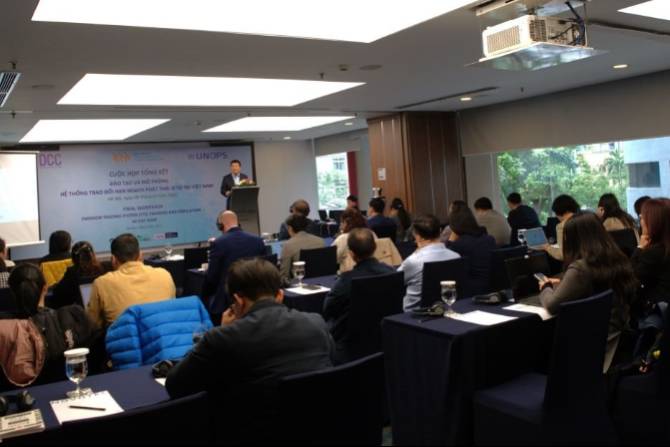 Quang cảnh hội thảo
The program provided key insights and recommendations for designing and implementing the ETS in Viet Nam based on an in-depth analysis of training outcomes, surveys, and simulation exercises.
Policy recommendations emphasized the need for clear, measurable targets aligned with national GHG emission reduction goals, transparent ETS scope and sectoral coverage criteria, and robust methodologies for setting and allocating emission allowances. Experts highlighted the importance of regularly reviewing and adjusting ETS design while monitoring international developments—such as the EU's Carbon Border Adjustment Mechanism (CBAM)—to ensure Viet Nam 's ETS remains effective and competitive globally.
The training sessions also underscored the strong demand for ongoing capacity-building initiatives, with calls for more advanced, specialized training programs.
Mr. John Robert Cotton, Senior Manager of the Southeast Asia Energy Transition Partnership (ETP), stressed that developing an effective ETS is crucial for achieving GHG emission reduction targets at a reasonable cost. According to World Bank studies, carbon pricing tools—including ETS, carbon taxes, and carbon credit mechanisms—can reduce the cost of emissions reduction by up to 30%, helping Viet Nam meet its Nationally Determined Contribution (NDC) targets. By capping total emissions and allowing businesses to trade emission allowances, the ETS creates economic incentives for companies to cut their GHG emissions efficiently and cost-effectively.