Livelihoods and forests in a shared development equation
In many areas bordering forests in Lam Dong Province, local livelihoods have long been closely tied to land, water resources, and surrounding natural assets. However, alongside new demands for sustainable development, the challenge is no longer only how to protect forests, but also how to enable local communities to improve their incomes and develop livelihoods directly on their existing production land.
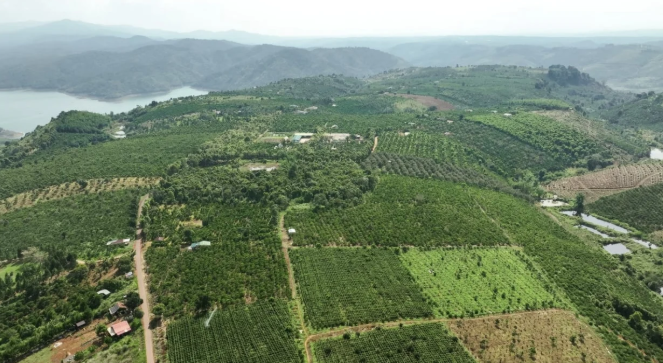
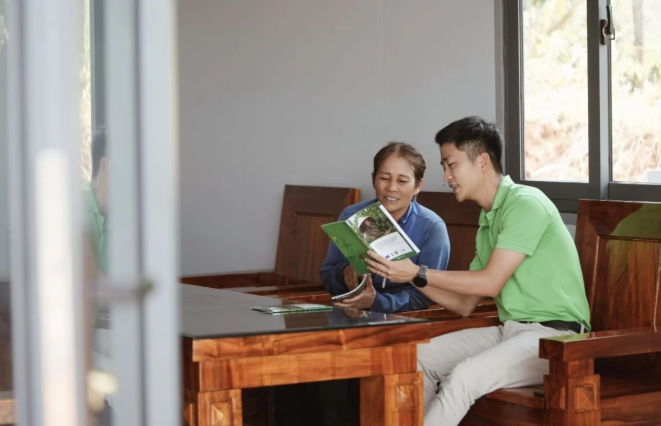 The forest ecosystems and agricultural production areas in Lam Dong Province are closely interconnected, together forming the foundation of local community livelihoods. Photo: EU Delegation to Viet Nam.
Building on this approach, the project “Integrated Sustainable Landscape Management through a Deforestation-Free Jurisdictional Approach in Lam Dong,” funded by the European Union (EU) and implemented through the United Nations Development Programme (UNDP), is being carried out to promote a balanced development model.
With a total budget of EUR 5 million, the project aims to reduce deforestation and forest degradation, conserve biodiversity, and create sustainable development opportunities for local communities, particularly households living near forest areas.
Enhancing livelihoods through sustainable farming practices
The impacts of the project are gradually becoming visible through changes in how farmers care for their orchards.
In coffee-growing areas, instead of clearing all vegetation under the trees, many households are now retaining natural ground cover to increase soil moisture and reduce erosion. Agricultural by-products such as coffee husks are being reused as compost to produce organic fertilizer. The use of fertilizers and irrigation water is also being managed more efficiently, helping reduce input costs while improving production effectiveness.
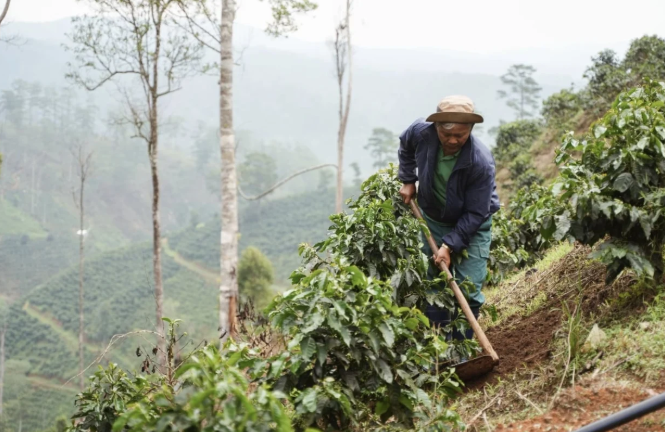 Sustainable farming models are helping improve local livelihoods while reducing pressure on land and forest resources. Photo: EU Delegation to Viet Nam.
In addition, many households have adopted intercropping systems, combining coffee with other crops such as durian. This approach not only diversifies income sources but also increases ground cover, improves growing conditions, and enhances resilience to climate variability.
“Our family has gradually changed farming practices, such as using fertilizers more appropriately and managing the orchard more efficiently to improve productivity,” said Mr. Lieng Jrang Ha Dan, a farmer participating in the project.
 Training materials and project activities are helping strengthen local communities’ capacity in transitioning toward sustainable production models. Photo: EU Delegation to Viet Nam.
Towards a deforestation-free development model
According to Mr. Vu Thai Truong, Head of Environment, Energy and Climate Change at UNDP Viet Nam, the “sustainable landscape” approach promoted by UNDP represents a shift from sector-based thinking to viewing ecosystems as an integrated whole. Rather than separating agriculture, forestry, and economic development, this approach simultaneously addresses livelihoods, nature conservation, and climate resilience.
Mr. Hoang Thanh, Programme Manager at the EU Delegation to Viet Nam, noted: “When farmers, cooperatives, and businesses gradually meet green market requirements domestically and internationally, Vietnamese agricultural products can build stronger trust and branding, increase value, and integrate more deeply into high-value global sustainable supply chains.”
For the European Union, through coordination with UNDP and international technical partners, these experiences are being adapted and applied to suit Vietnam’s local context.