Improving energy efficiency by 10% boosts GDP by 1%, cuts emissions and raises income. This is a result of the ESAM tool launched on July 13 in Hanoi.
On July 13, Ha Noi hosted the workshop "Developing the Energy-focused Social Accounting Matrix (ESAM) for Viet Nam to promote a just energy transition and green transformation". The event was organized by the Central Steering Committee for Policy and Strategy Development in collaboration with the United Nations Development Programme (UNDP) and other partners.
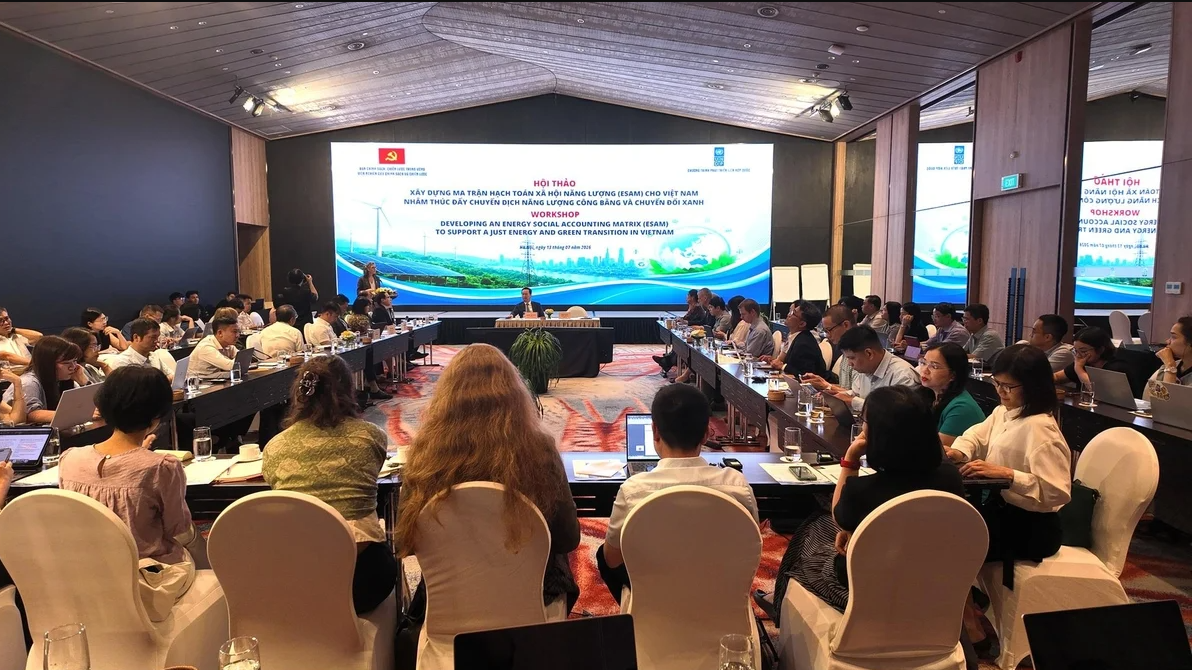 Overview of the workshop "Developing the Energy-focused Social Accounting Matrix (ESAM) for Vietnam to promote a just energy transition and green transformation" held on July 13 in Ha Noi. Photo: UNDP.
New research released today finds that a 10 per cent improvement in energy efficiency could increase Viet Nam’s GDP by around 1 per cent, reduce energy consumption and emissions, and raise disposable incomes across all household groups, demonstrating how well-designed energy-transition policies can deliver economic, environmental and social benefits simultaneously.
These tools are built around a new Energy-focused Social Accounting Matrix (ESAM), a comprehensive economic dataset that maps the links between production, energy use, household income and emissions within a single analytical framework. The ESAM was developed by the Institute for Policy and Strategy Studies (IPSS) in collaboration with the University of Copenhagen, the Viet Nam National Statistics Office and UNDP in Viet Nam.
Linked to economic simulation models, the ESAM enables decision-makers to test policy options and estimate their economic, environmental and distributional effects. The tools can also assess the impacts of external energy-price shocks, helping policymakers better understand risks to energy security, economic resilience and household welfare. The research applies these tools to a range of policy scenarios, such as energy efficiency improvements, carbon pricing, and electricity-price shocks. The analysis highlights both the opportunities and trade-offs associated with different policy choices, providing evidence to support more informed decision-making.
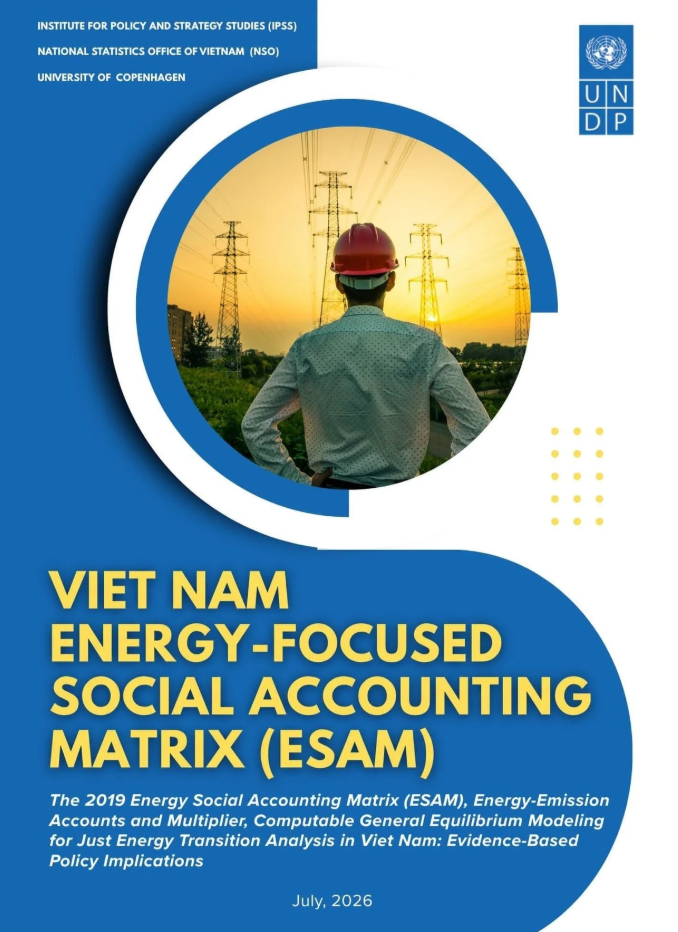 The Energy-focused Social Accounting Matrix (ESAM) toolkit published in July 2026. Photo: UNDP.
The results show that both the effectiveness and distributional impact of carbon pricing depend heavily on policy design. When revenues are redistributed through targeted social transfers, poor rural households could experience a net income gain, helping to ensure that the benefits of the transition are shared across income groups. The research suggests that a gradual introduction of carbon pricing combined with such targeted support measures, would help manage the transition costs.
Speaking at the workshop, Mr Nguyen Duc Trung, Deputy Head of the Central Policy and Strategy Committee, highly appreciated the research findings, noting that the dataset and analytical tools will help improve the quality of research, forecasting, and policy advisory work.
“I highly appreciate the collaboration between the Institute for Policy and Strategy Studies, UNDP in Viet Nam, the National Statistics Office (Ministry of Finance), and the Development Economics Research Group of the University of Copenhagen in developing the dataset and policymaking analytical tools to serve policy planning," he highlighted.
In her remarks at the workshop, UNDP Resident Representative Ramla Khalidi highlighted the ESAM as a valuable tool for helping policymakers assess the economic, social, and distributional impacts of energy transition policies.
“What this research allows us to do, drawing on Viet Nam's own data, is to see clearly who stands to gain and who stands to lose as the transition unfolds. The value of a tool like the ESAM lies in helping policymakers understand these trade-offs and design policies that advance energy security, environmental sustainability and, crucially, equity. Importantly, the ESAM can continue to be applied and updated by Vietnamese institutions as new policy questions arise,” she said.
The ESAM dataset and modelling tools will be made publicly available on the websites of UNDP and the University of Copenhagen, with regular updates planned to ensure they remain relevant as Viet Nam's energy transition advances.
As Viet Nam accelerates its transition towards a low-carbon economy, robust evidence and forward-looking policy analysis will be critical to ensuring that growth, energy security, emissions reduction and social inclusion advance together.