The scientific forum on acacia and provides a platform for stakeholders to exchange views on developing a more productive plantation forestry sector.
From October 5-8 in Hanoi, the Vietnamese Academy of Forest Sciences (VAFS), in collaboration with the International Union of Forest Research Organizations (IUFRO), the Australian Center for International Agricultural Research (ACIAR), and the Viet Nam Timber and Forest Products Association (VIFOREST), is organizing the international conference “Sustainable Development of Acacia Plantations in a Dynamically Changing World.”
Hosted by Viet Nam, the conference brings together more than 200 scientists, experts, policymakers, businesses, forest growers and representatives of international development organizations from nearly 20 countries.
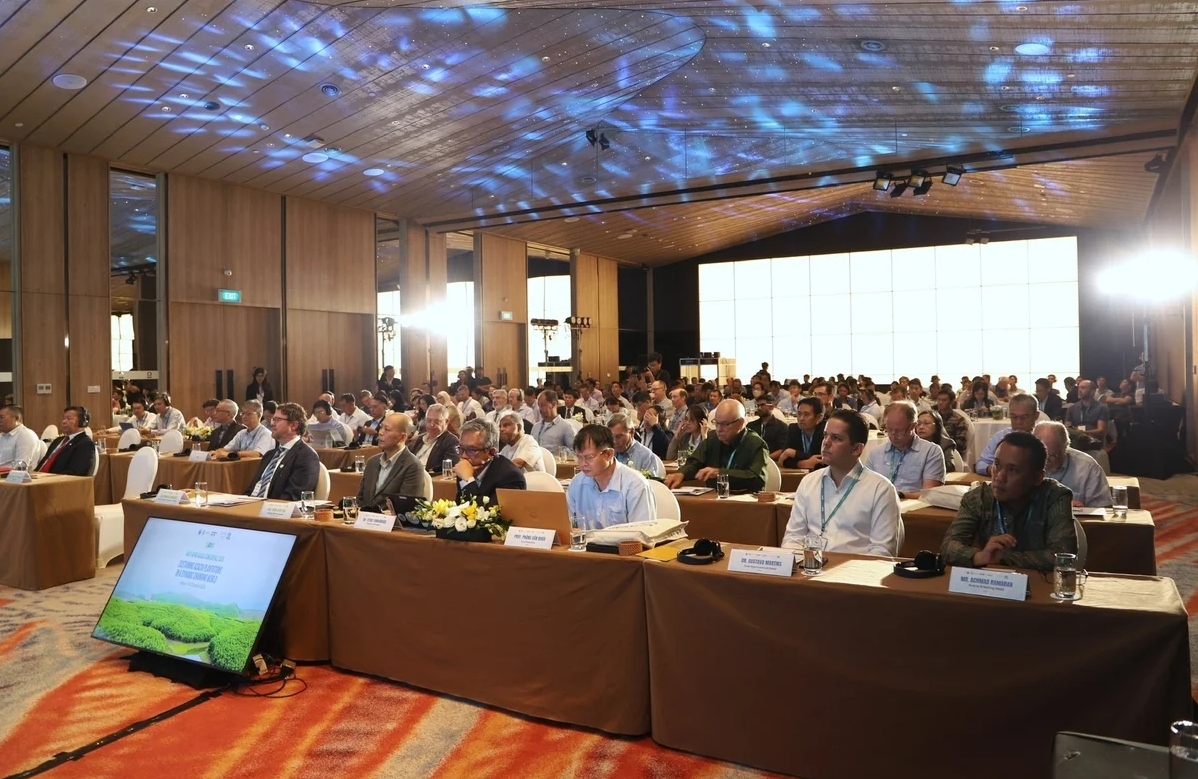 The conference promotes international cooperation in areas including breeding, biotechnology, silviculture, forest management and wood value chains. Photo: VAFS.
Speaking at the conference, Deputy Director of the Department of Forestry and Forest Protection Trieu Van Luc said that Viet Nam’s hosting of IUFRO Acacia 2026 recognizes the country’s efforts and contributions over several decades to research and develop acacia plantations and the acacia wood value chain.
According to data from the department, Viet Nam’s forestry sector has made significant progress over more than three decades. By the end of 2025, the country’s forest area had reached nearly 15 million hectares, with forest cover maintained at above 42%. Alongside protecting and restoring natural forests, plantations have increasingly become an important source of timber for processing industries, exports, and the livelihoods of millions of households.
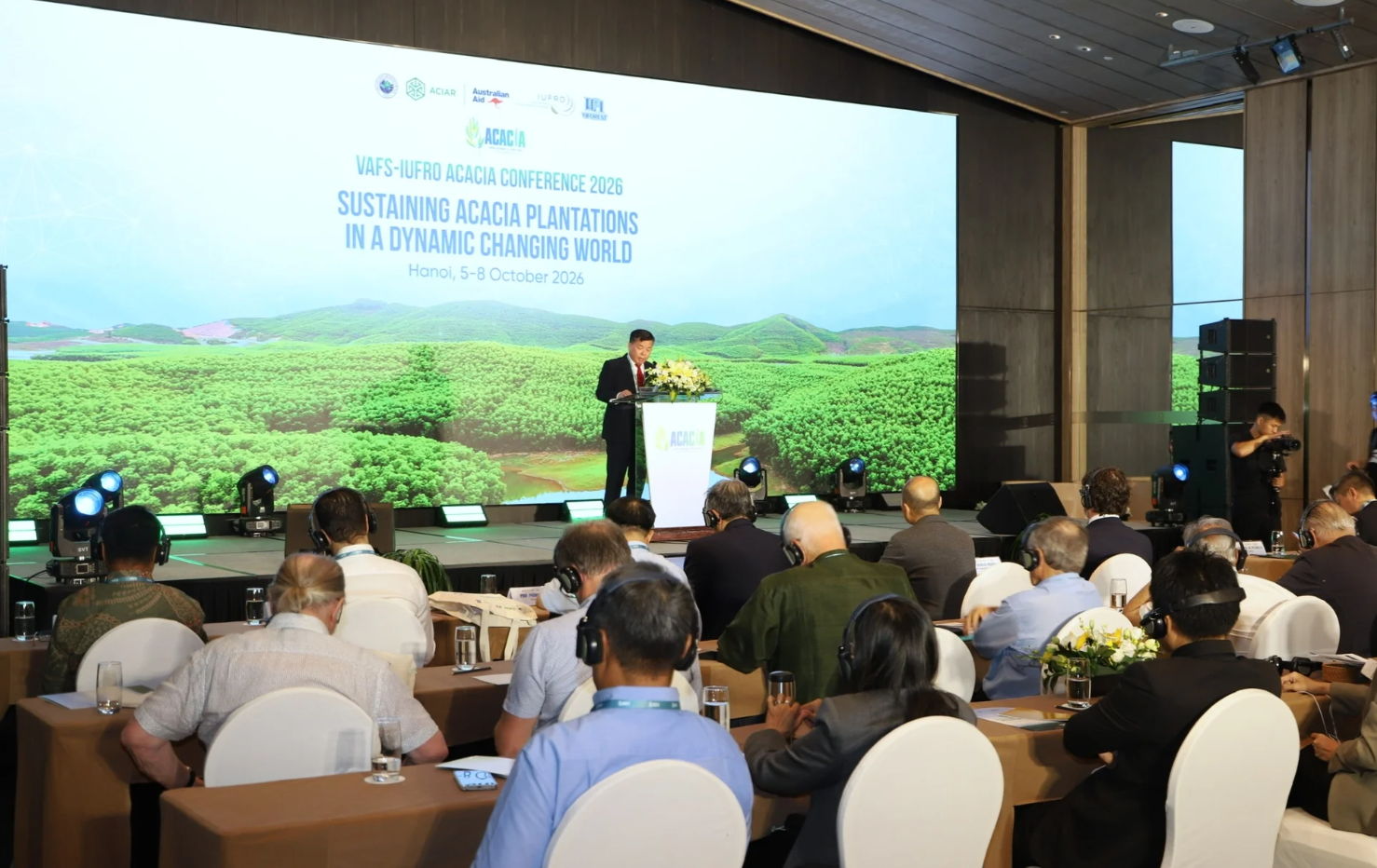 Deputy Director of the Department of Forestry and Forest Protection Trieu Van Luc speaks at the conference. Photo: VAFS.
Within Viet Nam’s production forest system, acacia holds a particularly important position, covering around 2.5 million hectares. This raw material base has supported the development of a large-scale wood processing industry, supplying a wide range of products, from woodchips, pulp, and panels to export furniture.
Viet Nam has also gradually shifted from reliance on natural forest resources to plantation forestry, expanding household participation and establishing raw material areas for the processing industry. Deeper integration into global wood value chains has also brought increasingly stringent requirements on legality, traceability, certification and compliance with markets’ environmental standards.
Changes in markets and production conditions are ushering acacia plantations into a new phase of transformation. Climate change, disasters, pests and diseases, declining soil productivity over successive rotations, and increasingly stringent requirements for legal timber, sustainable forest management, traceability, and deforestation- and forest-degradation-free products are directly affecting how plantations are developed.
The challenge, therefore, is not simply to maintain forest area and output, but to improve productivity, quality, added value, resilience and the sustainability of plantations.
At the conference, Ngo Sy Hoai, representing VIFOREST, said the global wood industry is shifting from competition based primarily on price and volume toward competition based on governance and value. Markets are becoming increasingly differentiated, while requirements on legality, traceability, climate and due diligence are becoming more stringent.
At the same time, wood supply chains are being restructured under the influence of geopolitics, tariffs and the need for risk diversification. For countries with strengths in plantation forestry, competitiveness must go hand in hand with the ability to demonstrate sustainability.
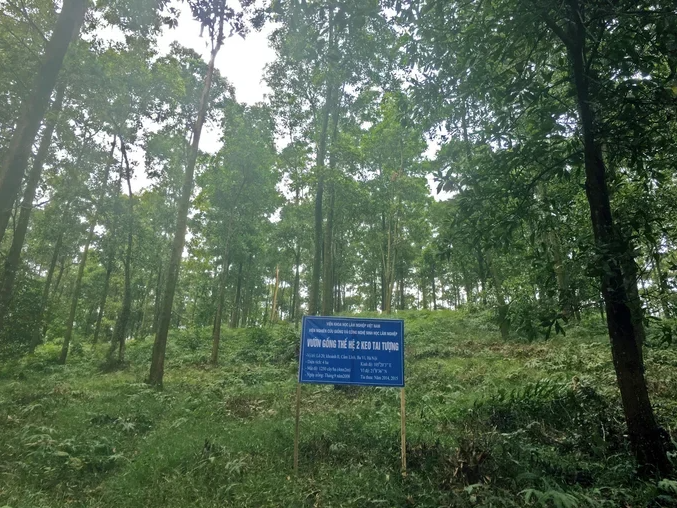 A Acacia mangium seed orchard at the Institute of Forest Genetics and Biotechnology under the Vietnamese Academy of Forest Sciences in Ba Vi, Hanoi. Photo: Nguyen Huan.
“The question for Viet Nam is not simply how much acacia wood it can supply, but how much value, trust and resilience each cubic meter of wood can generate,” said Ngo Sy Hoai.
According to the VIFOREST representative, acacia should be viewed as a foundation of the national forestry value chain, rather than simply a source of raw material for short-rotation harvesting. The industry’s focus should shift from “more output” to “more value per hectare.”
The Ministry of Agriculture and Environment identifies science, technology, and the quality of planting material as key areas for developing acacia plantations. Viet Nam continues to prioritize selecting, breeding, and using varieties with high productivity and quality, resistance to pests and diseases, and adaptability to adverse conditions. At the same time, the country is developing large-timber plantations with longer rotations, targeting 1 million hectares by 2030.
Nicholas Hogarth, ACIAR Forestry Program Director, and international experts at the conference further emphasized the role of research in reducing risks and uncertainties for forest growers, processing businesses, investors and buyers.
Speaking at the conference opening session, Assoc. Prof. Dr. Phi Hong Hai, Director of the VAFS, said acacia remains a pillar of plantation forestry in Vietnam and the wider region. In terms of achievements, breeding programs have improved productivity and wood quality, while certified large-timber plantations have continued to expand, marking a shift from short-rotation pulpwood toward higher-value timber.
In terms of challenges, wilt disease caused by Ceratocystis fungi and other pests and diseases are causing increasingly significant damage over successive rotations, while the genetic base of widely planted clones remains narrow. The increasingly complex impacts of climate change continue to create challenges for forest development.
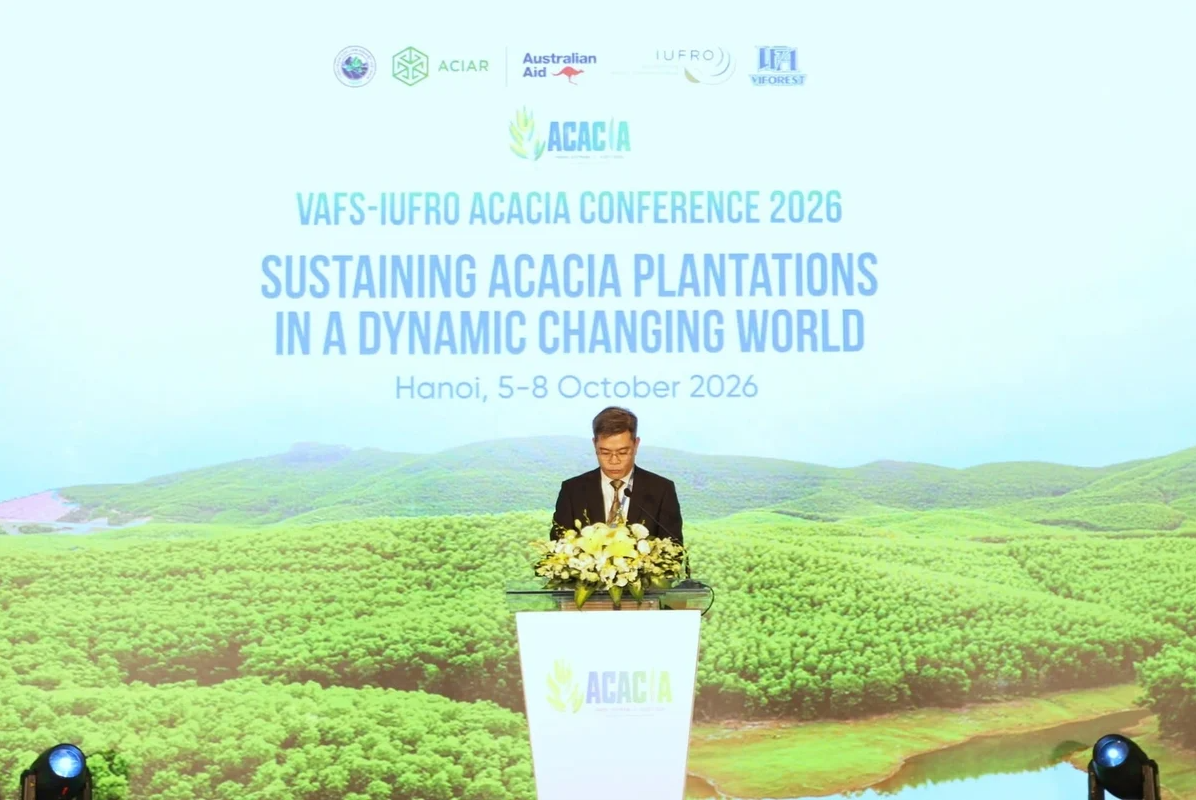 Assoc. Prof. Dr. Phi Hong Hai, Director of the Vietnamese Academy of Forest Sciences (VAFS), speaks at the international conference. Photo: VAFS.
For future directions, he proposed prioritizing the selection of multi-trait varieties, applying biotechnology, implementing integrated pest and disease management, and promoting mechanization to reduce reliance on manual labor, while developing higher-value products. These approaches should be aligned with sustainable forest management and the circular economy. In particular, ensuring that new varieties reach smallholder forest growers should be a central priority, so breeding achievements can translate into real productivity gains.
Building on the plantation forestry foundation already established, the next phase of Viet Nam’s forestry sector is focused on generating greater value from every hectare of land and every cubic meter of timber. This requires improved varieties, silvicultural techniques, supply chain management, and access to higher-value markets, while ensuring quality planting material reaches smallholder forest growers.