Environmental education becomes more meaningful when translated into concrete actions within every classroom, school campus, and daily routine.
On November 13 in Hanoi, Viet Nam Agriculture and Nature Newspaper, in coordination with the International Cooperation Department under the Ministry of Agriculture and Environment, held the ASEAN Eco-School Network Conference.
In his opening remarks, Tran The Cong, Deputy Director of the International Cooperation Department, emphasized the need to turn environmental awareness into practical action while strengthening connections and sharing initiatives among schools across the region.
Environmental education should begin early, helping young people develop the knowledge, attitudes, and skills needed for a sustainable future. Schools play a vital role in shaping students' character, lifestyles, and lifelong values.
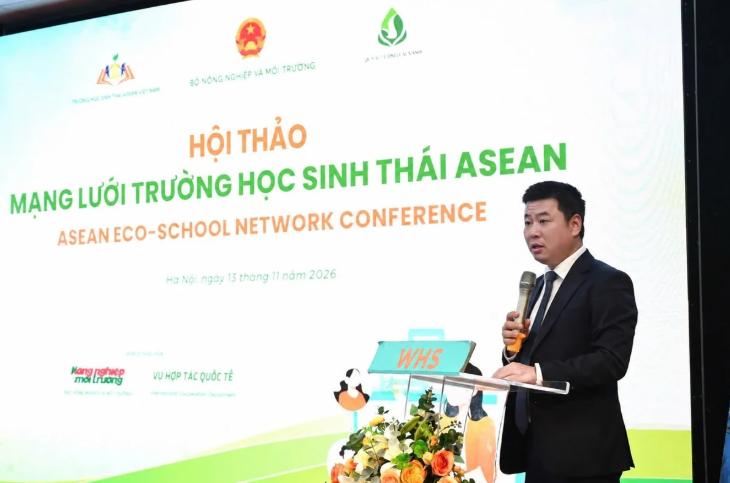 Tran The Cong, Deputy Director of the International Cooperation Department, delivers the opening remarks. Photo: Kieu Chi.
“An eco-school is not simply a place with greenery and clean surroundings. It must foster green thinking, environmentally friendly practices, creativity, and a sense of responsibility among all members,” Cong emphasized, describing this as the core mission of the ASEAN Eco-Schools Network.
Through the Network, successful school initiatives can be shared, adapted, and replicated across ASEAN member states. Individual activities can also develop into broader cooperation programs, strengthening the Network's impact.
To enhance its effectiveness, Cong called for wider participation from schools of different levels and regions. Education and environmental authorities should encourage and support participation, particularly among schools in remote, border, island, and disadvantaged areas, ensuring equal access to environmental education.
Schools should develop practical environmental action plans suited to local conditions, with clear goals, measurable outcomes, and sustained involvement from teachers, students, and parents. Each school should become a space where students can learn through experience and drive positive change.
Cong also encouraged schools to actively share successful models, practical experiences, and lessons learned through the Network while expanding exchanges and connections among ASEAN students and teachers.
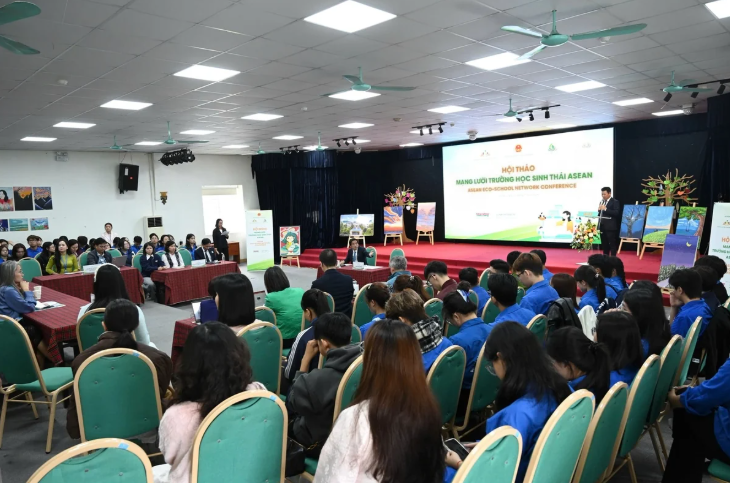 The workshop was held at West Hanoi Primary and Secondary School. Photo: Kieu Chi.
Building eco-schools is a long-term effort requiring not only schools and government agencies but also international organizations, businesses, social organizations, experts, and communities. Appropriate support will help schools implement initiatives, sustain results, and replicate successful models.
The International Cooperation Department will continue working with ministry units, relevant agencies, and international partners to strengthen ASEAN cooperation and mobilize resources for environmental education initiatives and the development of Viet Nam's Eco-Schools Network.
Each participating Vietnamese school will strengthen the Network, while shared initiatives and sustained actions will help nurture a generation of environmentally responsible young people.
Tran The Cong expressed confidence that, with support from authorities and partners, dedicated teachers, and creative, responsible students, the ASEAN Eco-Schools Network will continue to grow as an effective platform for knowledge sharing, innovation, and environmental action across the region.