All data from the updated climate change scenarios have been integrated into the Ministry of Agriculture and Environment’s National Climate Change Database.
On October 9, the Ministry of Agriculture and Environment held a conference to announce the 2025 update to Viet Nam’s climate change scenarios.
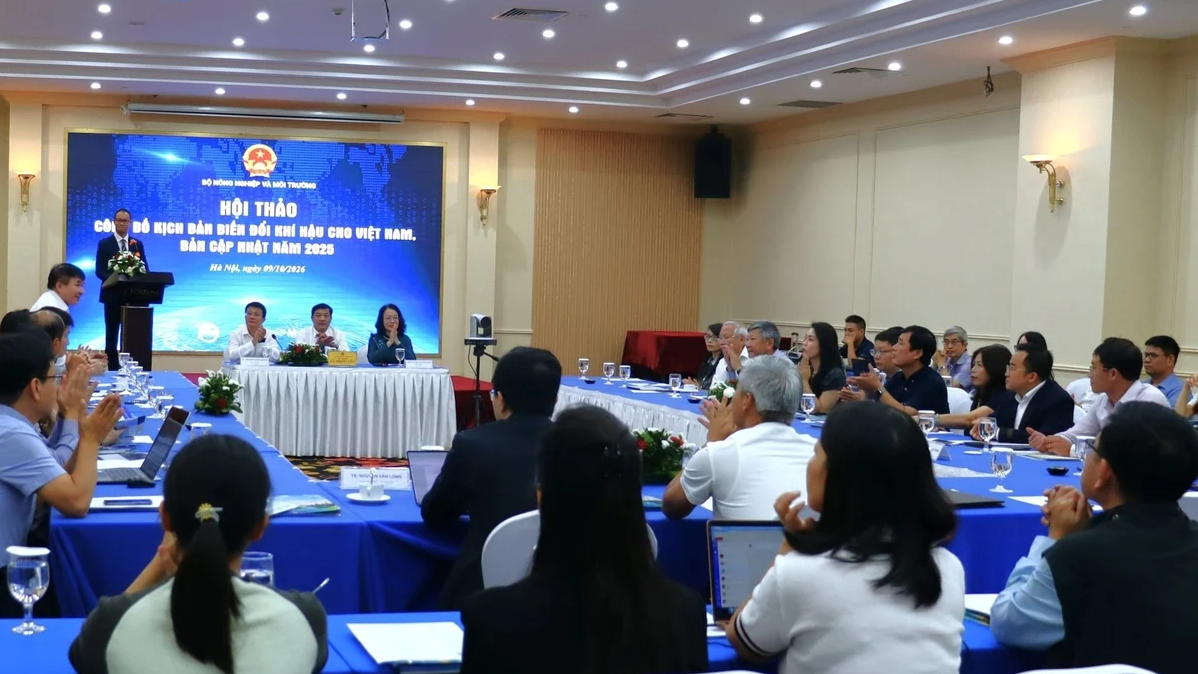 Deputy Minister of Agriculture and Environment Le Trong Yen, Nguyen Tuan Quang, Director of the Department of Climate Change, and Assoc. Prof. Dr. Pham Thi Thanh Nga, Director of the Institute of Meteorology, Hydrology, Environment and Marine Sciences, chaired the conference. Photo: Trung Nguyen
Highlighting the importance of the scenarios, Deputy Minister Le Trong Yen noted that Conclusion No. 75-KL/TW, issued by the 14th Party Central Committee on July 28, 2026, identified proactive climate change response, disaster risk reduction, and improved safety for people and the economy as key priorities for the new period.
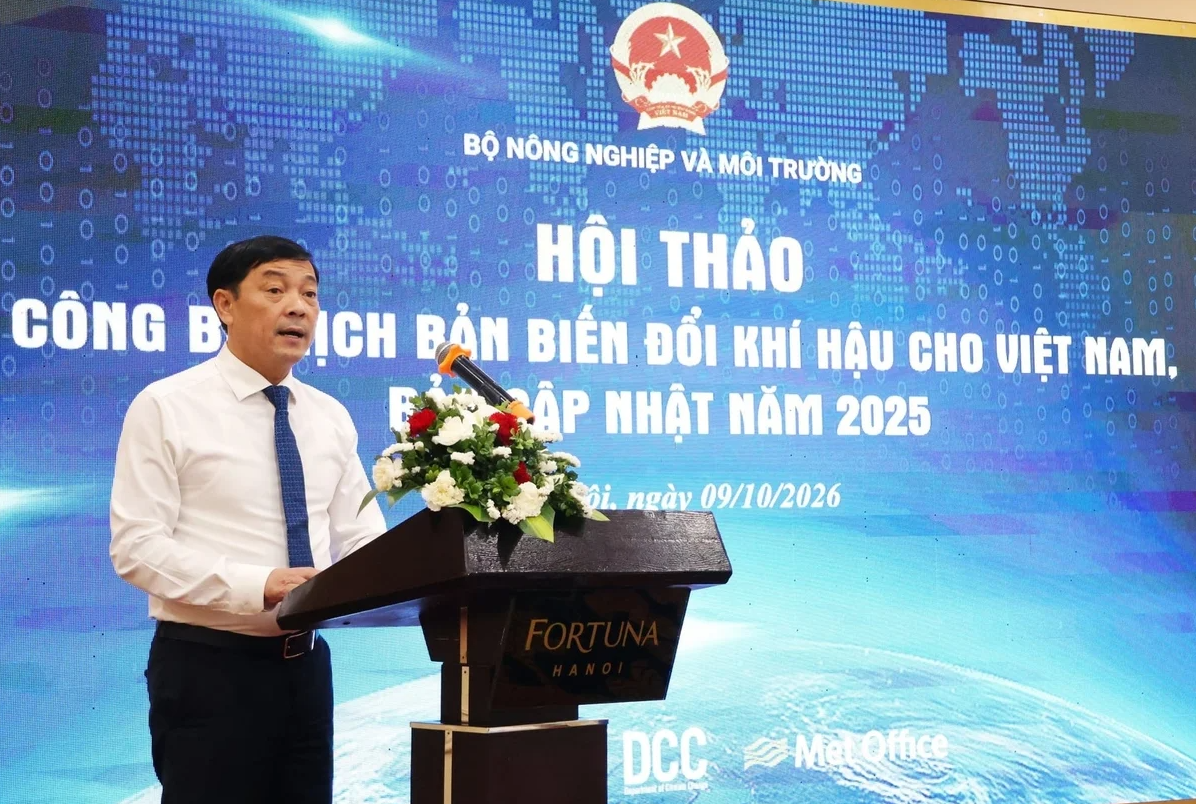 Deputy Minister of Agriculture and Environment Le Trong Yen highlights the importance of the climate change scenarios. Photo: Trung Nguyen.
In this context, the 2025 update to Viet Nam’s climate change scenarios provides a scientific basis for governance, policymaking, planning, risk management and proactive adaptation to climate change. The updated scenarios build on previous versions while incorporating the latest scientific findings of the Intergovernmental Panel on Climate Change (IPCC). They are designed to improve climate risk assessments and support the development and selection of appropriate solutions for different sectors and localities.
Deputy Minister Le Trong Yen called on ministries, sectors, local authorities, businesses, and social organizations to proactively incorporate scenario information into development strategies, master plans, development plans, production and business plans, long-term investment projects, and risk management measures. This would help strengthen resilience and improve preparedness for climate change.
Assoc. Prof. Dr. Pham Thi Thanh Nga, Director General of the Institute of Meteorology, Hydrology, Environment and Marine Sciences (IMHEMS), the lead agency responsible for developing the scenarios, said the 2025 update features substantial changes in both content and structure. It comprises eight chapters and detailed technical appendices, adding urban climate scenarios, scenarios based on global warming levels (GWLs), flood risk assessments and guidance on accessing and using the data. These additions make the scenarios more detailed, accessible and practical.
 Assoc. Prof. Dr. Pham Thi Thanh Nga, Director General of the Institute of Meteorology, Hydrology, Environment and Marine Sciences, discusses the development of the updated scenarios. Photo: Trung Nguyen.
Assoc. Prof. Dr. Pham Thi Thanh Nga stressed that climate change scenarios are not forecasts. Rather, they are scientifically grounded representations of plausible future climate trends, based on the relationships between socio-economic activities, greenhouse gas emissions, climate change and sea-level rise. Using the scenarios effectively requires an understanding of the associated uncertainties and the selection of scenarios appropriate to the intended purpose. For planning and design linked to specific timeframes, the institute recommends using low, medium and high-emissions scenarios. Meanwhile, information based on global warming levels can be used to assess risks and develop flexible adaptation pathways.
The 2025 update features improved spatial resolution, providing information down to the commune level, and updated decade-by-decade projections. In addition to temperature and rainfall, the updated scenarios cover other climate variables, including wind, radiation and sea surface temperature. They also provide more detailed information for major urban areas. This is a significant practical improvement, as demand for climate change information increasingly extends beyond the national and regional levels to cover individual localities, sectors and infrastructure projects.
Another major addition is information on extreme weather and climate events under global warming levels of 1.5°C, 2°C, 3°C and 4°C. As global temperatures rise, heat extremes, heavy rainfall and many other climate-related extremes are expected to increase in both frequency and intensity.
Under the high scenario, the number of hot days could increase by more than 50 days by the end of the 21st century, while the number of days with extreme heat could rise by around 20 days. Meanwhile, the number of days with severe cold in northern Viet Nam and the north-central region is projected to decline sharply. Maximum one-day and five-day rainfall totals are projected to increase by around 30-40% in northern and southern Viet Nam. The number of days with heavy rainfall is also expected to rise significantly, particularly in the south. In some areas of northern Viet Nam, the Central Highlands and the south, the number of days with rainfall exceeding 100 mm could increase by 80-100% under the high scenario.
For the first time, the 2025 update includes a dedicated assessment of urban climate, focusing on Ha Noi and Ho Chi Minh City. The assessment examines the combined effects of global warming and urbanization, highlighting rising temperatures, more intense heat, the urban heat island effect and extreme rainfall.
The update also revises projections of sea-level rise in the East Sea and along Viet Nam’s coastline, while providing maps of potential inundation caused by sea-level rise.
By 2100, average sea-level rise across the East Sea is projected to range from approximately 46.1 cm under the low scenario to 63.7 cm under the high scenario.
Along Viet Nam’s entire coastline, the average rise by the end of the century is projected to reach around 61.9 cm under the high scenario, with an upper estimate of 82 cm.
The inundation maps reveal marked differences in flood risk between regions. The Mekong Delta faces the highest risk, while many coastal areas in northern and central Viet Nam have lower inundation rates due to their topographical characteristics.
Alongside a summary for policymakers and a full report, the 2025 update is available through a WebGIS platform. The platform lets users explore and access information by location and time period, compare projections under different Shared Socioeconomic Pathways (SSPs) and across time horizons, and access the underlying scenario database.
This is an important step towards making climate research more accessible and relevant to the needs of local authorities, sectors and organizations that rely on climate information.
The 2025 update to Viet Nam’s climate change scenarios provides a strong scientific foundation for ministries, sectors, local authorities, organizations, and businesses to strengthen climate risk assessments, improve development planning, guide infrastructure investment, and develop 21st-century adaptation measures.