In partnership with the ASEAN Eco-Schools Network, the German Agency for International Cooperation (GIZ) has introduced pilot models for waste reduction at source in schools.
Speaking at the ASEAN Eco-Schools Network Workshop in Viet Nam on November 13, Le Thi Thuy Hang, an expert from GIZ, noted that the ASEAN Eco-Schools Award is gradually expanding beyond the national level to become a regional initiative.
According to Hang, since 2023, GIZ has supported the ASEAN Secretariat in revising and updating the ASEAN Eco-Schools Guidelines, first issued in 2011, through two regional projects: ASEAN Municipal Solid Waste Management Enhancement (AMUSE) and Reduce, Reuse, Recycle to Protect the Marine Environment and Coral Reefs (3RproMar).
In 2024, the projects also supported Soc Trang (now part of Can Tho City) and Da Lat (now part of Lam Dong Province) in developing municipal solid waste management plans, with particular attention to waste generated by schools.
Building on these efforts, local environmental and education authorities jointly launched Green School initiatives and piloted the "Green House" model with technical assistance from GIZ.
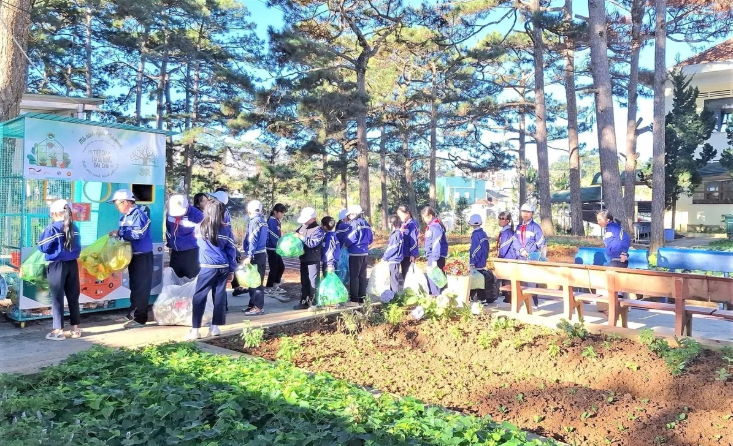 Students in Da Lat sort waste at source and deposit recyclable materials in their school's "Green House." Photo: Viet Trong.
The pilot models have shown promising results in both localities. In Da Lat, six Green Houses and 50 waste bins collected 1,488 kg of recyclables over three months. Meanwhile, in Soc Trang, 100 Green Houses and 286 bins helped collect and sort more than 500 kg of plastic each month.
The models were adapted to local conditions. In Da Lat, implementation reflected the highland climate and terrain, while Soc Trang integrated waste collection with school recycling campaigns and accepted discarded fishing nets from students' families for recycling.
The programme adopted a whole-school approach, establishing implementation procedures to help schools foster sustainable habits among students and teachers. Through training sessions, teachers, environmental club members, and student "environmental ambassadors" continued promoting plastic waste reduction and waste sorting at source even after the project ended.
Drawing on these experiences, Hang identified two key factors behind the models' success. First, the initiatives aligned with Viet Nam's Law on Environmental Protection, particularly waste sorting requirements, and local action plans.
Second, they mobilized cooperation among multiple stakeholders, including relevant authorities, schools, teachers, programme coordinators, and students themselves.
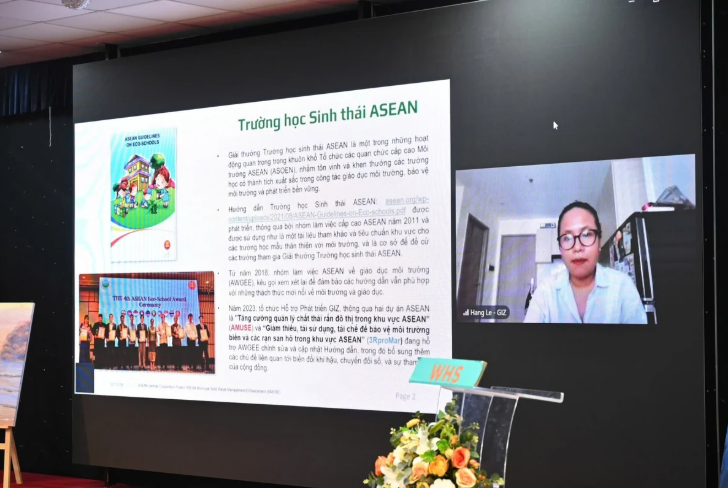 Le Thi Thuy Hang, an expert from the Deutsche Gesellschaft für Internationale Zusammenarbeit (GIZ), speaks at the ASEAN Eco-Schools Network Conference in Viet Nam, organized by Viet Nam Agriculture and Nature Newspaper on November 13. Photo: Kieu Chi.
According to Hang, following the project's completion in 2025, GIZ continued working with the Ministry of Agriculture and Environment to review and finalize two publications aimed at sharing experiences and scaling up green school initiatives.
The first is a report on international green school initiatives in solid waste management, examining the current situation, opportunities, and challenges of green education in Viet Nam and Southeast Asia. The second is a handbook on improving municipal solid waste management through eco-school initiatives, featuring good practices from Viet Nam and ASEAN for teachers, students, and local authorities.
Hang described the technical assistance and expertise provided over recent years as a practical "catalyst" for unlocking schools' green potential. Beyond the pilot phase, the models' long-term sustainability depends on teachers' and students' initiative and flexibility in integrating environmental practices into everyday teaching and school activities.
She also emphasized that active involvement from local authorities and regulatory agencies in mobilizing and integrating resources will be essential to scaling up successful eco-school models and turning green initiatives into sustainable community habits.