On the morning of December 11, the Ministry of Agriculture and Environment and the British Embassy officially launched the Climate and Ocean Adaptation and Sustainable Transition project.
The project has a total budget of GBP 18.19 million and will be implemented over 55 months, from October 2025 to March 2030, in Ha Noi and eight provinces and cities: Quang Ninh, Hai Phong, Da Nang, Gia Lai, Khanh Hoa, Can Tho, Ca Mau, and An Giang.
The COAST project is designed in close alignment with major national strategies and plans on the marine economy, fisheries, biodiversity, and climate change, as well as policies on fisheries resource protection and the fight against illegal, unreported, and unregulated (IUU) fishing.
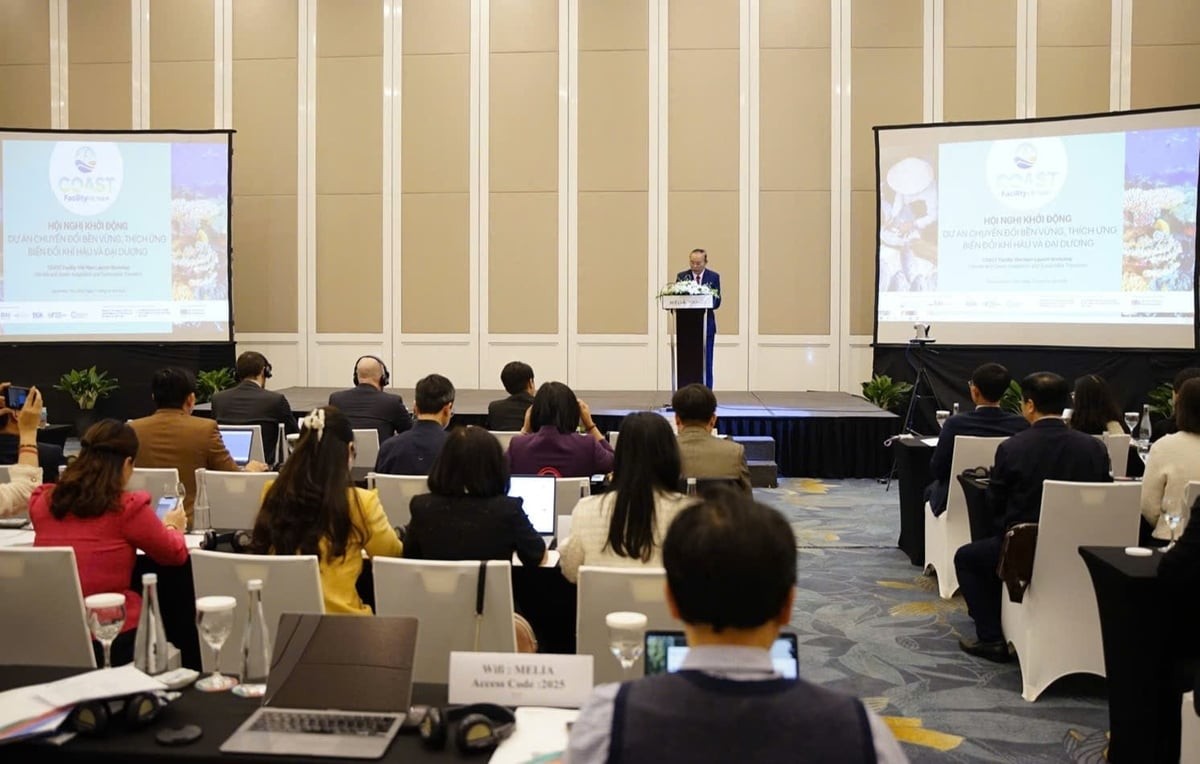 The launch conference of the “Climate and Ocean Adaptation and Sustainable Transition” (COAST) Project on the morning of November 12. Photo: Linh Linh.
The project’s overall objective is to protect and develop fisheries resources, marine and coastal ecosystems, and biodiversity, while strengthening climate resilience and promoting sustainable livelihoods for coastal communities, particularly vulnerable groups. The project comprises three components: protection and sustainable exploitation of resources; climate-resilient and sustainable aquaculture; and project management.
Under the resource protection component, the project is expected to support the preparation of dossiers for the establishment of three marine protected areas, restore two degraded coral reefs, deploy artificial reefs, and increase biodiversity indices in 14 fisheries resource protection zones. Seven marine protected areas and fisheries protection zones will apply monitoring technologies such as UAVs and camera systems. Artificial breeding research will be conducted for four rare marine species, while 16 models will be developed to help shift ineffective fishing livelihoods toward more sustainable activities, accompanied by technical guidelines as well as communication and training programs.
Under the aquaculture component, the project will review and reorganize seven marine farming areas and seven brackish-water shrimp farming zones to ensure environmental carrying capacity and promote the adoption of sustainability certifications. It will also develop three high-tech marine aquaculture models and 23 climate-resilient, low-emission aquaculture models; pilot marine aquaculture insurance schemes; and develop artificial intelligence–based software to integrate environmental and disease monitoring data. In addition, the project will study emissions from marine aquaculture and the carbon sequestration potential of seaweed, while finalizing technical guidelines on seed production, farming processes, and biosecurity.
Speaking at the conference, Deputy Minister of Agriculture and Environment Phung Duc Tien emphasized that the implementation of the COAST project is of great significance in supporting Viet Nam’s response to climate change and marine ecosystem management, enhancing the sustainability of the fisheries sector, and improving local livelihoods.
Ambassador Extraordinary and Plenipotentiary of the United Kingdom of Great Britain and Northern Ireland to Viet Nam, Iain Frew, said this is one of the largest programs the UK has supported in Viet Nam in the environment and climate sector. According to him, the COAST project is “a clear example of turning commitments into action,” with a strong focus on supporting people in the areas most severely affected.
Under the aquaculture component, the project will review and reorganize seven marine farming areas and seven brackish-water shrimp farming zones to ensure environmental carrying capacity and the adoption of sustainability certifications. It will establish three high-tech marine aquaculture models and 23 climate-resilient, low-emission aquaculture models; pilot marine aquaculture insurance schemes; and develop artificial intelligence–based software to integrate environmental and disease monitoring data. The project will also study emissions from marine aquaculture and the carbon sequestration potential of seaweed, while finalizing technical guidelines on seed production, farming processes, and biosecurity.
Speaking at the conference, Deputy Minister of Agriculture and Environment Phung Duc Tien emphasized that the implementation of the COAST project is of great significance in supporting Viet Nam’s response to climate change and marine ecosystem management, enhancing the sustainability of the fisheries sector, and improving the livelihoods of local communities.
Ambassador Extraordinary and Plenipotentiary of the United Kingdom of Great Britain and Northern Ireland to Viet Nam, Iain Frew, noted that this is one of the largest environment and climate programs supported by the UK in Viet Nam. According to him, the COAST project is “a clear example of turning commitments into action,” with a strong focus on supporting people in the areas most severely affected.