Tuyen Quang launches VSLA groups and forest carbon (C4G) project zoning training to enhance local community livelihoods.
Recently, the Tuyen Quang Department of Agriculture and Environment, in collaboration with CARE Vietnam, organized a conference to introduce Village Savings and Loan Associations (VSLA) and conduct training on methods for identifying potential areas for forest carbon projects under the C4G Project in Tuyen Quang province.
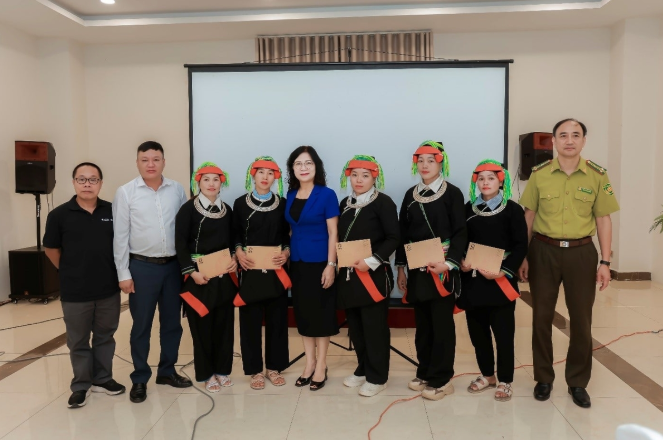 Leaders presenting gifts to VSLA groups in the villages of Tat Khao, Tham Con, Lung Tao, Tham Ve, and Khuoi Luong (Cao Bo commune). Photo: Bui Thi Thanh Tinh.
Ms. Mai Thi Hoan, Deputy Director of the Tuyen Quang Department of Agriculture and Environment, highly commended the project's implementation at the commune level. The systematic establishment of the groups has helped village and commune officials clearly understand the connection between livelihood models and the C4G project's objectives, thereby supporting the formation and operation of VSLA groups. Group members act as initial catalysts, broadly spreading the message within the community about improving livelihoods in tandem with forest management, protection, and development.
Furthermore, the training conference served as an opportunity to update participants on new knowledge regarding forest carbon services. It prepared the necessary steps to ensure readiness for immediate implementation as soon as the Government and central ministries finalize the legal framework for developing Vietnam's forest carbon market.
Mr. Le Xuan Hieu, Climate Change Adaptation, Resilience and Humanitarian Program Manager at CARE International, also shared insights related to forest carbon services and expressed his hope that Cao Bo commune will continue to accompany the project.
Representing the locality, Mr. Hoang Van Luong, Vice Chairman of the Cao Bo Commune People's Committee, stated that the project has received strong consensus and support from both the authorities and residents, successfully achieving its initial planned goals. In the coming time, the commune hopes to receive further support to strengthen the VSLA groups' activities, as well as opportunities to visit and learn from sustainable livelihood models in other provinces within the project area.
Following the VSLA introduction, experts from CARE, UBC (University of British Columbia), IFEE (Institute for Forest Ecology and Environment), and CIFOR (Center for International Forestry Research) presented and discussed the techniques and methods for identifying potential areas to implement forest carbon projects.
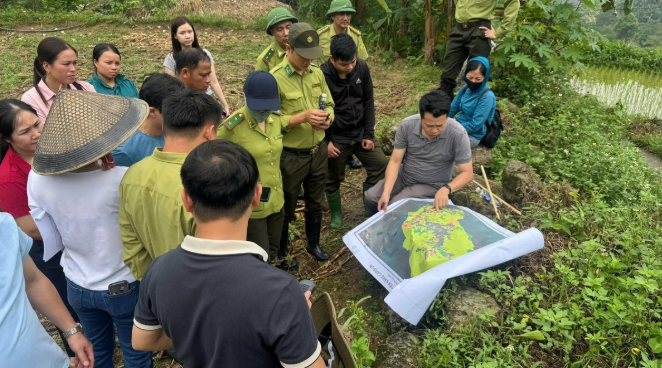 Conducting practical guidance on identifying potential forest carbon areas, mapping stakeholders and gathering field survey data in Tham Con village, Cao Bo commune. Photo: Bui Thi Thanh Tinh.
After the theoretical session, the organizing committee guided a practical exercise on identifying potential forest carbon areas, mapping stakeholders, and collecting field survey data in Tham Con village (Cao Bo commune). In the near future, the project will continue surveying potential areas across the entire commune.