A huge market with high purchasing power, the Middle East opens new space for Viet Nam farm produce, from fruit, rice, coffee to processed food.
Strong demand growth, many Vietnamese items hold advantages
In recent years, the Middle East has been evaluated as one of the fast-growing markets for Vietnamese agricultural and food products. In addition to strong demand for traditional items such as rice, coffee, cashew nuts, and seafood, the region is also expanding opportunities for many new product groups, especially fresh fruits and processed foods.
 Shrimp is one of Viet Nam's seafood items with ample room to expand exports to the Middle East market. Photo: Ha Duyen.
Sharing at the seminar "Elevating the value of agri-food products through sustainable supply chains" jointly organized by the Ho Chi Minh City Investment and Trade Promotion Centre (ITPC) and the Foreign Market Development Department (Ministry of Industry and Trade) on September 4, Mr. Mirash Basheer, Chief Operating Officer of Lulu Group International in Viet Nam, stated that Lulu is currently one of the largest retail chains in the Middle East.
Viet Nam has become one of Lulu's crucial supply sources for many years. Hundreds of items are imported from Viet Nam, ranging from agricultural products and processed foods to household appliances, plastics, and handicrafts.
For the agricultural product group alone, besides rice, coffee, cashew nuts, fruits and vegetables, and frozen seafood, many processed products are also increasingly embraced by Middle Eastern consumers.
He noted that Lulu is currently importing about 890 product groups from Viet Nam, of which nearly 100 are direct agricultural and food products. The majority of the remainder are processed products - a sector evaluated to still have plenty of room for growth.
Notably, new opportunities are opening up for bananas. According to the Lulu representative, for many years, the Philippines and Ecuador have been the two main banana suppliers for the Middle East. However, shipping times from these countries to the region often take more than 40 days.
Meanwhile, thanks to advantageous shipping routes, many banana shipments from Viet Nam can now reach the Middle East in just about 20-25 days. This is a significant advantage in terms of freshness, quality, and logistics costs.
"We are receiving an increasing number of orders for Vietnamese bananas. Banana quality has also significantly improved as producers have paid more attention to maintaining consistent quality to compete with major suppliers", Mr. Mirash Basheer shared.
Besides bananas, the Lulu representative said many other items, such as rice, fruits, processed agricultural products, and food products from Vietnam, have strong potential in the Middle Eastern market.
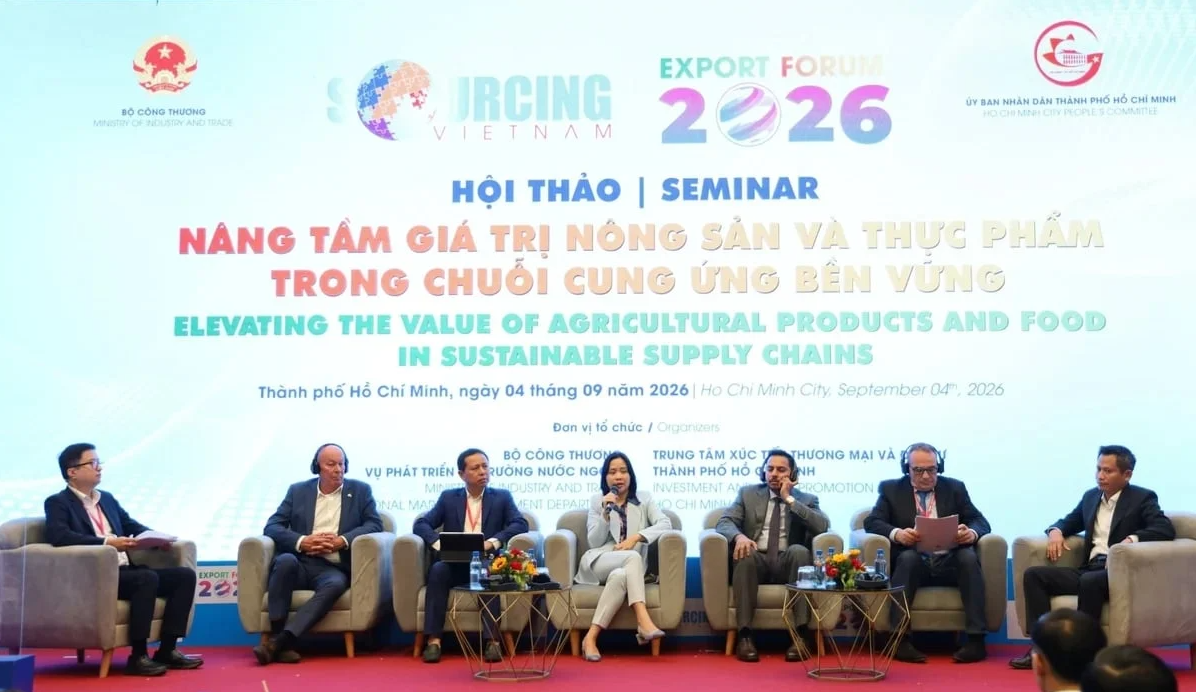 Speakers believed that building sustainable supply chains is a prerequisite for Vietnamese farm produce to enhance value and expand export market share. Photo: Phu Quoc.
Brand building and product standardization needed
Currently, many Vietnamese brands are present in the Lulu system, from coffee and processed foods to consumer products. Concurrently, this enterprise also regularly organizes Vietnamese Goods Weeks and various promotional activities to increase the recognition of Vietnamese goods in the Middle East.
However, according to him, many small enterprises still face a major limitation: they only design packaging suitable for domestic consumers or the overseas Vietnamese community.
Sharing this perspective, Mr. Sjoerd de Boer, co-founder of Miss Linh in the Netherlands, noted that many Vietnamese products are of good quality but must adjust their formulas, additives, packaging, and labels to comply with European regulations.
Moreover, businesses must also calculate right from the packaging stage to optimize logistics. "If the carton dimensions do not fit European standard pallets, the business will have to pay significantly higher shipping costs," he shared.
From a diplomatic perspective, Ms. Raïssa Anais Marteaux, Consul General of the Kingdom of the Netherlands in HCMC, observed that global consumption trends are shifting from "producing more" to "creating more value". Therefore, the goal is no longer exporting more tons of goods but elevating the value per ton of agricultural products.
This also aligns with the increasingly high requirements from international distribution systems. Not only the Middle East but many other markets are strongly shifting toward choosing products with stable quality, clear branding, and full compliance with food safety, sustainable development, and social responsibility standards.