Strengthening the Mekong Delta's resilience requires international knowledge transfer and sustainable livelihood models that are aligned with the region's ecological conditions.
Mounting pressures on Viet Nam's rice bowl
The Mekong Delta has long served as Viet Nam's agricultural heartland, playing a decisive role in ensuring national food security and generating significant agricultural export revenues. Yet this fertile region is now facing a harsh reality: it has become one of the world's most climate-vulnerable deltas. The fragility of the "land of the Nine Dragons" is no longer confined to scientific projections but is increasingly evident through every prolonged drought, every season of saltwater intrusion, and every stretch of riverbank swallowed by erosion.
_7e24634eda.jpg) In recent years, the Mekong Delta has benefited from numerous international cooperation programmes supporting climate change adaptation. Photo: Kim Anh.
In recent years, the Mekong Delta has benefited from numerous international cooperation programmes supporting climate change adaptation. Photo: Kim Anh.A series of extreme challenges is converging across the region, including sea-level rise, deep saltwater intrusion into inland areas, riverbank and coastal erosion, land subsidence, and the severe decline of sediment flowing from upstream. These threats do not occur in isolation. Instead, they reinforce one another, placing enormous pressure on agricultural production systems, the livelihoods of millions of people, and the socio-economic development of local communities.
Providing deeper insight into the root causes of these challenges, Mr. Huynh Quoc Tinh, Director of the Sustainable Agriculture and Food Programme at WWF-Viet Nam, said the problems are systemic in nature, stemming from both climate change and human development activities. Located at the downstream end of the Mekong River, the delta is directly affected by upstream developments, particularly hydropower dams that have altered the river's natural flow and trapped the nutrient-rich sediment essential for maintaining the delta's fertility.
The combination of human-induced pressures and climate-related disasters has intensified drought, accelerated ecosystem degradation, and posed a serious threat to water security. According to Mr. Tinh, the Mekong Delta can no longer rely on fragmented responses. Instead, it requires integrated, cross-sectoral, nature-based solutions supported by close coordination across regions and national borders.
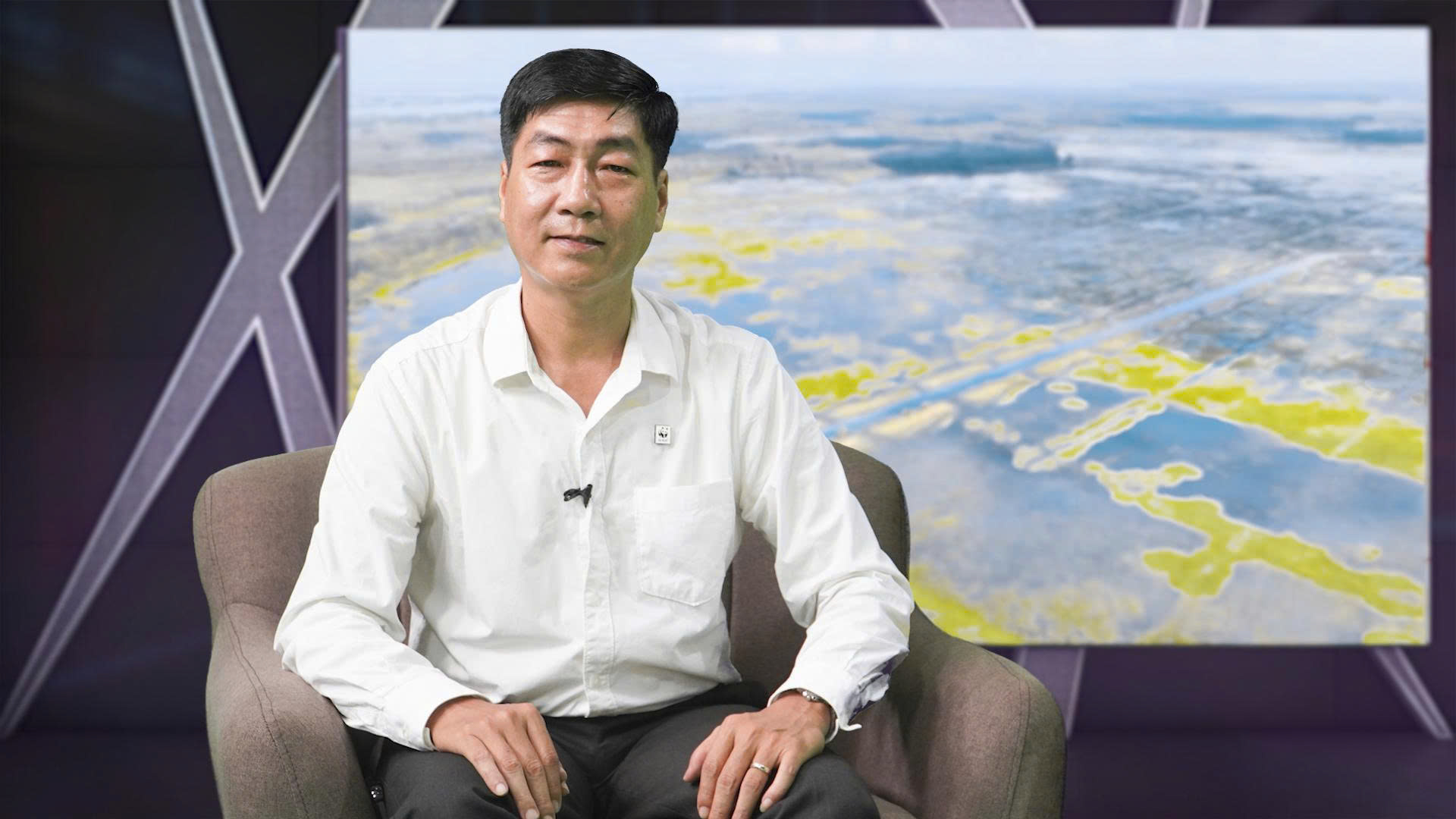 Mr. Huynh Quoc Tinh, Director of the Sustainable Agriculture and Food Programme at WWF-Viet Nam, speaks at a panel discussion organised by Nong Nghiep va Moi Truong (Agriculture and Environment) Newspaper. Photo: Kim Anh.
Unlocking resilience through nature-based livelihoods
Against a backdrop of limited domestic resources, international cooperation programmes have become an important catalyst for adaptation. Beyond providing much-needed financial support, international partners contribute knowledge, technology, governance experience, and sustainable development models, enabling local authorities to accelerate the adoption of long-term solutions tailored to the delta's unique conditions.
Mr. Huynh Quoc Tinh noted that, after more than three decades of working alongside Viet Nam, WWF is currently implementing four strategic programmes in the Mekong Delta: freshwater conservation; climate and energy; marine conservation; and the transformation of agriculture and food systems. Based on the region's master plan and ecological zoning, WWF has piloted a range of nature-based models that have delivered highly encouraging results, demonstrating that environmental protection and economic growth can go hand in hand.
Seasonal flood-based livelihood models in the Dong Thap Muoi Plain and the Long Xuyen Quadrangle - such as floating rice cultivation combined with fish farming, and lotus-fish integrated farming - have proven particularly successful. Rather than relying on high dikes to keep floodwaters out and intensify production, these models embrace seasonal flooding, helping restore natural ecosystem functions, retain freshwater and sediment, reduce land subsidence, and lower greenhouse gas emissions.
_cd49247d95.JPG) A seasonal flood fish conservation and farming model supported by WWF-Viet Nam in Dong Thap Province. Photo: Kim Anh.
A seasonal flood fish conservation and farming model supported by WWF-Viet Nam in Dong Thap Province. Photo: Kim Anh.In coastal areas, climate-adaptive production systems that respond to changing salinity conditions, including rice-shrimp rotation, mangrove-shrimp farming, and shrimp-seaweed farming, are helping restore ecosystems while enhancing the resilience of local communities to increasingly harsh weather conditions.
To ensure these models move beyond the pilot stage and can be scaled up across the delta, strengthening value-chain linkages among businesses, cooperatives, and farmers is essential.
Mr. Huynh Quoc Tinh emphasised that enhancing the Mekong Delta's adaptive capacity is not simply a matter of investing in dikes, embankments, or other hard infrastructure. More importantly, it requires transferring knowledge, modernising governance approaches, and establishing stable market mechanisms that allow local people, particularly vulnerable groups, to recognise the long-term economic benefits of nature-based agriculture and willingly embrace this development pathway.
The future prosperity of the Mekong Delta will no longer depend on extracting every possible resource in pursuit of higher output. Instead, it will rest on the region's ability to work in harmony with nature. International partnerships and nature-based livelihood models represent the key to helping Viet Nam's rice bowl withstand the growing impacts of climate change.
With an ecological economic mindset taking root across the region, the land of the Nine Dragons will not only be better equipped to overcome future challenges, but also confidently transform itself into a thriving and sustainable region.