On March 5, the Southeast Asia Energy Transition Partnership (ETP), in collaboration with the Department of Climate Change under the Ministry of Natural Resources and Environment, organized a workshop to launch technical support for the design and pilot of a voluntary carbon labeling program in Viet Nam.
The program aims to support the Ministry in developing policies for voluntary carbon labeling while enhancing the private sector's capacity in carbon accounting and greenhouse gas (GHG) emissions reduction, aligning with international climate policies. This initiative is part of broader efforts to strengthen Viet Nam 's climate change response.
Mr. Nguyen Tuan Quang, Deputy Director of the Department of Climate Change, emphasized that the technical support will provide theoretical and practical foundations for carbon labeling policies. He highlighted its role in advancing emissions reduction activities and fostering the development of Viet Nam 's carbon market.
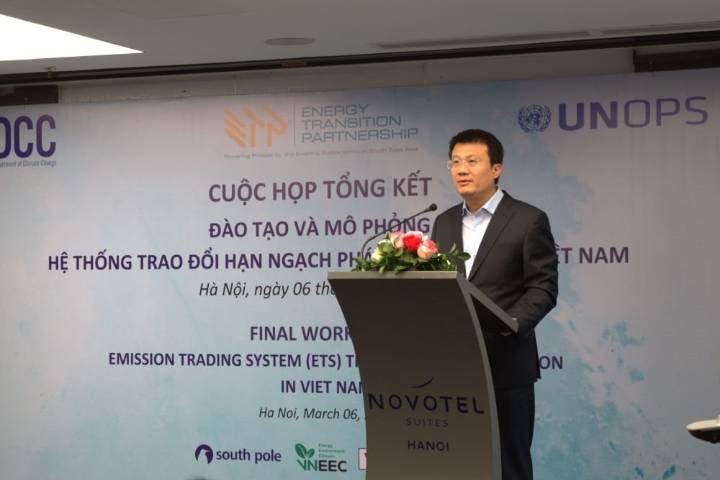 Mr. Nguyen Tuan Quang, Deputy Director of the Department of Climate Change (Ministry of Agriculture and Environment), speaking at the workshop
Mr. John Robert Cotton, Deputy Head of ETP, praised the partnership with the Viet Nam ese Government, expressing optimism that the program will effectively contribute to Viet Nam 's net-zero emissions commitment.
During the workshop, the project consulting team shared global best practices in carbon labeling, introduced the methodology, and outlined the implementation plan for the voluntary carbon labeling program. The team will propose policies, regulations, and capacity-building measures for stakeholders based on an assessment of Viet Nam 's policy framework, existing infrastructure, and international experiences.
 Mr. John Robert Cotton - Senior Manager of the Southeast Asia Energy Transition Partnership (ETP), speaking at the workshop
The program's design will align with Viet Nam 's emission reduction targets, the domestic carbon market development roadmap, and the capacity of key sectors. It will also comply with current GHG reporting regulations to keep roles and responsibilities evident and avoid overlaps.
The pilot phase will include awareness-raising campaigns, training sessions, and communication activities to promote carbon labeling among enterprises in energy-intensive export sectors. Up to 10 enterprises will be selected to participate based on export volume, production capacity, and emissions profiles.
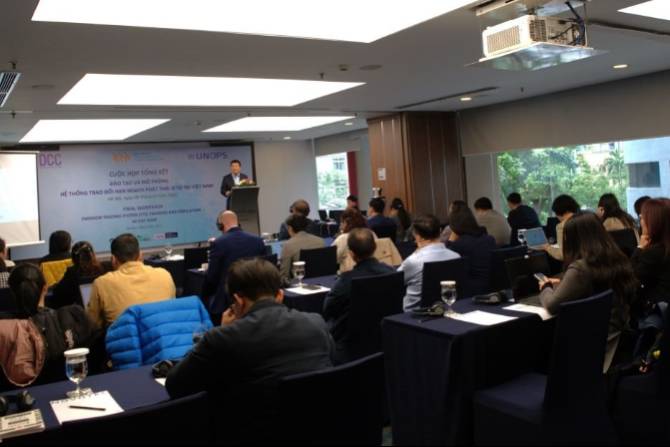 Delegates exchanging and discussing at the workshop
Viet Nam has pledged to achieve net-zero emissions by 2050. The Prime Minister has recently introduced various programs, projects, and legal regulations to support GHG emissions reduction. In the near term, 2,166 establishments across four sectors must conduct GHG inventories, per the Prime Minister's directive. Ministries and sectors are also tasked with encouraging organizations, individuals, and businesses to cut emissions voluntarily.