On March 3, at the headquarters of the Ministry of Agriculture and Environment, Deputy Minister Nguyen Hoang Hiep met with Ms. Pauline Tamesis, United Nations Resident Coordinator in Viet Nam, to discuss the 2026 work plan of the Disaster Risk Reduction Partnership (DRRP).
At the meeting, Ms. Pauline Tamesis presented the United Nations’ new support package for Viet Nam in 2026. The package consists of three components, designed to complement activities implemented by UN agencies under the DRRP framework.
According to Ms. Pauline, the package is built on two pillars: emergency response and strengthened disaster preparedness. In the medium and long term, the focus will be on enhancing resilience, bridging immediate response efforts with sustainable development strategies.
 Ms. Pauline Tamesis presented the United Nations’ new support package for Viet Nam in 2026. Photo: Phuong Linh.
 In addition to UN agencies operating in Viet Nam, two entities play a core role in providing expertise, financial resources, and technical capacity across the humanitarian and community recovery cycle: the United Nations Office for the Coordination of Humanitarian Affairs (OCHA) and the United Nations Office for Disaster Risk Reduction (UNDRR). Both maintain regional offices in Bangkok and have closely coordinated with Viet Nam in developing joint response plans in recent years.
Under the support package, four main groups of activities have been proposed.
First, an After-Action Review (AAR) of the 2025 Joint Response Plan will be conducted to comprehensively assess the coordinating role of the United Nations across seven sectors: water, sanitation and hygiene (WASH); shelter; food security; livelihoods; education; health; and protection. This activity is considered a critical step to draw lessons learned and enhance coordination effectiveness in the time ahead.
Second, the Contingency Plan will be updated and finalized. Relevant sectors will review and adjust the draft plan to ensure operational feasibility, while also organizing virtual meetings to harmonize implementation tools and monitor Minimum Preparedness Actions (MPA). OCHA will coordinate this process immediately after the initial step is completed.
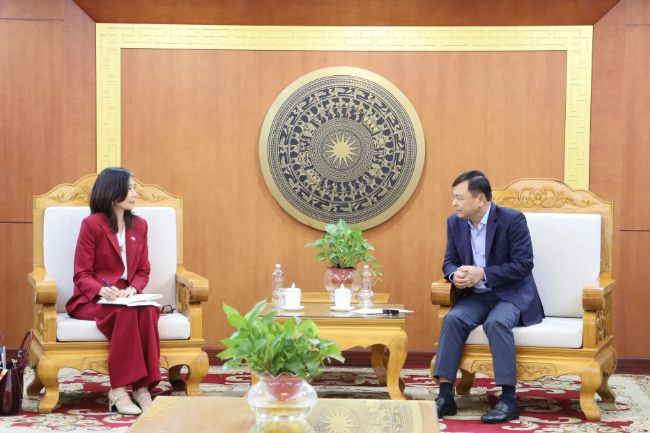 Deputy Minister Nguyen Hoang Hiep met with Ms. Pauline Tamesis, United Nations Resident Coordinator in Viet Nam, to discuss the 2026 work plan of the Disaster Risk Reduction Partnership (DRRP). Photo: Phuong Linh.
 Third, anticipatory action (AA) will be advanced through resources from the United Nations Central Emergency Response Fund (CERF). The Resident Coordinator’s Office, together with relevant partners, will discuss procedures for accessing funding, coordinate with the Government of Viet Nam to identify priority risks, develop scenarios, establish trigger thresholds, and finalize analytical models with technical support from OCHA.
Fourth, efforts will be made to strengthen the Early Warning System (EWS) over the medium and long term. Partners will conduct an After-Event Review (AER), using a specific storm as a case study to assess the accuracy, timeliness, and capacity to translate warnings into action. The findings will support the implementation of the National Strategy for Natural Disaster Prevention and Control to 2030, the workplan of the Disaster Risk Reduction Partnership, and the targets of the UNDRR Sendai Framework. They will also help the Government identify investment gaps, design and mobilize resources, and strive to keep disaster-related losses below 1.2% of GDP in line with the national strategic target.
Welcoming the proposals from the United Nations, Deputy Minister Hiep described them as the most appropriate course of action for Viet Nam at this stage. Accordingly, 2026 will focus on conducting a comprehensive review of the 2025 results as a basis for developing the contingency plan for the following year. The Vietnamese side acknowledged the close coordination among the United Nations, partners, and domestic authorities in drafting the contingency plan from late 2024, which enabled the country to respond more proactively in 2025.
Regarding disaster prevention and control, the leadership of the Ministry of Agriculture and Environment emphasized the need for a larger force, particularly non-specialized local responders. Viet Nam is currently strengthening capacity to ensure that each commune has at least 100 people equipped with essential knowledge and minimum equipment to proactively respond to natural disasters.
Regarding anticipatory action, Viet Nam is among the beneficiary countries of CERF - an effective mechanism for responding to floods and storms. He urged all parties to further clarify the content and implementation modalities to ensure maximum effectiveness,
In the long term, the Deputy Minister underscored the need to enhance resilience through the Medium-Term Public Investment Plan for 2026-2030, with a focus on infrastructure to minimize flood-induced isolation. However, the Ministry’s leadership also candidly acknowledged that reinforcing residential housing remains a “major challenge” that cannot be immediately addressed solely through state resources. He therefore proposed direct community participation, alongside support from the Government and international organizations. To realize this roadmap, he called for a comprehensive review and the early completion of the legal framework, creating a solid foundation for local-level implementation.