Against the backdrop of the global financial system's accelerating transition toward sustainable development, Environmental, Social and Governance (ESG) standards are increasingly becoming a key requirement for financial institutions. The adoption of climate-related disclosure standards, carbon pricing mechanisms, green taxonomies, and supply chain transparency requirements is prompting banks to reshape their business strategies in a more sustainable direction.
According to the report "The Sustainability Journey of Viet Nam's Banking Sector (2020-2025): A 2025 Analysis of 14 Vietnamese Commercial Banks," published by the Fair Finance Viet Nam (FFV) initiative, 2025 marks the fourth consecutive year that FFV has assessed the ESG policy commitments of commercial banks in Viet Nam.
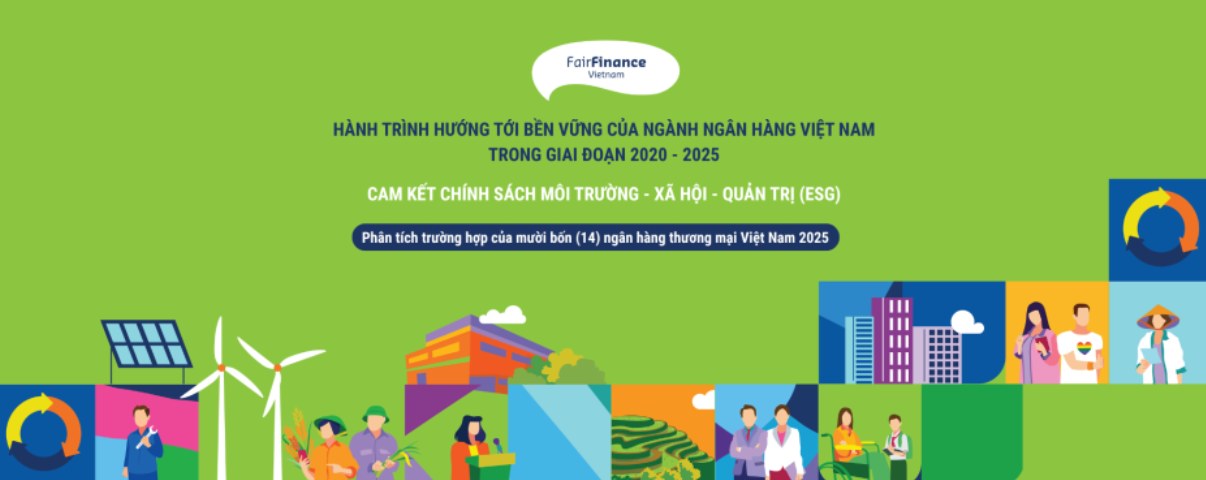 The report "The Sustainability Journey of Viet Nam's Banking Sector (2020-2025): A 2025 Analysis of 14 Vietnamese Commercial Banks" published by the Fair Finance Viet Nam (FFV). Photo: Oxfam.
The report finds that, compared with the first assessment released in 2020, commercial banks have made considerable progress in publicly disclosing their ESG commitments. However, compared with the 2024 report, the level of improvement recorded in 2025 was modest, indicating signs of a slowdown in further strengthening ESG policies.
According to the research team, the average ESG assessment score increased by only 0.1 point between 2024 and 2025, compared with increases of 0.4 point during 2020-2022 and 0.6 point during 2022–2024. This suggests that upgrading ESG policies may require more time or that banks have yet to make significant breakthroughs in aligning their policies with emerging standards.
The report also notes that although more banks are disclosing ESG-related topics than in previous years, the quality of the information remains limited. Many commitments remain at the level of broad policy statements, lacking specific targets, measurable indicators, and clearly defined implementation roadmaps.
Notably, most ESG policies continue to focus primarily on banks' internal operations. Meanwhile, ESG requirements for corporate borrowers, investee companies, and suppliers remain relatively underdeveloped. Only a small number of banks have begun incorporating criteria such as labour rights and human rights into their lending policies, and the scope and level of disclosure remain limited.
The report nevertheless highlights several positive developments over the 2020-2025 period. These include more banks publishing credit exclusion lists, issuing standalone sustainability reports, launching green bonds, and maintaining more consistent ESG disclosures. These developments are regarded as important building blocks for aligning with international sustainability reporting standards such as IFRS S1 and IFRS S2.
 ESG commitments among Viet Nam's commercial banks continued to improve during the 2020-2025 period. Photo: VinaControl.
Among the banks assessed, HDBank, VPBank, MSB, SeABank, ACB, and Agribank achieved the highest ESG policy commitment scores. Agribank was the only state-owned commercial bank ranked among the top performers and has maintained a consistent upward trajectory throughout the 2020–2025 period.
According to FFV, the Social (S) pillar recorded the most significant improvement in 2025, while progress in the Environmental (E) and Governance (G) pillars remained relatively limited. Financial inclusion continued to be the ESG topic most widely addressed by banks, whereas biodiversity received the least disclosure meeting the report's assessment criteria.
To enhance the quality of ESG commitments, the report recommends that banks expand the scope of their policies beyond internal operations to include corporate clients, particularly those operating in sectors with high environmental and social risks. Banks are also encouraged to establish more systematic ESG disclosure strategies, standardize sustainability reporting, strengthen greenhouse gas emissions measurement across all three scopes, and progressively adopt international reporting standards such as IFRS S1 and IFRS S2.
For regulators, FFV recommends that the State Bank of Viet Nam and relevant ministries and agencies develop a unified ESG framework for the banking sector as soon as possible. It also calls for clearer guidance on green taxonomies, green project assessment, and ESG disclosure requirements, thereby establishing a coherent legal foundation to advance sustainable finance in Viet Nam.