Beyond preserving its age-old salt-making craft, Sa Huynh aims to connect cultural heritage, natural landscapes, and community experiences to expand sustainable livelihoods for local residents.
Sa Huynh Ward in Quang Ngai Province lies at the heart of the Sa Huynh culture, one of the three cradles of ancient civilization in Viet Nam. The area is home to more than 120 hectares of salt fields with a history of salt production spanning over a century. In late 2024, the traditional Sa Huynh salt-making craft was inscribed on the National List of Intangible Cultural Heritage.
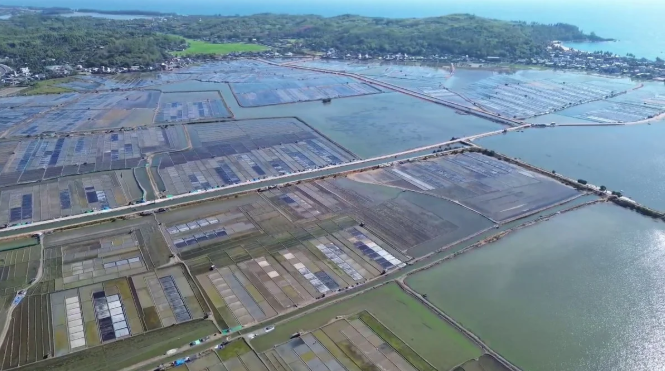 The salt production area in Sa Huynh currently covers approximately 120 hectares. Photo: NT.
Amid growing pressure from waste, urbanization, and the risk of degradation of the saltwater lagoon ecosystem, efforts to preserve the traditional salt fields are increasingly linked to environmental improvement and sustainable livelihoods for local communities.
This is the goal of the project "Preserving Traditional Sa Huynh Salt Fields and Promoting Community-Based Tourism in Sa Huynh Ward, Quang Ngai Province," managed by the Sa Huynh Ward Farmers' Association. The project received VND 1.1735 billion in funding from the UNDP/GEF Small Grants Programme (SGP) in Viet Nam and was implemented from May 2024 to September 2026.
Throughout implementation, the project identified community participation as a key factor in sustaining conservation outcomes. The project management board organized seven community consultation workshops attended by 145 households and seven training sessions for 239 salt-producing households in Thanh Duc 2, Dong Van, Tan Diem, and Long Thanh residential areas. A pilot waste segregation model was also introduced, alongside field surveys and monitoring activities.
A survey of 300 households found that 198, or 66%, were properly segregating waste. Floating waste in the saltwater lagoon declined significantly, while waste collection points began operating on more consistent schedules.
The project also established three used-battery collection points, installed four public awareness billboards, distributed 5,000 leaflets, and helped organize "Green Sunday" activities. In addition, 24 sets of waste bins were donated to schools, residential communities, health stations, and local government agencies.
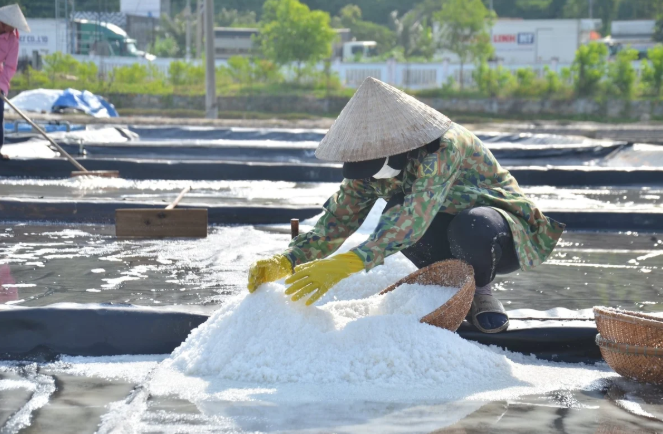 Salt making in Sa Huynh has a history spanning more than a century. Photo: L.K.
Alongside environmental protection, improving the livelihoods of salt farmers is another key priority. One approach adopted by the project is to increase the value of salt products. Through a workshop on high-value fleur de sel production at Sahu Salt One Member Limited Liability Company, local farmers gained opportunities to explore value-added production. The company committed to purchasing products from 30 salt-producing households, helping secure more stable market outlets.
The project also undertook efforts to restore the mangrove ecosystem surrounding the saltwater lagoon. Three nurseries were established with approximately 1,000 seedling mounds, while around 1,000 mangrove trees were planted on a trial basis. However, the results fell short of expectations, with only about 150 trees surviving. The low survival rate was attributed to local livelihood activities, storms, tidal impacts, and inadequate maintenance.
Drawing lessons from these challenges, the project management board has raised approximately 1,000 additional seedlings. Under the plan, once the seedlings reach a height of over 120 cm, they will be planted at suitable locations in 2027. Local residential communities will then be assigned responsibility for their protection and maintenance.
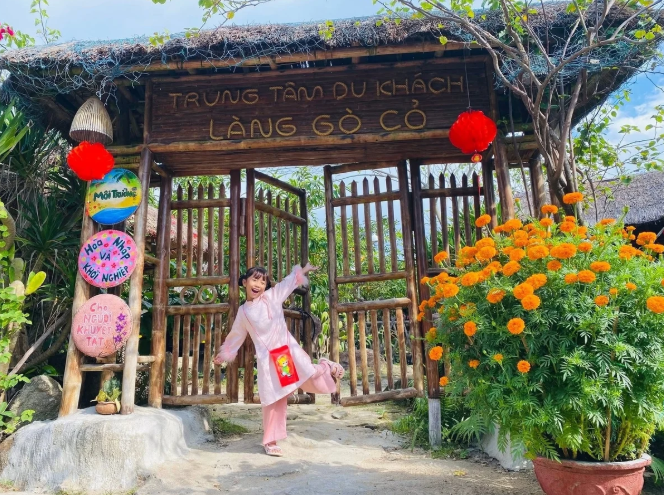 Go Co Village is one of Sa Huynh's well-known community-based tourism destinations. Photo: N.T.
In addition to environmental protection and increasing the value of salt products, the project seeks to harness local cultural heritage to develop community-based tourism. A traditional performing arts club was established with three groups specializing in sac bua folk singing, bai choi, and ba trao performances. From 2025 to June 2026, the groups performed for 32 tours, serving a total of 410 visitors.
Educational and experiential activities were also organized for 60 primary school pupils, 60 secondary school students, and 30 students and lecturers from Pham Van Dong University. These activities introduced participants to traditional salt making, helping them better understand the production process and the livelihoods of salt farmers. Local officials and salt producers also joined study visits to community-based tourism models in Binh Son and the Bac Lieu Salt Festival.
To improve visitor access to the salt fields, the project developed a check-in area covering approximately 40 square meters and installed four directional signs, a diagram explaining the salt production process, and a QR code-enabled tourism information board.
The information system introduces visitors to local attractions, including An Khe Lagoon, Go Ma Vuong, the Sa Huynh Culture Exhibition House, Hoc Mo, and Hang En Cave, as well as local cuisine.
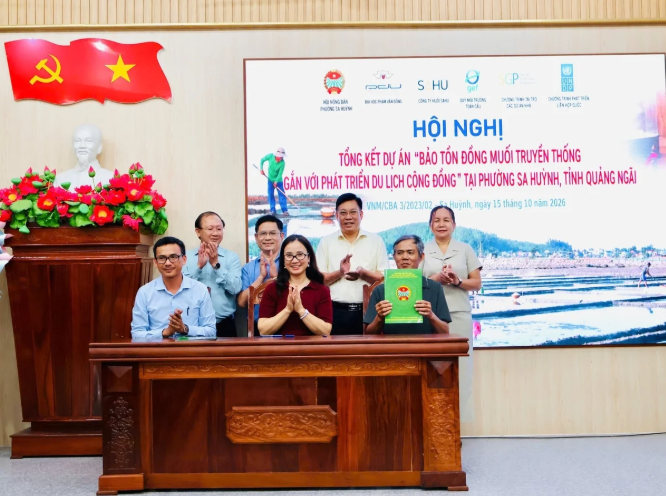 After 2 years of implementation, the project "Preserving Traditional Sa Huynh Salt Fields and Promoting Community-Based Tourism in Sa Huynh Ward, Quang Ngai Province" has achieved positive results. Photo: N.T.
According to the Sa Huynh Ward Farmers' Association, the area currently has 28 homestays and welcomes approximately 10,000-13,000 community-based tourism visitors annually. This provides favorable conditions for connecting the salt fields with existing tourist attractions and services. However, visitor numbers for activities specifically developed under the project still need to be monitored and evaluated to determine their potential to generate direct income for local residents.
Despite these achievements, the project continues to face several challenges. These include limited product quality, fluctuating visitor numbers, ineffective promotion, and shortages of tourism infrastructure and skilled personnel. Registration of Sa Huynh salt tourism as an OCOP product has also yet to be completed.
Tran Phung Duy, Head of the Project Management Board, said the Ward Farmers' Association would continue working with local authorities to strengthen cooperation among government agencies, businesses, communities, and scientists.
The Project Management Board has proposed that the Provincial People's Committee, the Global Environment Facility, and UNDP/GEF SGP consider supporting a second phase. This would focus on developing salt production through technology integration, product traceability, stronger product storytelling, and expanded cultural experiences showcasing Sa Huynh's heritage.
$ 1 = VND 26,080 - Source: Vietcombank.