The conference can be carbon-neutral by offsetting emissions from travel, energy use, printing, and other activities with carbon credits.
For the first time in Viet Nam, the Institute for Innovation and Development under the Foreign Trade University (FTU) has applied a carbon-neutral conference model. The international conference titled “International Carbon Markets for Sustainable Transition: From Advanced Theory to Innovative Practice” has been verified as having fully offset its emissions in line with international standards.
According to KLINOVA Climate Innovation Consulting and Services JSC, a co-organizer of the event, the carbon neutrality process involves both reducing greenhouse gas emissions and offsetting the remainder.
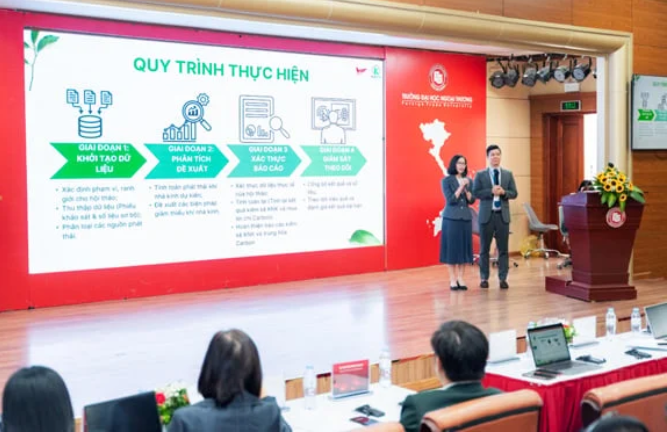 The organizers announce the implementation of the Net Zero model at the conference. Photo: Trung Nguyen.
Organizers encouraged participants to use low-emission transport, minimize printed materials, and reduce waste. As a result, total emissions from the conference were calculated and verified at around 10 tonnes of CO₂ equivalent.
These emissions were offset through the purchase of international carbon credits under the Gold Standard. The credits were subsequently retired on the global registry, ensuring they cannot be reused or double-counted, in line with international best practices and transparency requirements.
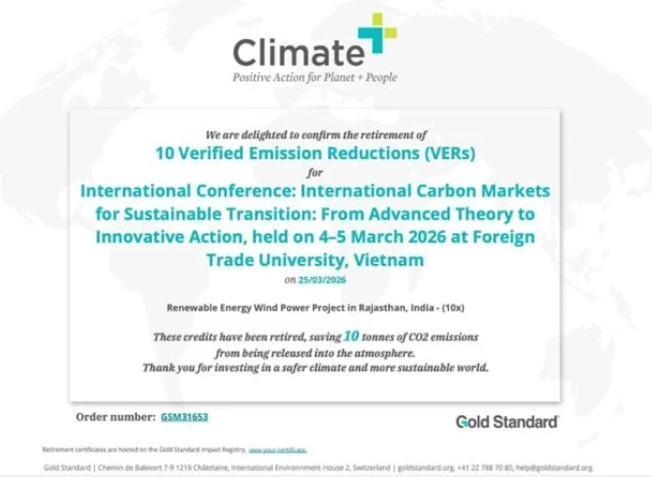 The organizers purchased Gold Standard carbon credits to offset the conference’s greenhouse gas emissions, with 10 verified emission reductions (VERs) acquired. Photo: Courtesy of the organizers.
Beyond offsetting, the conference also contributed 380 trees to a forest garden project through the Joy Foundation. Over time, such reforestation efforts can generate forest-based carbon credits in Viet Nam, while improving ecosystems and raising community awareness of environmental protection.
Associate Professor Nguyen Ngoc Ha, Director of the FTU Institute for Innovation and Development, noted that the successful implementation of a carbon-neutral conference model provides an important foundation for scaling sustainable practices in research, education, and event organization. It also demonstrates how academic activities can be aligned with climate action and environmental responsibility.
 Participants contribute saplings to the Forest Garden project by the Joy Foundation. Photo: Trung Nguyen.
Completing the offset process and receiving climate certification not only reflects high organizational standards, but also contributes to Viet Nam’s net-zero ambitions and broader global efforts to reduce greenhouse gas emissions.
Looking ahead, the Institute, together with its partners, plans to further refine and expand the model, deepen collaboration in carbon markets, and promote sustainability initiatives across Viet Nam’s innovation ecosystem.