On July 10, the Food and Agriculture Organization of the United Nations (FAO), in partnership with the Institute for Market and Institutional Research (AMI Institute), convened a policy dialogue to strengthen private sector engagement in transforming Vietnam’s food systems.
The event was part of the project “Promoting Innovation in Partnerships and Financing Mechanisms for Food Systems Transformation,” funded by the UN Joint SDG Fund and implemented by FAO, UNDP, and IFAD.
Mr. Ngo Sy Dat, Director of the AMI Institute, noted that private sector participation in the food systems transition remains limited due to lack of information, difficulties accessing policy incentives, and limited financing channels. The workshop aimed to provide a platform for sharing government policy orientations and international best practices adapted to Vietnam’s context.
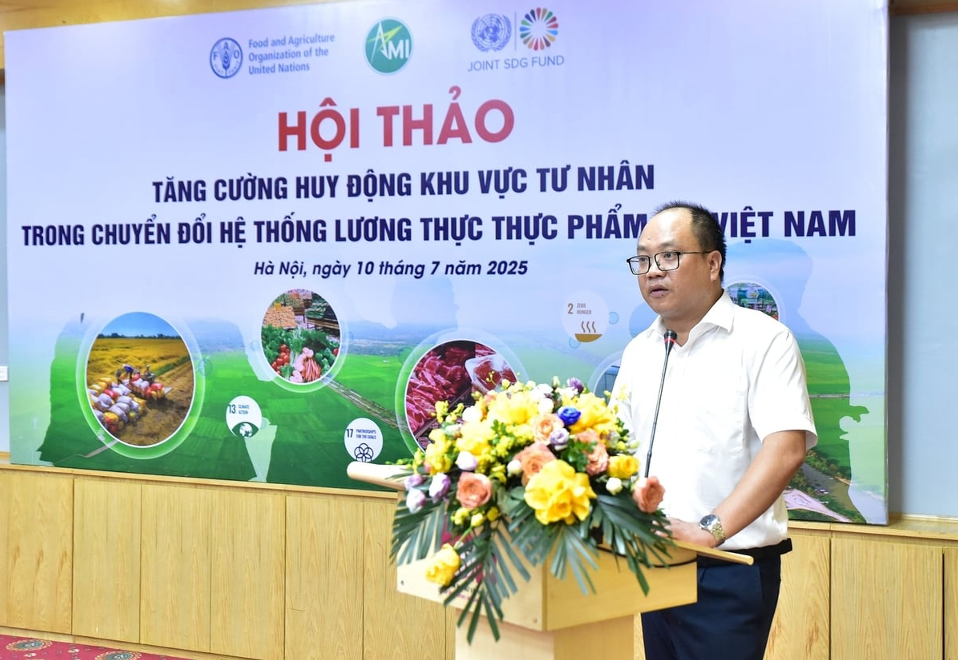 Mr. Ngo Sy Dat, Director of the AMI Institute, speaks at the event.
Dr. Dang Kim Son Lead Expert for the development of Vietnam’s National Action Plan on Food Systems Transformation, emphasized the pivotal role of the private sector in implementing Resolution 68-NQ/TW and Decision 300/QĐ-TTg. These policy frameworks target a transparent, accountable, and sustainable food system by 2030.
From a business perspective, Nguyen Thi Mai, CEO of Vinh Ha Food JSC, pointed to challenges including poor access to market intelligence, unstable raw material zones, and barriers to international financing. She also highlighted structural issues such as small-scale production and weak linkages among cooperatives and farmers.
During the discussion session, participants identified five key bottlenecks: unstable policy environments, fragmented production, high agricultural risks, an aging rural workforce, and limited access to capital. Proposed solutions included capacity-building for cooperatives, promoting e-commerce and digital transformation, and introducing innovative financing models such as green funds, concessional loans, and flexible public–private partnerships (PPPs).
The dialogue concluded with a call for a long-term national strategy and stronger multi-stakeholder coordination mechanisms to mobilize private sector resources and accelerate progress toward a more sustainable and inclusive food system in Vietnam.