After eight years of implementation (2016–2024), the Mekong Delta Integrated Climate Resilience and Sustainable Livelihoods Project (WB9) has contributed to the region's new development mindset, promoting climate change adaptation and nature-based livelihood transformation. With a total investment of over VND 8,500 billion, the project has enhanced resilience and improved livelihoods for nearly 2 million people - 49% of whom are women.
Speaking at the WB9 closing conference and WB11 launch on June 20 in Can Tho, Deputy Minister of Agriculture and Environment Nguyen Hoang Hiep emphasized that WB9 was one of the highest-performing international projects in terms of disbursement (100%) and achieved numerous outstanding results. The project adopted one of the most diverse approaches, covering everything from planning, early warning, and environmental monitoring to livelihood development. It introduced 54 types of livelihoods and implemented nearly 900 models - far exceeding initial targets.
One of the most significant achievements was establishing the Mekong Delta Regional Data Center and training a skilled technical workforce, helping local communities shift their production mindset and maintain agricultural land instead of migrating. The project also supported the formulation of the Mekong Delta Regional Master Plan for 2021–2030, with a vision to 2050, and funded a range of critical infrastructure projects, including irrigation systems, water monitoring, flood protection dikes, and coastal embankments.
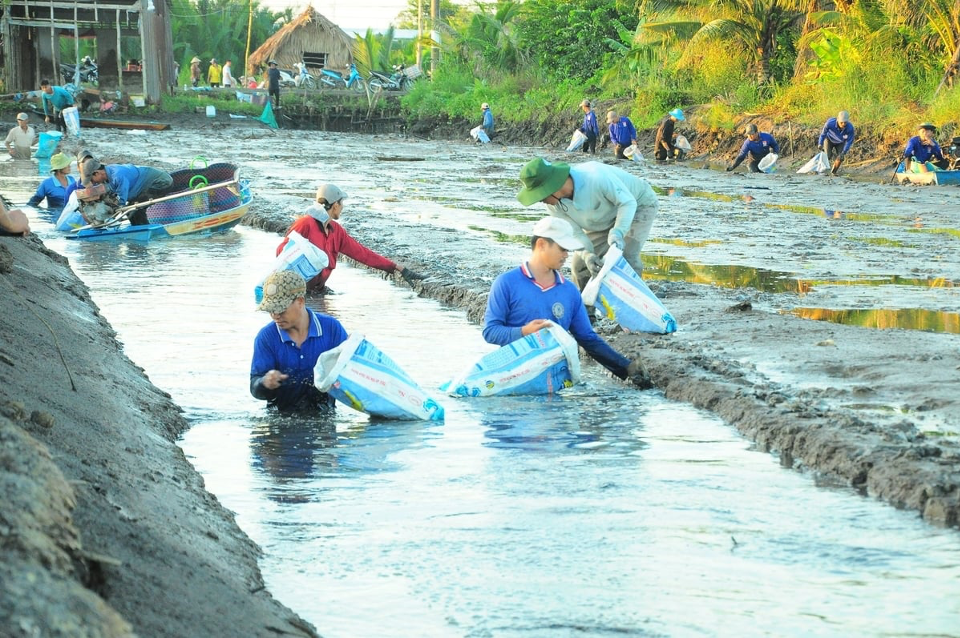 The WB11 Project focuses on developing livelihood models and investing in infrastructure that is more clearly aligned with a green and circular economy. Photo: Kim Anh.
Building on this success, the WB11 Project (MERIT) will focus on three major goals: enhancing the value of key agricultural products toward high quality and low emissions; developing raw material regions linked with processing and logistics industries; and adapting infrastructure in line with a green, circular economy model. Notably, a new concessional financing mechanism will allow localities to borrow just 10% of the capital, easing fiscal pressure and boosting local initiative.
WB11 is expected to become a strategic lever that helps the Mekong Delta develop sustainably and adapt effectively to climate change in the coming years.